





Phacelia: a bee flower and a green manure in one sowing
Sowing rate, time to flowering, when to cut depending on what you are after, how it compares with mustard and clover, its place in the rotation: what phacelia really does in the vegetable garden, and what it does not.
In this guide
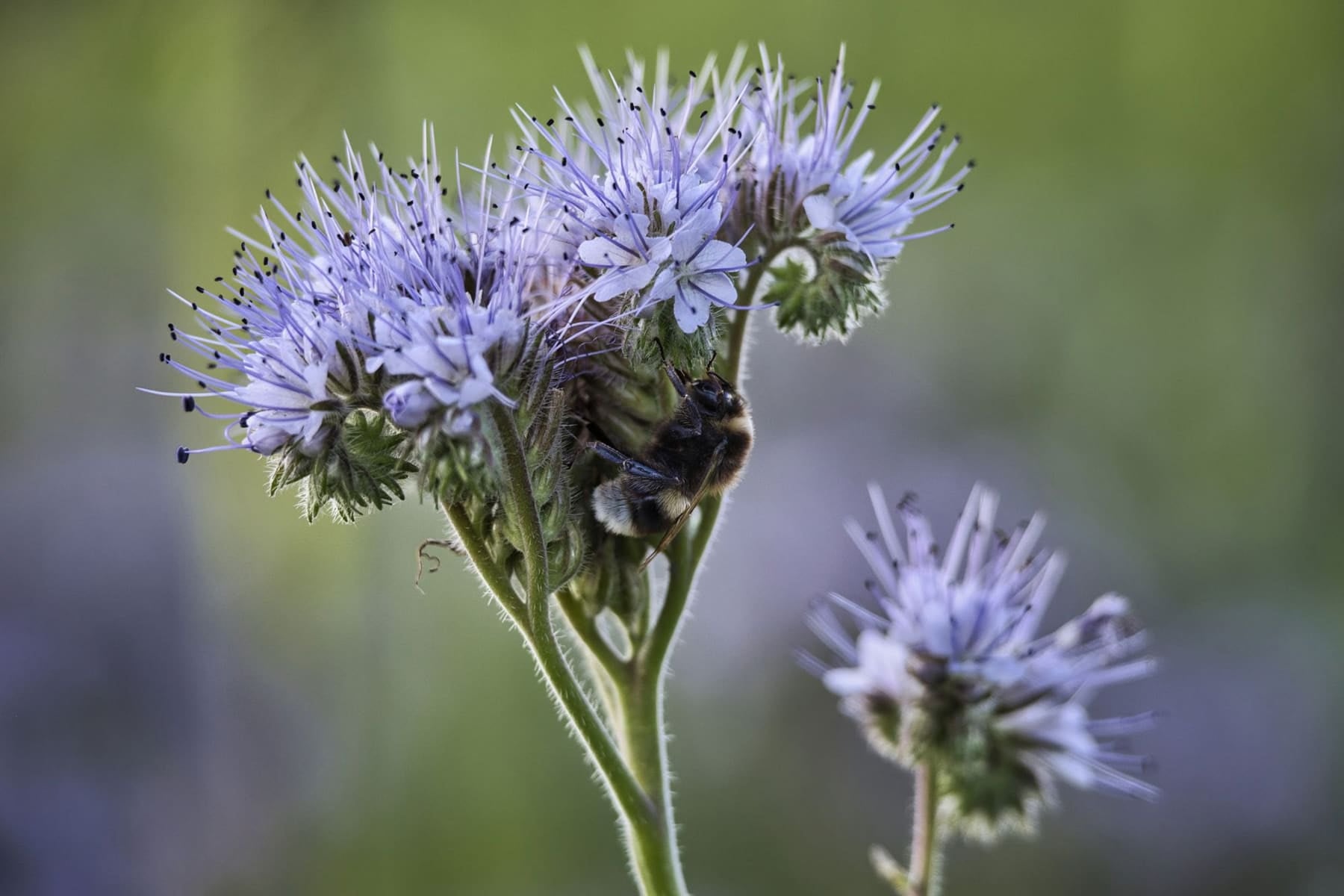
Phacelia (Phacelia tanacetifolia) is sown from March to September, at 1 to 1.5 g/m², and flowers six to eight weeks later in large lavender-blue heads that bees, bumblebees and hoverflies work hard. In the vegetable garden the same bed doubles as a green manure: its fine roots loosen the soil and its foliage covers the ground. One important reservation: it is not a legume, so it does not add nitrogen — it holds on to it.
What phacelia does, and what it does not
Three effects are real and well documented.
It covers the ground fast. A dense sowing closes the bed over in a few weeks and leaves little room for unwanted weeds. The soil stays protected from capping and from drying out.
It works the soil. Its root system, heavily branched but shallow, breaks up the top few centimetres and leaves behind, once it has rotted down, a more crumbly structure. On soil compacted deeper down it does not replace mechanical loosening.
It holds on to nutrients. A bed left bare through the winter loses nitrogen to leaching. Phacelia locks it into its tissues and gives it back to the soil as it rots down. This is a difference in kind from the legumes: clover or vetch fix nitrogen from the air and add it to the system, while phacelia only keeps what is already there. Saying that it "feeds" the soil is therefore wrong.
A fourth effect is the one that concerns this section: it feeds pollinators for several weeks, at a time when the vegetable garden often has few flowers to offer. A bed in flower draws in honeybees, wild bees, bumblebees and hoverflies, those small striped flies whose larvae devour aphids. Sowing phacelia beside a row of broad beans or French beans therefore also means settling the natural enemies next to their prey.
Two received ideas deserve to be set aside. Phacelia does not "clean" contaminated soil, and it does not get rid of established perennial weeds: couch grass or bindweed will come straight through a stand of phacelia. Its effect against unwanted weeds is limited to annuals, and only while it is standing.
Sowing: timing, rate, emergence
- Pick the period. From March to September. Sowing in succession every three or four weeks stretches the flowering across the whole season.
- Prepare roughly. Scratching over the top few centimetres is enough. No fertiliser is needed: rich soil mostly gives leaf.
- Broadcast the seed, at 1 to 1.5 g/m². Mixing the seed with dry sand helps spread it evenly over a small area.
- Cover with about 1 cm by raking lightly. The seed germinates in darkness: left on the surface, it comes up poorly.
- Water with a fine spray if the soil is dry, until emergence, which takes 7 to 10 days.
After that, reckon on 6 to 8 weeks between sowing and flowering, and a height of 50 to 70 cm at maturity. A 500 g packet covers about 400 m², which is a great many vegetable beds: better to plan several successive sowings than one massive one.
Two causes explain nearly every failure to come up: seed left on the surface, when it needs darkness to germinate, and dry soil with no watering during the first ten days. In high summer, sowing in the evening and covering with a light fleece until emergence puts the odds on your side. In a container, phacelia is happy with at least 20 cm of depth in full sun, provided it is watered more often than it would be in open ground.
When to cut it: the trade-off to settle
This is the question that decides everything, and the answer depends on the aim.
- For organic matter and the rotation: cut at the start of flowering. The stems are still soft, it rots down fast, and the bed is free early.
- For the pollinators: wait until the end of flowering, before the seed sets. The bed is tied up three to four weeks longer, but the flowering is used to the full.
- In every case, cut before it runs to seed if you do not want it self-sowing the following year.
After cutting, leave the stems to dry on the surface for a few days, then work them in shallowly, into the top few centimetres only. Burying a mass of green material deep creates a pocket of anaerobic decay, slow and foul-smelling. On a bed meant for a fine sowing, allow two to three weeks between working it in and the next sowing.
Phacelia, mustard or clover: which to choose
| Green manure | Family | Adds nitrogen | Frost hardiness | Strong point |
|---|---|---|---|---|
| Phacelia | No vegetable-garden family (Boraginaceae in the broad sense) | No, it holds on to it | Killed by a sharp frost | Fits into any rotation, very good for bees |
| White mustard | Brassicaceae — like cabbages, radishes, turnips | No, it holds on to it | Killed by the first frosts | Comes up very fast, but avoid before or after brassicas |
| Crimson clover | Fabaceae — a legume | Yes, it fixes it | Comes through winter in most regions | Genuinely enriches the soil, slower to establish |
| Forage rye | Poaceae — a grass | No | Comes through winter undamaged | Tough winter cover, deep roots |
The main argument for phacelia comes down to its botanical family: it belongs to none of the big vegetable-garden families. It can therefore come before or after any crop without carrying over a disease or a pest, which mustard, a cousin of cabbages and radishes, cannot.
Frost, self-sowing and winter
Phacelia is sensitive to cold. A sharp frost, in the order of −5 to −10 °C depending on the stage of the plants and how long the spell lasts, kills it. That is no drawback for a late-summer sowing: the frosted stand forms a mulch that protects the soil until spring, and the bed is then easy to work. For a cover that has to hold all winter in a cold region, however, rye or a vetch-based mix is safer.
Left to seed, phacelia self-sows readily. It is not an invasive plant in France, but the seedlings can be a surprise in a bed meant for fine sowings of carrots or salads. Cutting at the end of flowering settles the question.
A useful flower, but not a local one
This point has to be clear. Phacelia comes from North America, and California in particular. It is very attractive to generalist foragers, the honeybee first among them, but it does not replace the species the local wildlife evolved with. Some wild bees collect their pollen from only a small group of native plants, and no phacelia will ever be of use to them.
So the sound way to use it is this: phacelia in the vegetable garden, as a temporary cover and an extra source of flowers, and a mix of local species wherever you are after a lasting meadow. The guide Which plants attract pollinators goes through those species season by season, and Sowing a bee-friendly wildflower meadow gives the method for a larger area.
One last point matters as much as the choice of seed: with no pesticides, and nesting sites nearby, a bed of phacelia in flower becomes a real refuelling station. The guide How to attract solitary bees explains how to provide those sites, and the bee-friendly seed is gathered in the Pollinators section.
Sources
Frequently asked questions
Does phacelia add nitrogen to the soil?
No. It is not a legume: it does not fix nitrogen from the air. It does take up the nitrogen already in the soil and stops the rain leaching it away, then gives it back as it rots down. To genuinely enrich a bed you need clover, vetch or another member of the Fabaceae family.
How long does phacelia take to flower?
Six to eight weeks after sowing, depending on temperature and time of year. A spring sowing often flowers faster than a late-summer one, when the days are shortening. The flowering itself then lasts several weeks if the plants are not short of water.
Should phacelia be pulled up or left in place?
Neither, in fact. Cut it off at ground level and leave the roots in the soil, where they rot down and leave channels behind. The stems dry on the surface for a few days, then go into the top few centimetres only, never buried deep.
Can phacelia be sown between vegetables already in the ground?
Yes, between the rows of well-grown crops such as tomatoes, squashes or cabbages, as long as you leave it room. It reaches 50 to 70 cm and can shade low-growing plants. On a bed of fine sowings, better to wait until the crop is finished.