


A nest box on a town balcony: what really works
A quiet balcony with plants on it, close to trees, can take a blue tit. A 28 mm hole, put up in autumn, facing east, fixed without drilling, and the situations where the box will stay empty.
In this guide
A balcony nest box can be occupied, on three conditions: a quiet balcony with a few plants on it, trees or a hedge nearby, and putting it up as early as the autumn. The model to go for is a small enclosed box with a 28 mm hole, meant for the blue tit, fixed at least 2 m up, entrance turned to the east or south-east, away from the traffic of the balcony. Above the higher floors, or on a balcony in constant use, occupation becomes rare: water and plants are then the better bet.
The conditions that really decide
A nest box does not create birds: it offers a cavity where cavities are short. Three things weigh more than the model you choose.
The green surroundings. Town tits live in street trees, planted courtyards, parks and private gardens. A balcony within flying distance of one of those has a real chance; a balcony surrounded by three hundred metres of concrete has very little.
Quiet. A little-used corner of the balcony, away from the French window, the clothes airer and the pots handled every week, is worth more than the finest spot in the middle of the comings and goings.
The floor you are on. The higher you go, the smaller the chances. Above the fourth floor, or on a balcony in constant use, occupation stays rare without being impossible.
A box put up in good conditions is still not occupied in its first year. That is true everywhere, gardens included: tits prospect cavities very early in the season, and a new box often takes a year or two to enter the circuit.
Which nest box for a balcony
The compact format is the obvious one, but the design rules stay those of any nest box.
| Criterion | What is needed | Why |
|---|---|---|
| Hole diameter | 28 mm | Blue tit and coal tit; keeps larger species out |
| Depth below the hole | 15 cm at least | Puts the brood out of reach of a paw |
| Material | Solid wood, about 2 cm, never less than 1 cm | Insulates from spring cold and summer heat |
| Inside | Rough, never painted or varnished | The young grip the rough surface to climb out |
| Perch | None | It gives predators a foothold and tits no use |
| Opening | Removable roof or front | Essential for the annual clean |
The outside can be painted, with water-based paint in a neutral shade, which often helps to get the installation accepted by a building's management. The inside always stays bare wood: the LPO considers varnishes, paints and wood treatments to be repellent, and even toxic, to birds.
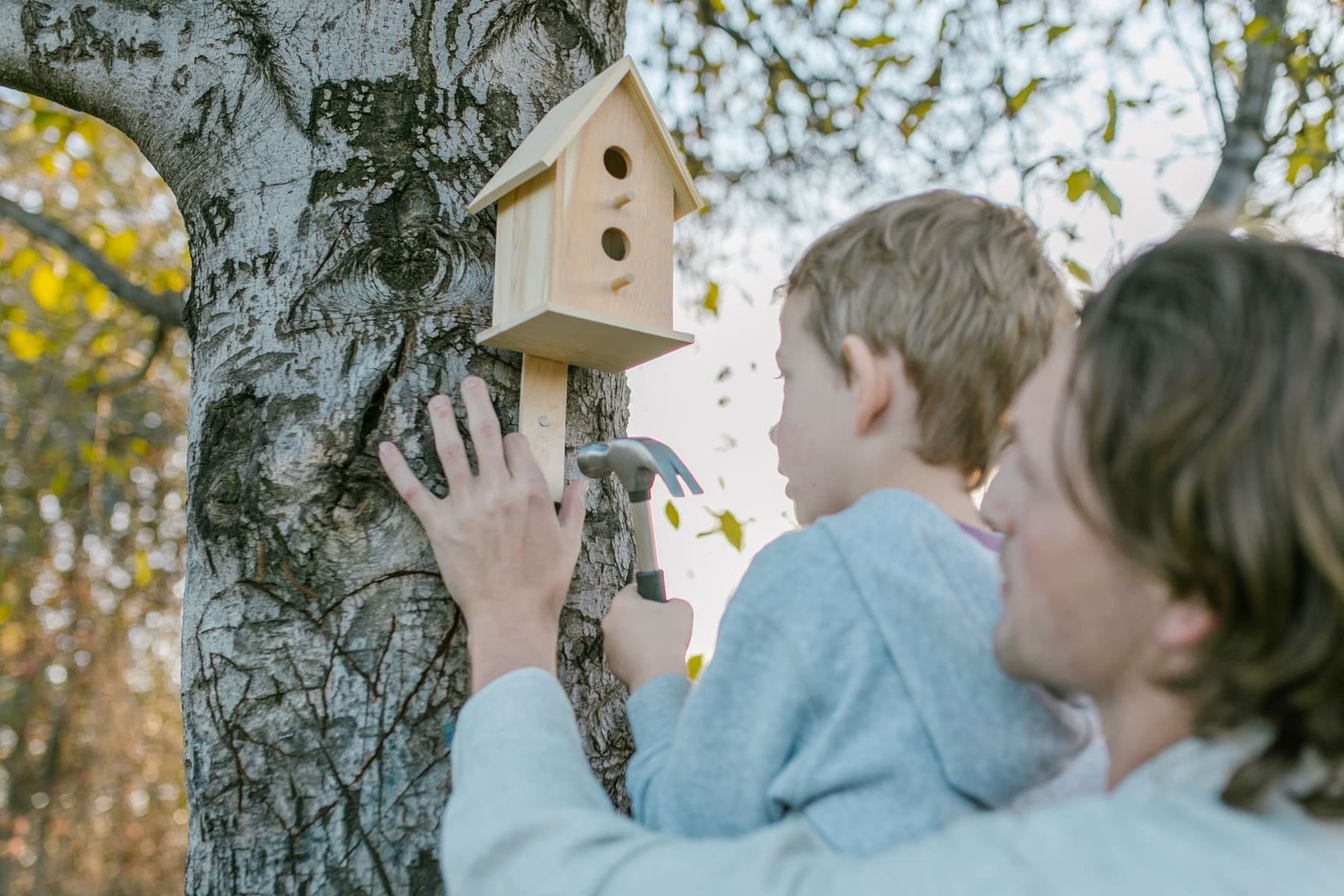
This model meets the criteria of the table for a balcony: a 28 mm hole for the blue tit, solid pine, an inside left rough and a lifting roof for the autumn clean. The diameters species by species are set out in Which nest box to choose?.
Exactly where to put it
- Pick the quietest corner of the balcony, at the opposite end from the French window and away from where people pass.
- Fix it at least 2 m up, on a solid wall or a solid railing. For the great tit, the LPO gives a height of about 6 m at most on a balcony.
- Turn the hole to the east or the south-east, away from the prevailing winds. A balcony facing due west, baking at the end of the day, will not do.
- Tilt it very slightly forwards, so that rain does not come in through the opening.
- Check that no ledge, window sill or tall trough lets a cat reach it, and that no branch acts as a bridge from outside.
- Keep it well away from the feeder: the traffic of a feeding station has no business in front of a nest entrance.
As for fixing, a balcony lends itself badly to drilling. A batten screwed to the back of the box, held to the railing by two wide cable ties or by straps, holds perfectly and comes off without a mark. All you need is to check that nothing can fall into the street or onto the balcony below, and to inspect the fixing every autumn.
The calendar
The box goes up in autumn or early winter. Tits spot cavities very early, sometimes from February, and some birds roost in nest boxes through the bad season. A box put up in March can still be occupied, but far more rarely.
From March to August, nothing is touched. No opening, no moving, no cleaning, not even "just for a look". Disturbance can lead to the clutch being abandoned, and deliberately disturbing protected birds in the breeding season is against the law. Watching is done from a distance, from indoors, through the glass.
Cleaning happens once a year, between the end of September and October, once the last broods have flown: take the old nest out with gloves on, brush the box, use boiling water, dry it completely before closing it again. No chemical product is needed. The full method is described in Cleaning a nest box.
What goes with the nest box
A cavity on its own is not enough. What turns a balcony into a stopping place is everything around it.
Water, all year round. A wide, shallow dish with a gently sloping edge is of more use than a feeder in summer. Change the water regularly, and clean the dish every week as you would a feeder. In frosty weather the ice is simply replaced with water: no salt, no alcohol, no antifreeze.
Plants. Climbers on a trellis, shrubs in containers, native flowering plants: they shelter the insects that tits feed their young on, and they break the view from outside. No insecticide, at any point — caterpillars are exactly what town broods are short of. The principle holds on a balcony as it does in a garden, as A garden rich in biodiversity explains.
Feeding limited to winter, from mid-November to the end of March, tailed off over seven to ten days when the mild weather returns. The detail is in Feeding birds in winter.
Glass that can be seen. A large picture window behind a planted balcony causes collisions. Closely spaced markings stuck to the outside of the glass work far better than a single bird-of-prey silhouette, which only protects the area it covers.
When it is better to give up on it
Some situations will come to nothing, and honesty means saying so before the purchase:
- a balcony facing due west, with no shade at all in the afternoon;
- a balcony crossed all day long, or used by a cat that goes outside;
- a high floor with no tree and no garden in the immediate neighbourhood;
- a front on a busy street, right on the edge of the traffic.
In those cases, clean water, a few flowering plants and sensible winter feeding do far more for the birds of the neighbourhood than a nest box that will stay empty. And if the box is already up and nothing is happening, there is still the aspect, the height and the date it went up to check before concluding that the place is wrong.
Sources
Frequently asked questions
Does a nest box on a balcony stand any chance of being used?
Yes, if the balcony is quiet, has a few plants on it and is close to trees, a hedge or a park. The blue tit is the species most likely to move in, with a 28 mm hole and the box fixed at least 2 m up. Above the fourth floor, or on a balcony in constant use, occupation becomes rare. As in a garden, a new box often takes a year or two before it is adopted.
How do you fix a nest box without drilling the balcony wall?
A batten screwed to the back of the box, held to the railing by two wide cable ties or by straps, holds perfectly and leaves no mark. The railing has to be solid or opaque, otherwise the box is too exposed. Check that nothing can fall into the street or onto the balcony below, and inspect the fixing every autumn. This solution has the advantage of being reversible, which makes it easier to get a building's management to agree.
Can a nest box and a feeder go on the same balcony?
Yes, but as far apart as the space allows. The traffic of a feeding station in front of a nest entrance disturbs the pair that has moved in and advertises the cavity. Their siting needs differ in any case: the nest box wants quiet and shelter, the feeder an open spot. On a narrow balcony it is better to choose one of the two and add a dish of water.
What should you do if birds nest in a trough on the balcony?
Leave the trough strictly alone until the young have flown, without watering it from above and without moving it. Destroying or moving the occupied nest of a protected bird is against the law, as is deliberate disturbance in the breeding season. Watering can be done through a saucer placed underneath, and watching from indoors. The trough goes back into cultivation once the brood has left, usually a few weeks later.