


Which nest box should you choose? Hole diameter, material and placement by species
The diameter of the entrance hole decides which bird will move in. Dimensions by species from the LPO, the wood to favour, height, orientation and the distance between two boxes: how to choose without getting it wrong.
In this guide
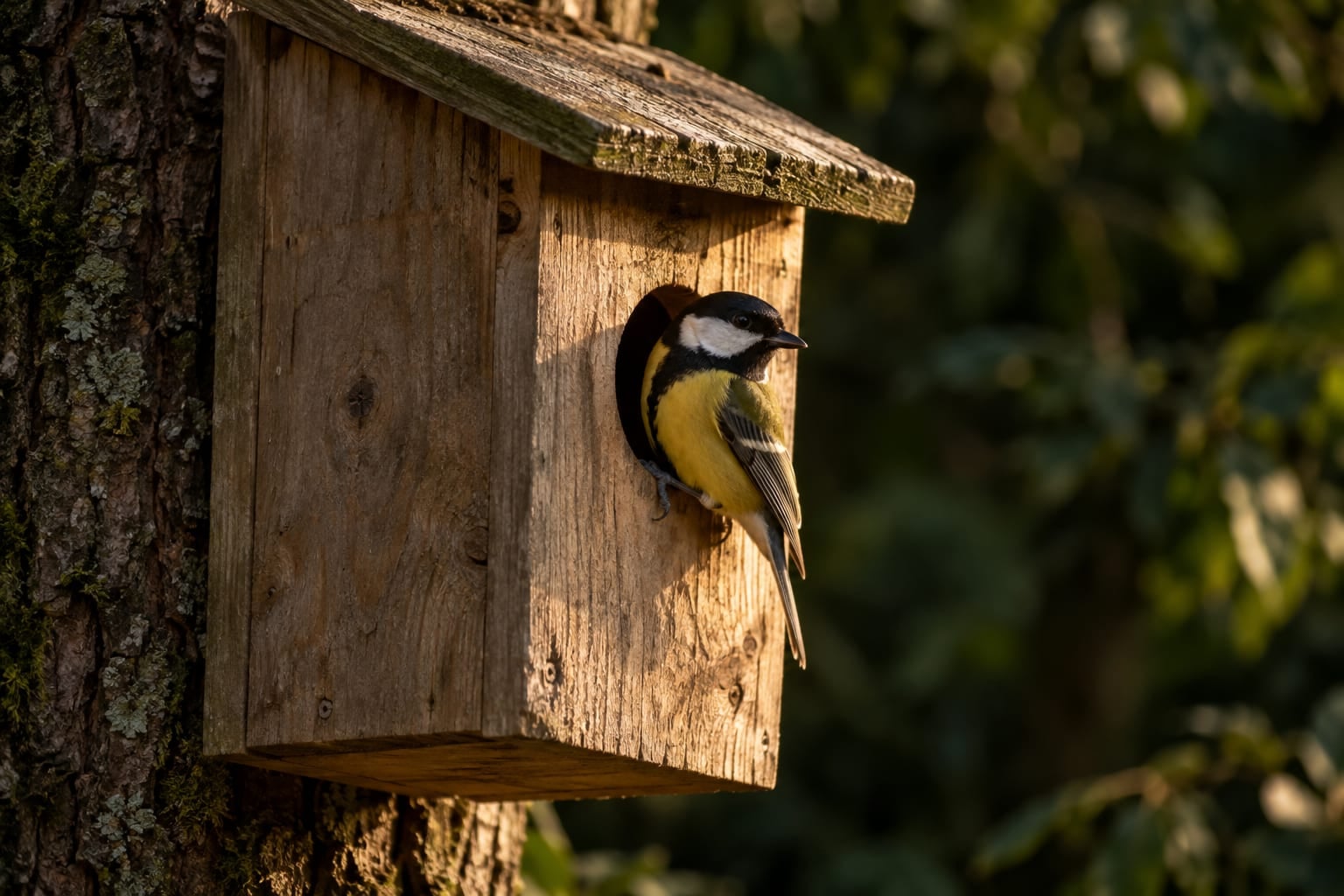
To choose a nest box, start from the bird you want to attract: it's the diameter of the entrance hole that does the selecting. According to the LPO (the French bird protection league), allow 26 to 28 mm for the blue tit, 25 to 27 mm for the coal tit and 32 mm for the great tit. Then choose a box made of solid, thick wood, left bare inside, with no perch, and with a roof or front panel that opens for cleaning. Put it up in autumn, at least 2 m high, with the hole facing east or south-east.
Closed box or semi-open box: two families of birds
Not all garden birds nest the same way.
- The closed box with an entrance hole suits hole-nesting birds, which naturally nest in a hollow tree or a crack: tits, sparrows, black redstarts, starlings. It's the most common model.
- The semi-open box, with a half-open front, is meant for other species: robins, common redstarts, wrens, spotted flycatchers, wagtails. The LPO recommends fitting it preferably on a wall, in a quiet spot, between 1.5 and 3 m high.
The rest of this guide covers the closed box, the one most often chosen for tits.
Which hole diameter for which bird?
The entrance hole lets the target species in and keeps larger birds out. Here are the dimensions from the LPO's "Nest boxes for songbirds" fact sheet:
- Coal tit: hole 25 to 27 mm; internal floor 10 × 10 cm; height 2 to 4 m.
- Blue tit: hole 26 to 28 mm; internal floor 13 × 13 cm; height 2 to 5 m.
- Great tit and tree sparrow: hole 32 mm; internal floor 14 × 14 cm; height 2 to 6 m. The LPO's page dedicated to the great tit gives 30 to 32 mm.
- House sparrow: hole 32 to 40 mm; internal floor 14 × 14 cm; height 3 to 8 m.
- Black redstart: oval hole 32 mm wide by 46 mm high; internal floor 14 × 14 cm; height 1.5 to 4 m.
- Common starling: hole 46 to 50 mm; internal floor 18 × 18 cm.
Two practical consequences follow. A 32 mm hole isn't reserved for the great tit: a sparrow can move in too. And a 26 to 28 mm hole excludes larger species, leaving the field clear for the small tits.
Depth matters too: the LPO recommends at least 15 cm between the entrance hole and the floor of the box, unless a species calls for something different.
Wood, wood concrete, plastic: which material?
Solid, thick, untreated wood
The LPO recommends solid, moisture-resistant wood: larch, pine, red cedar or oak. The recommended thickness is 2 cm, and never less than 1 cm: thick wood insulates against cold in spring and heat in summer. Wood concrete, very hard-wearing, is also a good option for a ready-to-hang box.
What to avoid
- Standard plywood and chipboard, which swell in damp conditions.
- Metal and plastic, which encourage condensation.
- Varnish, paint and treatment products, especially inside. The LPO considers them off-putting, even toxic, to birds. The inside must stay bare and unplaned: fledglings grip the rough surface to climb out. On the outside, a neutral colour or a coat of linseed oil is fine.
The details that make a good nest box
- No perch below the hole: it doesn't help tits, but it does make life easier for predators.
- A few holes of about 5 mm in the floor, for ventilation and drainage.
- A removable roof or front panel, essential for the annual clean.
- Screwed rather than nailed joints, with the floor held between the sides.
- A metal plate around the hole, if woodpeckers, garden dormice or squirrels are likely to widen it.
How high and which way should the box face?
Height and location
Respect the height range for the target species: for tits, at least 2 m in the garden. Choose a quiet spot, on a trunk or a wall, out of reach of cats. Avoid the top of a wall and the proximity of horizontal branches, which act as a bridge for predators.
The LPO also advises against a moss-covered trunk, which is too damp, and poplar or birch branches, which are fragile and snap easily.
Orientation
- entrance hole facing east or south-east, never into the prevailing wind;
- neither in full sun nor in complete shade;
- box tilted slightly forward, so rain doesn't get in.
Fixing
Screw a fixing bar to the box. On a tree, slip a piece of wood between the trunk and the wire, ideally an insulated electrical wire, so as not to injure the bark and to be able to tighten it later.
And on a balcony?
It's possible, in a quiet, sheltered corner, away from comings and goings. The LPO gives a maximum height of about 6 m on a balcony for the great tit. Otherwise, the same rules apply: orientation, no full sun, solid fixing.
How many nest boxes, and how far apart?
Most birds defend their territory against their own kind. Putting up identical boxes side by side is therefore pointless, even harmful. The LPO recommends varying the models and keeping a minimum distance between two boxes of the same type:
- 15 to 20 m for the blue tit;
- 40 to 50 m for the great tit.
Sparrows and starlings, on the other hand, happily nest in colonies: their boxes can be put up right next to each other.
When should you put up the nest box?
From autumn or early winter. Tits start scouting for a site very early, and some birds, such as the wren, sometimes sleep in nest boxes over winter. If a box stays empty for two or three years running, review the criteria above and move it.
Maintenance is part of the choice: a nest box should be cleaned every year after the breeding season. The method is explained in our guide Cleaning a nest box.
The kit
For small tits, a 27 mm hole falls within the range the LPO gives for both the blue tit and the coal tit.
To build the nest box as a family, the ready-to-assemble kit helps you understand every detail: hole, opening roof, ventilation. Check the product page for the hole diameter supplied to know which species it will welcome, then apply the placement rules above.
One thing not to confuse: a bumblebee nest box is not a bird nest box. It's meant for pollinators and follows different placement rules. You'll find it in our Pollinators section, and our advice on these insects in attracting solitary bees.
All our nest boxes are gathered in the Birds section. A nest box alone won't bring the tits in: food, water and a garden rich in insects also play their part, as explained in our guide How to attract tits to your garden.
Sources
Frequently asked questions
Which hole diameter for a nest box for tits?
According to the LPO: 26 to 28 mm for the blue tit, 25 to 27 mm for the coal tit, 32 mm for the great tit. A 32 mm hole can also attract the tree sparrow or the house sparrow.
Does a nest box need a perch?
No. Tits go straight into the hole, and a perch mainly gives predators something to grip. If there is one, remove it.
Can you paint a nest box?
Not the inside, which must stay bare. On the outside, avoid varnish, paint and treatment products; a neutral colour or a coat of linseed oil is enough.
Why does my nest box stay empty?
It may have been put up too late, in full sun, facing the wind, or too close to another identical box. Give it a season, then move it if it's still empty after two or three years.