




Blue tit or great tit: spotting and housing them
The blue cap and small build on one side, the black head, white cheeks and belly stripe on the other. The features that never lie, the song, and the right nest box for each.
In this guide
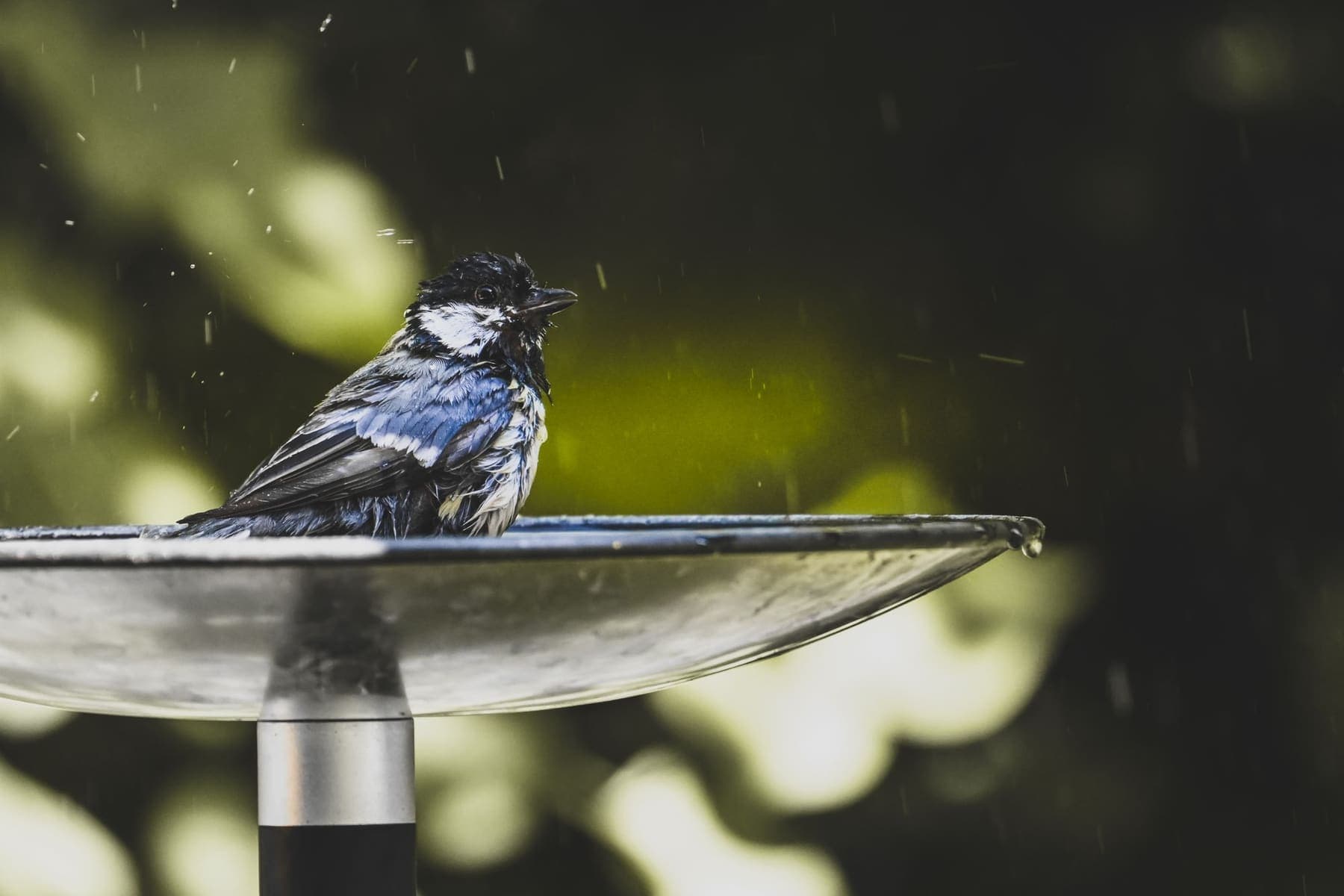
Two features are enough to separate the two commonest garden tits. The blue tit wears a blue cap over a white face crossed by a thin black line, and stays distinctly smaller. The great tit has an entirely black head and throat, sharply cut white cheeks, and a vertical black stripe running down its yellow belly. When it comes to housing them, everything turns on the diameter of the entrance hole: 26 to 28 mm for the blue tit, 32 mm for the great tit.
Telling them apart at a glance
Both species share the olive-green back and the yellow belly, which is what causes the confusion. Everything else differs.
| Feature | Blue tit | Great tit |
|---|---|---|
| Length | 10.5 to 12 cm | 13.5 to 15 cm |
| Weight | 9 to 12 g or so | 16 to 21 g or so |
| Wingspan | 17 to 20 cm | 22 to 26 cm |
| Cap | Blue, ringed with white | Black, glossy |
| Face | White, crossed by a black eye stripe | Clean white cheeks, black throat |
| Belly | Yellow, at most a faint dark line | Yellow, cut by a broad black stripe |
| Wings and tail | Blue | Blue-grey, with a white wing bar |
| Manner | Quick, acrobatic, often upside down | Heavier, feeds on the ground too |
Measurements vary from one source and one population to the next; it is the order of magnitude that counts. In the field, the size difference shows up above all when the two species meet at the same feeder: the great tit sees the blue tit off without any trouble.
Two other tits sometimes muddy the picture. The coal tit looks like a great tit in miniature, but it has a distinctive white patch on the nape and no belly stripe. The marsh tit has a black cap and white cheeks, with no yellow at all.
An illustrated guide and a notebook help fix the identification features in your mind and keep track, season after season, of which species visit the garden.
The breast stripe: male or female
In the great tit, the black belly stripe tells you the sex, with no equipment needed.
- The male has a broad stripe, which widens further between the legs and reaches the lower belly, in a deep black.
- The female has a narrower stripe, often uneven or broken off before the lower belly.
In-between birds exist, and a young bird of the year stays duller, with yellowish rather than white cheeks. In the blue tit the distinction is far harder with the naked eye: the male has a brighter cap on average, but the overlap between the sexes is wide.
Telling them apart by song
Song often lets you identify a tit before you see it.
The great tit delivers a two-note phrase repeated tirelessly, often written down as “tea-cher tea-cher tea-cher”, clear and carrying, much like the steady creak of a swing. It is one of the first garden songs of late winter. Its repertoire is otherwise very wide: an unknown call in the garden is often a great tit.
The blue tit has a higher, faster song, a few thin notes followed by a rolling trill that falls away, without its cousin's mechanical regularity. Its contact calls, small and nervy, go with its movements through the thin branches.
Two quite different nest boxes
This is where the distinction becomes practical: one nest box does not suit both species. The diameter of the entrance hole does the selecting, and a hole that is too wide hands the cavity to larger birds.
| Item | Blue tit | Great tit |
|---|---|---|
| Hole diameter | 26 to 28 mm | 32 mm |
| Internal floor | 13 × 13 cm | 14 × 14 cm |
| Mounting height | 2 to 5 m | 2 to 6 m |
| Distance between two identical boxes | 15 to 20 m | 40 to 50 m |
These figures come from the LPO, which elsewhere gives 30 to 32 mm on its page about the great tit. Three rules apply to both species: at least 15 cm between the hole and the floor, no perch below the entrance, and an interior left rough. Face the box east or south-east, away from the prevailing wind, and put it up in autumn or early winter.
A 32 mm hole is not reserved for the great tit: the tree sparrow, and even the nuthatch, can move in. A 26 to 28 mm hole, on the other hand, shuts the door on larger species — which is what makes the small diameter worth having where the great tit already dominates.
One model made in two hole sizes will house both species in a large enough garden, provided the distances in the table are respected. The other hole-nesting species are covered in Which nest box should I choose?.
Their year, month by month
The calendars of the two species are much alike.
- From autumn to February, pairs prospect the cavities on offer. That is why a nest box goes up well in advance, not in spring.
- In March and April, the nest is built: moss, dry grass, then a lining of feathers and hair. The female does almost all of it on her own.
- From April to June, the clutch usually holds 7 to 13 eggs in the blue tit, 6 to 12 in the great tit, depending on the year and the region. Incubation lasts 13 to 15 days.
- For 16 to 22 days, the young stay in the nest, fed almost entirely on caterpillars. At the peak of the rearing period a pair brings in several hundred a day.
- After fledging, the parents go on looking after the young for one or two weeks. A second brood is possible, and more common in the great tit.
From March to August, then, the nest box is not opened on any pretext: disturbance can lead to the brood being abandoned, and deliberately disturbing protected birds during the breeding season is against the law. Cleaning waits for late September or October, as explained in Cleaning a nest box.
Mortality in the first year is high, and average life expectancy runs to only a few years, even though ringed birds have passed ten. A garden population therefore turns over quickly, and the absence of a pair for one season does not mean much.
What they eat, and what that changes
Both species are insect eaters for much of the year, and that diet governs everything else. Caterpillars make up the bulk of the food given to the young; a garden treated with insecticide cannot feed a brood, whatever nest box has been put up.
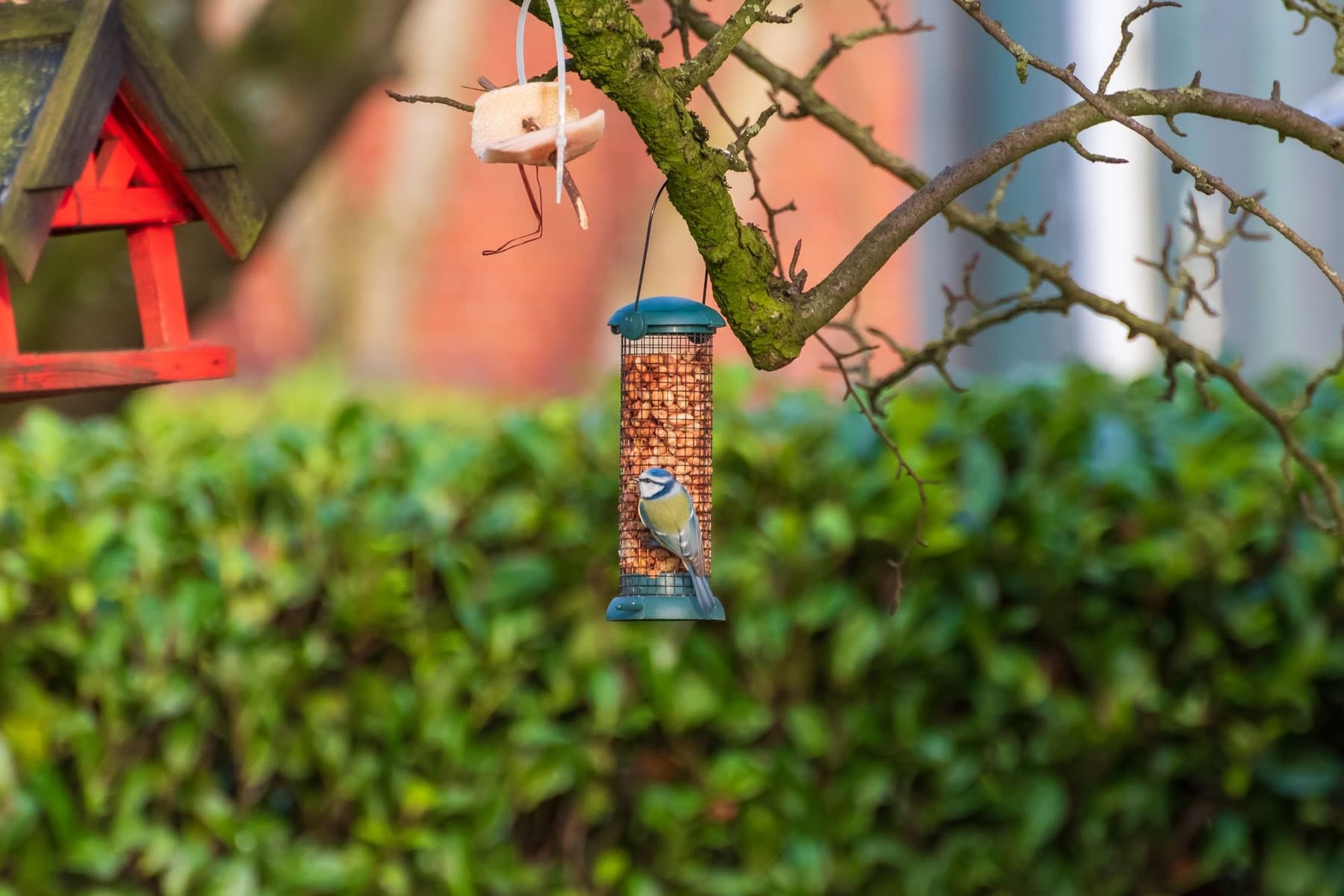
In winter they switch to seeds and fats. Black sunflower seed, hemp seed, whole peanuts offered in a mesh feeder and plain vegetable fat blocks suit them equally well. One difference in behaviour separates them, though: the blue tit, lighter and more acrobatic, happily works hanging tubes and the tips of branches, while the great tit also uses trays and the ground.
Feeding is limited to the cold months, from mid-November to the end of March, and is tapered off over seven to ten days when milder weather returns: the detail is in Feeding birds in winter.
Everything that brings them in is gathered in How to attract tits to the garden.
Sources
Frequently asked questions
How do I tell a blue tit from a great tit?
The cap settles it straight away: blue and ringed with white on the first, entirely black and glossy on the second. The great tit also carries a broad vertical black stripe on its yellow belly, which the blue tit lacks or shows only as a faint line. The size difference is obvious as soon as you see them together, the great tit being about a third longer. Both share the olive-green back and yellow belly, which is why they are so often confused at a distance.
Can you tell whether a great tit is male or female?
Yes, by looking at the black stripe on the belly. In the male it is broad, a solid black, and widens towards the lower belly; in the female it stays narrow, sometimes uneven or broken. In-between birds exist, and young of the year are duller, with yellowish cheeks. In the blue tit, by contrast, the two sexes are very hard to separate with the naked eye.
Will one nest box suit both tits?
No, the hole diameter does the selecting: 26 to 28 mm for the blue tit, 32 mm for the great tit. A 32 mm hole also lets in the tree sparrow and sometimes the nuthatch, whereas a 28 mm hole shuts the door on larger species. To take both, you need two separate boxes, spaced as the LPO recommends. In a small garden, one diameter is plenty.
How many eggs does a tit lay?
The clutch usually holds 7 to 13 eggs in the blue tit and 6 to 12 in the great tit, varying by year, by region and by how many caterpillars are around. Incubation lasts 13 to 15 days, and the young then spend 16 to 22 days in the nest. A second brood is possible, slightly more common in the great tit. Throughout that period the nest box must be neither opened nor moved.