

Which bird seed for which species: the table
Black sunflower, sunflower hearts, millet, hemp seed, peanuts, nyjer: what each garden bird actually comes for, which feeder to put it in, and what is only filler.
In this guide
Three seeds cover most of what the birds in a garden need: black sunflower, sunflower hearts and white millet. Whole peanuts join them, in a mesh feeder and nowhere else, and nyjer seed interests only a handful of fine-billed species. Wheat, rice and barley, which fill out the cheapest mixes, are barely touched and end up on the ground.
The seeds that actually earn their place
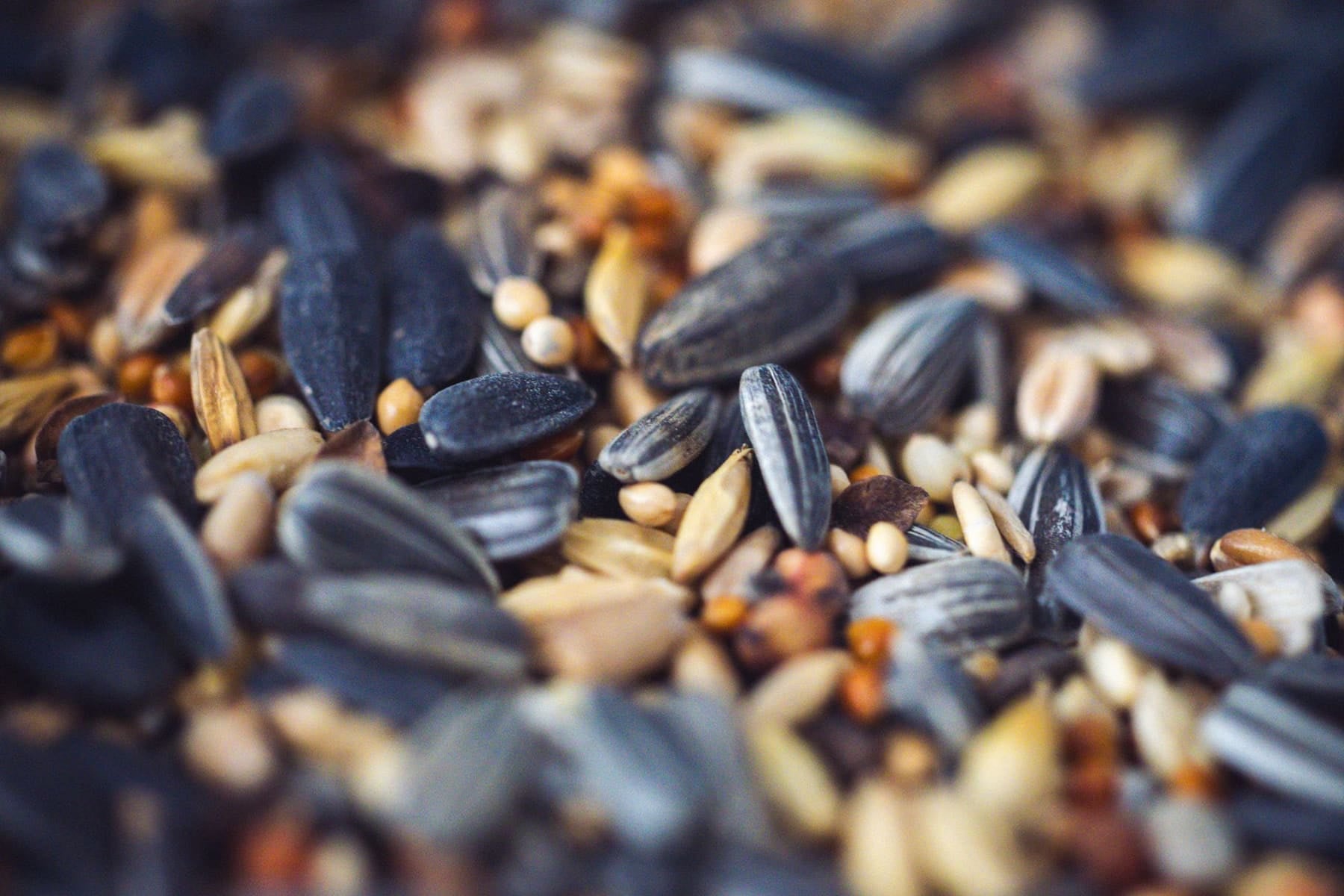
Black sunflower is the reference seed for winter feeding. Very rich in fat, it is opened without difficulty by tits, greenfinches and chaffinches, which trap it under one foot to split the husk. Its only drawback is the carpet of husks that builds up under the feeder.
Sunflower hearts bring the same energy without the husks. They suit small bills and birds that feed on the ground, but they take up moisture and turn rancid far faster: put them out in small amounts, in a sheltered container.
White millet is the seed of the species that eat on the ground or from a tray: sparrows, chaffinches, dunnocks, doves. A mix without it leaves those birds out.
Hemp seed and hulled oats round off the set. The first is a small oily seed that tits and greenfinches take readily; the second, with no added sugar or salt, suits ground feeders. Hulled oats have the further advantage of not germinating under the feeder.
Peanuts are the most energy-rich of all, and the worst served. They are given raw, unsalted, unroasted, and whole in a fine mesh feeder: a piece that is too big can choke a young bird being fed by its parents. Stored damp, they develop toxic moulds.
Nyjer seed, very fine and oily, concerns only a small group of sharp-billed species, goldfinch and siskin first among them. It needs a feeder with narrow slits, or it simply pours out of ordinary openings.
What each species comes looking for
The preferences below are tendencies, not rules: a hungry bird tries everything. They are still enough to explain why one feeder draws ten tits and not a single blackbird.
| Species | Preferred seeds | Where it feeds |
|---|---|---|
| Blue tit, great tit | Black sunflower, peanuts, hemp seed | Tube, hopper, hanging mesh feeder |
| Coal tit, marsh tit | Black sunflower and hearts | Tube and hopper, often carrying the seed off |
| European greenfinch | Black sunflower, hemp seed | Tube and hopper, holding its place for a long time |
| Goldfinch, siskin | Nyjer, sunflower hearts | Feeder with fine slits |
| Chaffinch | Sunflower hearts, millet, cracked maize | Tray and ground, rarely hanging |
| House sparrow and tree sparrow | Millet, sunflower hearts | Tray, ground, hopper with a wide lip |
| Dunnock | Millet, hulled oats | On the ground, under cover of a bush |
| Robin | Sunflower hearts, porridge oats, fats | Low tray or ground |
| Blackbird, thrushes | Bruised fruit, porridge oats | On the ground, never hanging |
| Nuthatch, woodpeckers | Whole peanuts, black sunflower | Mesh feeder and hopper fixed to a trunk |
| Collared dove, woodpigeon | Millet, cracked maize | On the ground, under the feeders |
Three lessons come out of this table. Black sunflower is the smallest common denominator, which is why it dominates every good mix. Some species never climb into a hanging feeder: without a tray or a clear patch of ground, they stay invisible. And a garden that hosts nothing but tits is usually short of small fine seeds, not of oily ones.
A feeder for each habit
The container counts as much as the seed. Several feeding points draw in more species and break up the crowds, and with them the spread of disease.
- The seed tube suits sunflower, whole or hearts, and small seeds. Birds that happily cling to it spend the day there.
- The hopper with a tray adds a lip where heavier species can land, and keeps the reserve out of the rain and the droppings.
- The peanut mesh feeder is for peanuts and nothing else; it takes neither loose seed nor a fat cake.
- A raised tray and a clear patch of ground are essential for blackbirds, robins and dunnocks. Scatter a handful of seed there each day, in an amount eaten the same day.
Where you put it weighs as much as which model you buy: the guide Where to put a bird feeder goes into it in detail.
Peanuts, for their part, go only into a dedicated mesh feeder, whose mesh forces the bird to take them in small pieces.
Making up a mix, or reading the label on the one you buy
The LPO suggests a simple mix anyone can copy: one third black sunflower, one third peanuts and one third cracked maize. It is a reliable starting point for a garden visited mainly by tits and by ground-feeding species.
For a shop-bought mix, three checks are enough:
- Read the ingredients in order of proportion: sunflower should come at the top of the list, not at the end.
- Rule out sacks where wheat, rice, barley or "assorted seeds" take up a large share. Those cereals are left untouched, and they mostly feed the rodents under the feeder.
- Check that no seed is salted, roasted or coated, and that the sack is dry, with no rancid smell and no grey dust.
A mix without wheat or rice wastes less and dirties the ground less. Peanuts stay apart: they go out whole, in their own mesh feeder.
What is never given
- Bread, too salty and badly digested, and behind real digestive trouble.
- Milk, which birds cannot digest.
- Salted, spiced or cooked leftovers: cured meat, bacon, cheese, crisps, cooking fat.
- Salted, roasted or snack seeds and peanuts.
- Any food that is damp, mouldy or rancid, which goes in the bin rather than on the garden compost.
- Fat balls left in their plastic net, which the LPO advises against: birds can catch their feet in the mesh.
Amounts, storage and hygiene
Feeding is limited to the hard season, generally from mid-November to the end of March, and tapers off over seven to ten days when milder weather returns. In spring the parents have to go back to insects, the only food that suits chicks. The full calendar is set out in Feeding birds in winter.
For a feeder visited by a dozen birds, reckon on 1 to 1.5 kg of seed a month, so in the order of 5 kg for a whole season. A large sack kept dry, in a closed container out of reach of rodents, beats a part-used supply left in a damp shed. Feeders are filled for a few days at a time, no more.
Hygiene is the most neglected point of all. The LPO recommends cleaning feeders and drinkers every week throughout the period of use, with a brush, hot water and black soap or Marseille soap, wearing gloves, then rinsing and letting everything dry before refilling. Spilt seed is cleared up, and the feeding point moved from time to time. The full method is in Cleaning a bird feeder.
Finally, no seed replaces a living garden. A hedge of local berry-bearing species, flowers whose seed heads stand through the winter, a corner of dead leaves and the absence of pesticides feed birds all year round, as the guide How to create a garden that supports biodiversity explains. That garden is what will produce the spring caterpillars, which no feeder knows how to make.
Sources
Frequently asked questions
Which seed attracts the widest range of birds?
Black sunflower, with no serious rival. Tits, greenfinches, chaffinches, nuthatches and many other passerines eat it, and its high fat content makes it a first-rate food in cold weather. Its drawback is the carpet of husks that builds up underneath; sunflower hearts avoid that, but keep less well. To widen the range of species, add a share of millet for the birds that feed on the ground.
Why do the birds ignore my seed mix?
In most cases the mix holds too much wheat, rice or barley, cereals that garden birds leave alone and that end up on the ground. A blend with sunflower at the top of the list usually changes things within a few days. The position can be at fault too: a feeder too close to a dense bush, a window or a busy path stays ignored. And a damp, rancid or dusty mix is refused, and should be thrown away.
Can sunflower seeds sold for human food be used?
Only if they are raw, whole or hulled, with no salt, no oil and no roasting. Seeds sold as snacks are salted or roasted and are never suitable: salt is harmful to birds, which clear it badly. The same goes for snack peanuts and seasoned mixes. Where the origin of a batch is in doubt, it is better not to put it out at all.
Should seed be put out in summer?
No, except in exceptional circumstances. Feeding is limited as a rule to mid-November through to the end of March, and tapers off over seven to ten days when mild weather returns. In summer the parents feed their young on insects, which are rich in protein, and oily seeds do not suit chicks. What does stay useful all year is a clean, shallow water point, refreshed regularly.