

Where to put a bird feeder so the birds come
Height, open ground, distance to the shelter bush, distance from glass and from cats: the criteria that decide whether a feeder is used or ignored.
In this guide
A feeder is adopted when it stands between 1.5 and 2 m above the ground, in open space where the bird can see danger coming, about two metres from a hedge or bush that serves as shelter, and well away from large panes of glass. The position counts for more than the model or the make. What remains is to choose it without going wrong, and to recognise the three or four mistakes that leave a feeder hopelessly empty.
The four criteria that decide everything
A bird approaching a feeding station makes a simple calculation: what it gains in energy against the risk it takes. Four things go into that calculation.
- Visibility. From the feeder, the bird must be able to see a cat, a magpie or a sparrowhawk coming. An open position, with no wall or hedge pressed against the back of it, meets this condition.
- Shelter. A few metres away there needs to be a bush, a hedge or a tree to dive into when alarmed, and to wait its turn in.
- Dryness. Wet seed clumps together, goes mouldy and becomes dangerous. A roof, a hopper or a dome keeps it dry.
- Quiet. A door that slams, a dog, constant coming and going: the feeder will be visited, but far less.
These four criteria sometimes pull against each other. The classic compromise is to put the feeder in the open, but two metres from cover.
Height, open ground and distance to shelter
The height depends on the support. In every case, stay above the level a cat can reach with a standing jump, which means at least 1.5 m for a hanging feeder.
| Support | Recommended height | Species expected | Point to watch |
|---|---|---|---|
| Hung from a branch | 1.5 to 2 m | Tits, goldfinches, greenfinches, nuthatches | Swings in strong wind; choose a thin branch, hard for a squirrel to reach |
| Hopper feeder on a pole | 1.5 to 2 m | Tits, house sparrows, chaffinches, greenfinches | A pole can be climbed: a baffle or a smooth pole is useful |
| Raised bird table | 1 to 1.5 m | Robin, dunnock, blackbird | Open to rain and droppings, it needs cleaning more often |
| Fruit laid on the ground | On the ground | Blackbirds, thrushes, dunnocks | Never against a dense bush where a cat can lie in wait |
| Balcony or railing | 1.5 m above the floor | Tits, house sparrows | Plan for catching the husks, and check your building's rules |
The shelter bush goes about two metres away. Any closer and it becomes a hiding place for predators; any further and small songbirds hesitate to cross open ground. This distance is an order of magnitude, not a measurement to the centimetre: anywhere between 1.5 and 3 m has the same effect.
Avoid horizontal branches that come to rest right beside the feeder, and the top of a wall: these are ready-made access ramps for a cat or a marten.
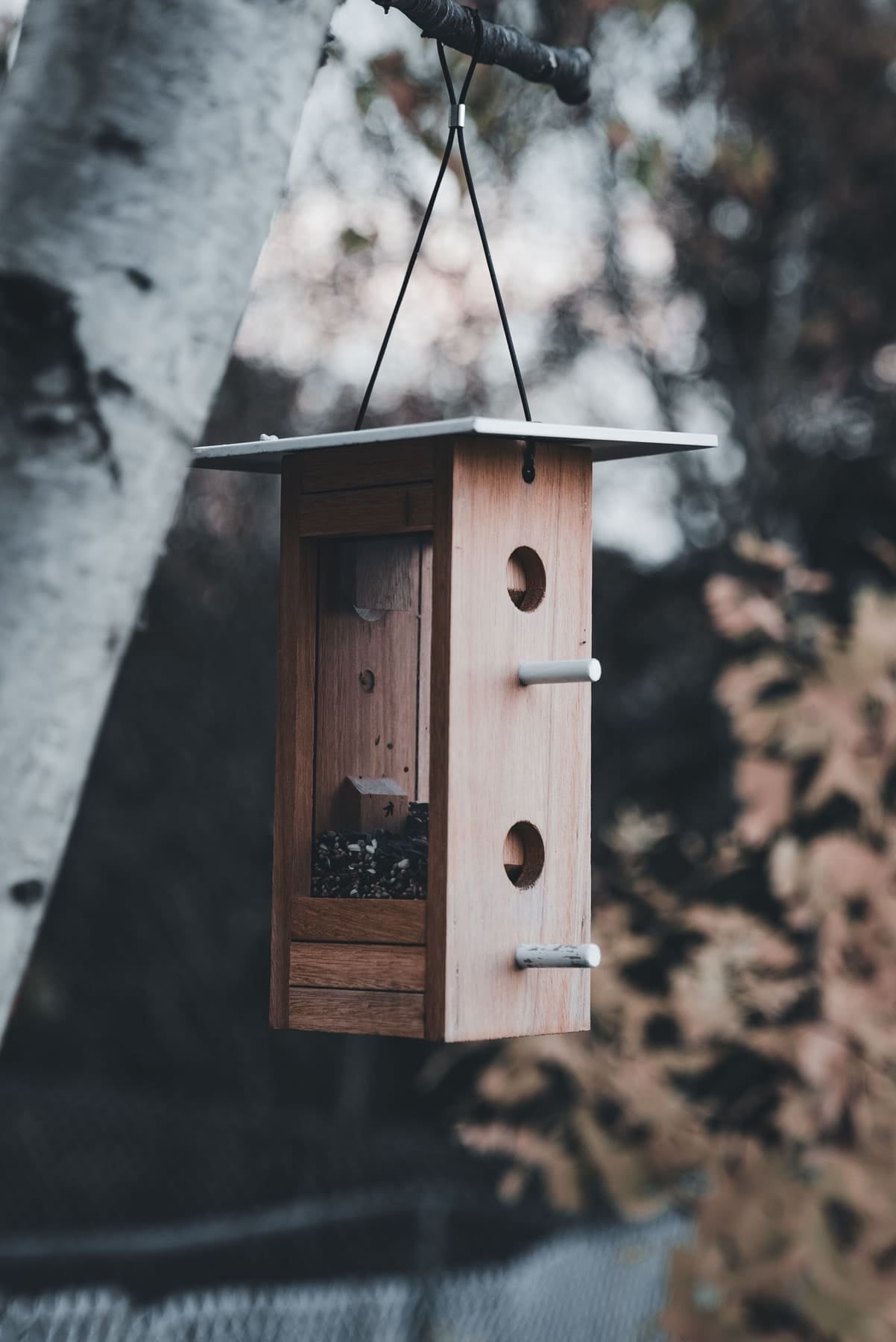
The hopper keeps the seed clear of rain and droppings, which limits the spread of disease — that is the main advantage of this design over an open table.
Cats and glass: the two dangers of a feeding station
Cats and ground predators
The domestic cat is the main risk around a feeder. A few arrangements are enough to discourage it:
- Place the feeder in the open, with a two-metre radius clear of low planting and log piles.
- Remove the launch pads: low wall, garden table, planter or low branch within a metre.
- Choose to hang the feeder rather than use a pole when cats visit the garden.
- Sweep up the seed that falls to the ground, which draws birds down to the level where they are most vulnerable.
For pigeons, magpies and squirrels the answer is different: the aim is less to shut them out than to keep part of the seed for the small songbirds. An adjustable dome, lowered over the table, closes the way to large birds without getting in the way of the tits.
Glass, the risk you do not see coming
A patio door reflects the sky and the planting. A startled bird leaving the feeder suddenly can strike it in full flight, and the collision is often fatal.
Two positions limit the danger, and they are opposites:
- Very close to the glass, less than 50 cm away: a bird taking off has no time to build up speed, and any impact stays harmless.
- Clearly away from it, more than 2 m: the bird has room to turn aside.
It is the middle ground, roughly between 50 cm and 2 m, that has to be avoided. If the glass remains a problem, make it visible with closely spaced markings stuck to the outer face, a few centimetres apart: a single bird-of-prey silhouette in the middle of the pane achieves virtually nothing.
Several stations rather than one
Concentrating every bird in one place increases the spread of disease and the squabbling. It is better to spread two or three feeding stations around the garden, of different kinds:
- a hanging tube or hopper for tits and goldfinches;
- a raised bird table for the robin and the dunnock, which feed more readily on a flat surface;
- a few bruised apples laid on the ground, in the open, for blackbirds and thrushes.
Spacing these stations a few metres apart is enough. The species do not mix a great deal: tits will hang upside down, the robin and the dunnock will not, and the blackbird almost never lands on a tube. A single feeder, however well stocked, therefore leaves part of the garden's birds out.
This spread also suits the gardener: it allows a dirty station to be moved without depriving the birds of the rest. The detail of which seed to offer and which foods to avoid is in the guide feeding birds in winter.
On a balcony or a small terrace
A balcony can work very well, provided it is quiet and has a few plants on it, and is within reach of trees or hedges. The rules stay the same, scaled down:
- fix the feeder on the least-used side, away from the French window and the clothes airer;
- provide a perch to wait on nearby — a trellis, a tall planter, a climbing plant;
- shelter it from wind and from afternoon sun, which turns oily seed rancid;
- catch the husks so that they do not end up with the neighbour below.
Above the first few floors, visits become rarer, unless trees reach up to balcony height. A small-capacity feeder suits that case better: it empties quickly, so it is refilled often, and the seed has no time to take up moisture.
In town, the ivy on a façade, a shared hedge or a nearby square plays the part of the shelter bush. Work out first where the birds settle of their own accord, then put the feeder within reach of that perch: this works better than choosing the position that is most convenient for you.
When to put the feeder up and when to move it
Feeding is done from mid-November to the end of March, and above all during spells of frost, snow or prolonged cold. Put the feeder up a few weeks beforehand, in autumn: the birds then have time to find the station before they need it. In spring, reduce the quantities over seven to ten days rather than stopping overnight.
A feeding station is worth moving from time to time, by a metre or two, so that waste does not always build up in the same place. It is a chance to review the position: a feeder ignored for several weeks in the depths of winter is almost always badly placed — too exposed, too close to a cat's hiding place, or on too busy a route.
Water, on the other hand, is offered all year round, and a bird bath often draws more species than a feeder: that is the subject of the guide a water source for birds. Once the feeder is in place, maintenance becomes the priority, as explained in cleaning a bird feeder. And to bring tits in all year round, nest box included, see how to attract tits to the garden.
Feeders, hoppers, seed and bird baths are gathered together in the Birds section.
Sources
Frequently asked questions
How far from the house should a bird feeder be?
There is no minimum distance, as long as the spot stays quiet. The only real criterion is the glass: put the feeder either less than 50 cm from a patio door or more than 2 m away, and avoid the middle ground where collisions are most frequent. A feeder visible from a window remains the best place to watch from, provided that rule is respected.
Why are birds not coming to my feeder?
The commonest causes are a position that is too exposed or, on the contrary, too enclosed, the lack of shelter a few metres away, a cat that comes round regularly, or simply time: it often takes two or three weeks before a new station is found. Check the quality of the seed too, and throw away anything damp. If nothing changes after a month in the depths of winter, move the feeder a few metres.
Can a feeder go near a nest box?
It is better to keep them several metres apart. A feeding station draws traffic, squabbling and sometimes predators, which disturbs a settled pair. The two are not for the same season in any case: the feeder is used in winter, the nest box in spring.
Should the feeder be brought in at night?
No, it is not necessary and it does nothing for the birds, which feed by day. What matters is to put out only what is eaten within a few days: leftovers attract rodents at night and take up moisture. A closed hopper greatly limits that problem.