

Where to put an insect hotel so that it gets used
Aspect, height, support, distance to the flowers, places to avoid and the balcony case: the spot you choose decides whether an insect hotel fills up, far more than the model you buy.
In this guide
An insect hotel faces south or south-east, fixed rigidly to a wall, a post or its own legs, with the lowest compartments about 1 m off the ground, its back to the prevailing winds and sheltered from driving rain. The criterion that counts for most, though, has nothing to do with the shelter itself: there have to be flowers within a few metres and no pesticide anywhere around. A handsome hotel set in the middle of a close-mown lawn will stay empty, however good its tunnels are.
The real criterion: what is around it
The main occupants of an insect hotel are the solitary bees that nest in existing cavities: mason bees, leafcutter bees, small resin bees. Many of them forage within a short radius of their nest. A female who has to fill a cell with pollen makes dozens of return trips: if the resource is fifty metres away, the site will not be chosen.
Before picking a wall, then, look at what grows in the immediate surroundings. A bed of nectar-rich perennials, a patch of herbs in flower, a strip of meadow, a stand of ivy, an orchard: all of that makes good company. A closely mown lawn, a thuja hedge or a paved terrace does not.
Two additions make a site distinctly more attractive:
- a patch of bare, firm, sunlit soil, with no mulch, a few metres from the shelter. About 70 % of solitary bees nest in the ground and will never use the tunnels; leaving them a square of soil is often more use than the hotel itself. The guide on attracting solitary bees sets out both ways of welcoming them;
- a little damp earth, at the edge of a water feature or under an outdoor tap: mason bees use it to partition their cells.
Which flowers to choose, season by season, is covered in the guide on which plants for pollinators.
Aspect, height, fixing: the three settings
Aspect comes first. Facing south or south-east, the entrances catch the morning sun, which warms the insects and lets them come out early. A north-facing wall stays cold all day and the shelter is almost never occupied. Due west, the shelter gets the afternoon sun but also the rain carried on the wind.
Height is measured from the first compartments: about 1 m off the ground at the very least, more if the ground is damp or if tall grass risks hiding the entrances. At ground level, damp makes the tunnels go mouldy. Small solitary bee shelters follow the same rule.
The fixing has to be rigid. A shelter hung from a branch swings at the slightest gust, and the females will not go in. It is screwed to a wall, strapped to a post, or stood on its own legs pushed into the ground. The entrances stay clear: no stem, no foliage should hang in front of them.
Two details finish the job: a slight forward tilt, so that water does not sit in the tunnels, and a roof or an overhang that shields the entrances from driving rain.
Good and bad places
| Place | Verdict | Why |
|---|---|---|
| South-east wall of a garden shed, in front of a flower bed | Very good | Morning sun, rigid support, food within reach |
| Post in the middle of a flowering meadow | Very good | Resources right there, good aspect if turned the right way |
| North gable of the house | Avoid | No morning sun, cold entrances all day |
| Hung from the branch of a tree | Avoid | It swings, and the females do not move in |
| Standing on the ground against a hedge | Avoid | Damp, mouldy tunnels, hidden entrances |
| Middle of a close-mown lawn | Pointless | No flowers nearby, the shelter stays empty |
| Near a sprayed rose or a weedkilled edge | Harmful | Insecticides reach the foragers and their stores |
One big hotel or several small shelters?
A very large hotel concentrates hundreds of cells in one place. It is spectacular and it teaches people a great deal, but that density also draws in parasites and predators. Several small shelters spread about the garden, a few tens of metres apart and each one close to its own flowers, often give better results.
The large model keeps a real point when the site is genuinely favourable — a well-exposed wall with a nectar-rich bed along it — and when what you want is an observation post for children or for a class.
One qualification about the compartments: they do not all fill up at the same rate, or in the same spot. Hollow stems and drilled logs are often colonised in the first or second season. Clay bricks, slotted boards and pieces of bark shelter more discreet guests — lacewings, ladybirds, earwigs — which move in mainly in autumn and winter, and of which almost nothing can be seen. A compartment that looks empty is not necessarily empty.
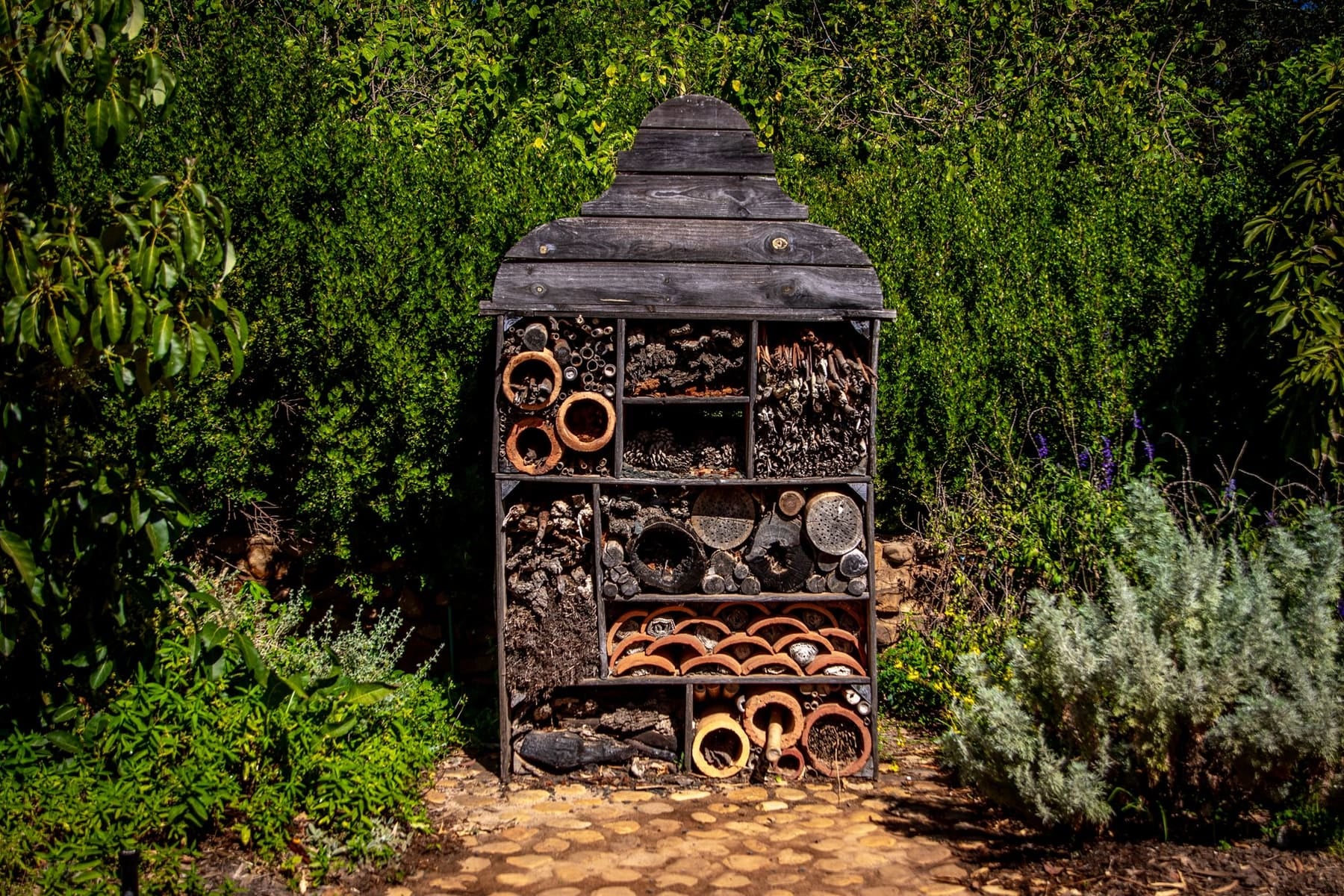
This model stands on its removable legs or is fixed to a wall by its brackets, front to the south or south-east, lower compartments about 1 m off the ground. Its tunnels of 2 to 10 mm across and 10 to 15 cm deep match the dimensions recommended for solitary bees; the reasoning behind those figures and how to build a shelter at home are explained in the guide on choosing and setting up an insect hotel.
On a balcony or a terrace
It can be done, on two conditions: a south or south-east aspect, and flowers on the balcony itself. A few large troughs of sage, oregano, thyme, borage or lavender are enough to create the nearby resource that is otherwise missing.
The format, on the other hand, has to change. A large hotel more than 80 cm tall is out of scale on a balcony, hard to fix solidly to a railing, and exposed to the wind. A small solitary bee shelter, screwed to the wall or to a rigid upright about 1 m off the ground, suits the situation far better.
Its cavities of 2 to 10 mm and its tunnels of 10 to 15 cm repeat the figures of the large model, in a size that works on a balcony wall. Solitary bees have no colony to defend and very rarely sting: a shelter can go near a table or a container vegetable patch, as long as you simply avoid standing in front of the entrances.
When to put it up, and when to leave it alone
The best time to install one is the end of winter, before the first emergences. A shelter put up in February or March has a chance of being occupied in its first season; put up in June, it will often wait for the following year.
After that the rule is simple: leave it alone. The larvae develop in the sealed tunnels for months, winter included. Do not move the shelter, do not bring it indoors, do not open it. The only useful maintenance is to renew part of the stems or logs gradually every two to three years, after the spring emergences, keeping the tunnels that are still sealed until their occupants have come out.
A move is sometimes unavoidable, if the shelter has stayed empty for two or three seasons. In that case, wait for the end of winter, move the shelter in one piece, and start by looking again at the aspect and the flowers around it: that is almost always where the cause lies. Shelters for insects and pollinators are gathered in the Insects section.
Sources
Frequently asked questions
How high should an insect hotel be placed?
The first compartments should sit about 1 m off the ground at the very least. Lower down, damp from the soil makes the tunnels go mouldy and tall grass hides the entrances. There is no real maximum height, but a shelter placed too high becomes hard to maintain and hard to watch.
Can an insect hotel be hung from a tree?
It is not advisable. A hanging shelter swings in the wind, and solitary bees will not enter an unsteady tunnel. Better to screw it to the trunk, strap it to a post driven in beside the tree, or stand it on its legs at the foot of the tree.
My insect hotel is staying empty: what should I do?
Check the aspect and the flowers before blaming the shelter. A north-facing wall, a position that is too low, a support that moves or the absence of nectar-rich plants within a few metres explain most failures. An insecticide treatment in the garden or at a near neighbour's has the same effect.
Should the insect hotel be brought indoors for winter?
No, never. The larvae spend the winter in the sealed tunnels and need the cold to finish their development. Bringing the shelter into a garage or a conservatory makes them emerge too early, at a time when no flower will feed them. It stays outside, simply sheltered from driving rain.