


Insect hotels: choosing, building and installing them properly
Hole diameters, tunnel depth, aspect, height and nearby flowers: how to choose or build a shelter that solitary bees actually use, and avoid gimmicky models.
In this guide
A useful insect hotel is, first and foremost, a shelter for solitary bees: hollow stems or holes roughly 2 to 10 mm in diameter, 10 to 15 cm deep, facing south or south-east, raised off the ground, well sheltered from rain and surrounded by local flowers. Many decorative models, filled with pine cones and straw, stay empty. Here's how to choose, build and install a shelter that will actually be occupied.
Who does an insect hotel really serve?
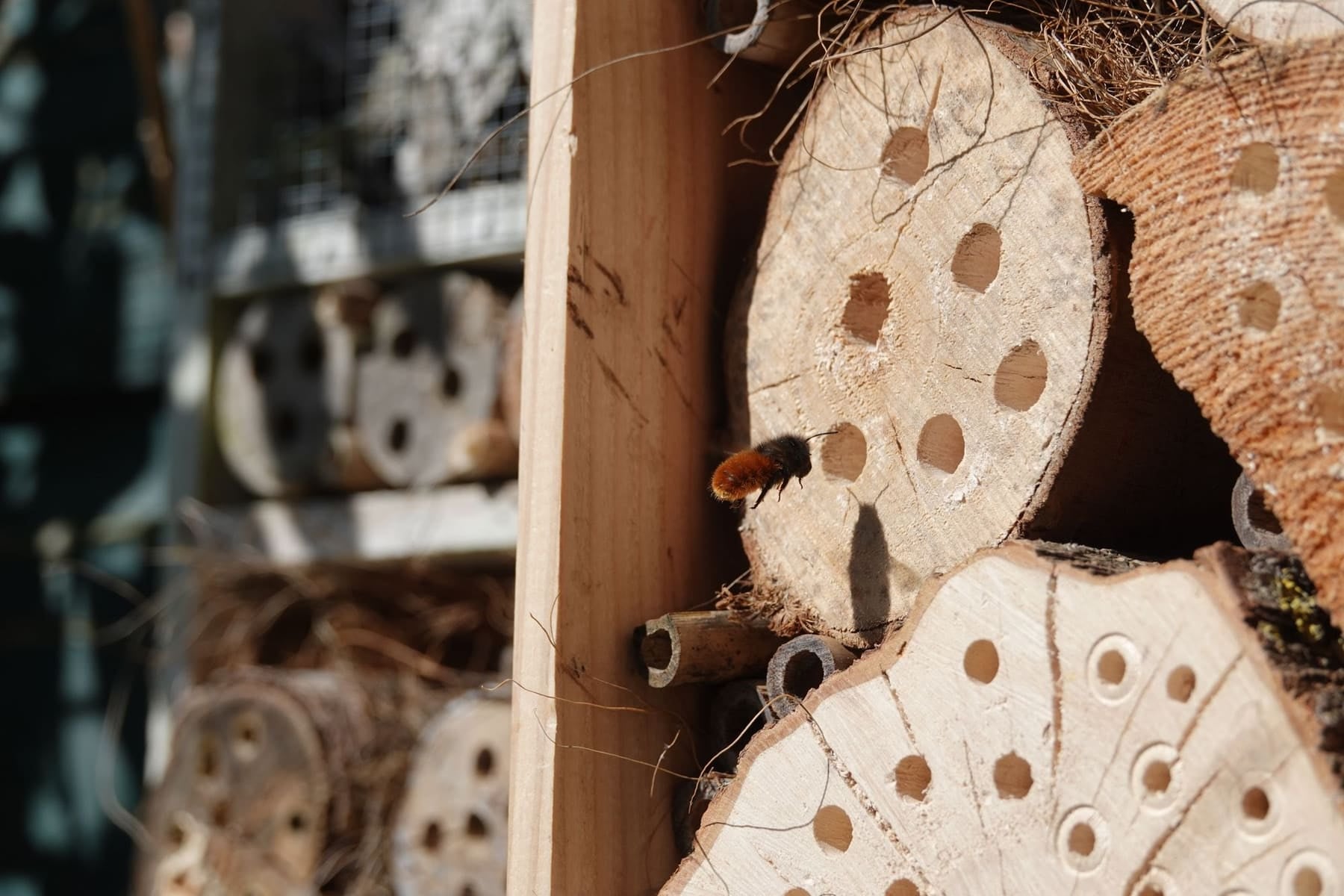
The main occupants are solitary bees that nest in existing cavities: mason bees, leafcutter bees or yellow-faced bees, depending on the region. Unlike the honeybee, they don't live in colonies, don't produce honey, and rarely sting. Each female builds a tunnel alone, stocks it with a store of pollen and one egg per cell, then seals the entrance with mud (mason bees) or pieces of leaf (leafcutter bees). The young emerge the following spring or summer.
An important nuance: around 70% of solitary bees nest in the ground, according to the LPO, and will never use a hotel. A hotel with tunnels therefore helps some pollinators, not all of them. Hence the value of also leaving a small patch of bare, compacted, sunny ground sheltered from wind, with no mulch or ground cover. Our guide to attracting solitary bees covers both ways of welcoming them.
Choosing well: the criteria that matter
- A range of diameters, roughly 2 to 10 mm: each species has its preferred size, and a wide range attracts more occupants. Larger mason bees tend to use holes of 6 to 8 mm.
- A depth of 10 to 15 cm: in a tunnel that's too short, the female fits in fewer cells and lays proportionally more males. Larger mason bees need around 15 cm for a good balance between males and females.
- Tunnels closed at the back, with smooth edges and no splinters that would damage wings.
- An overhanging roof that protects the entrances from rain.
- Untreated wood, with no varnish, stain or preservative: these substances can harm the larvae. For a drilled log, the LPO recommends hardwood.
Watch out for gimmicky models: a large front panel of compartments filled with loose pine cones, bark or straw, stems just a few centimetres long, holes drilled into end-grain wood that splits. Pretty but not very functional, they disappoint. And a very large hotel where cells are packed together can concentrate parasites and predators: several small shelters spread out are often better than one big one.
This "beehive" shelter from Esschert Design is a small pine-and-zinc model about 15 cm across, filled with stems and drilled wood, with holes of 2 to 7 mm: it suits small to medium-sized species. To also offer wider, deeper tunnels, complement it with a hardwood log or a bundle of stems you make yourself.
Building your own
An effective shelter can be built in an afternoon.
With hollow stems
Cut bamboo or reed stems just after a node, which naturally seals the back, or plug the rear with a little clay. Aim for 15 to 20 cm in length and lightly sand the entrance. Pack the stems horizontally into a raw-wood box, set slightly back under the roof to keep them dry. Pith-filled stems, such as elder or bramble, can be fixed separately, vertically or at an angle: some species hollow out the pith themselves.
With a drilled log
Choose dry hardwood (oak, beech, hornbeam, sweet chestnut) and drill perpendicular to the grain, into the side of the log, not into the end grain, where cracks appear. Drill holes of 3 to 8 mm, spaced at least 1.5 to 2 cm apart, to a depth of 10 to 15 cm, without going all the way through. Remove shavings and smooth the entrances with sandpaper.
Installing it in the right place
- South or south-east facing: solitary bees need the warmth of the morning sun to become active.
- Raised up, on a wall, post or fence. Avoid ground level, which is too damp.
- Fixed firmly, so it doesn't sway in the wind: hung from a branch, it moves too much.
- Sheltered from rain and prevailing winds, with the entrances clear of any vegetation.
- Local flowers close by: many solitary bees forage within a small radius of the nest. Without floral resources, the shelter stays empty.
The best time to install one is late winter, before the first emergences. Occupants then arrive gradually, sometimes as early as the first season, sometimes the following year.
Feeding the occupants: the role of flowers
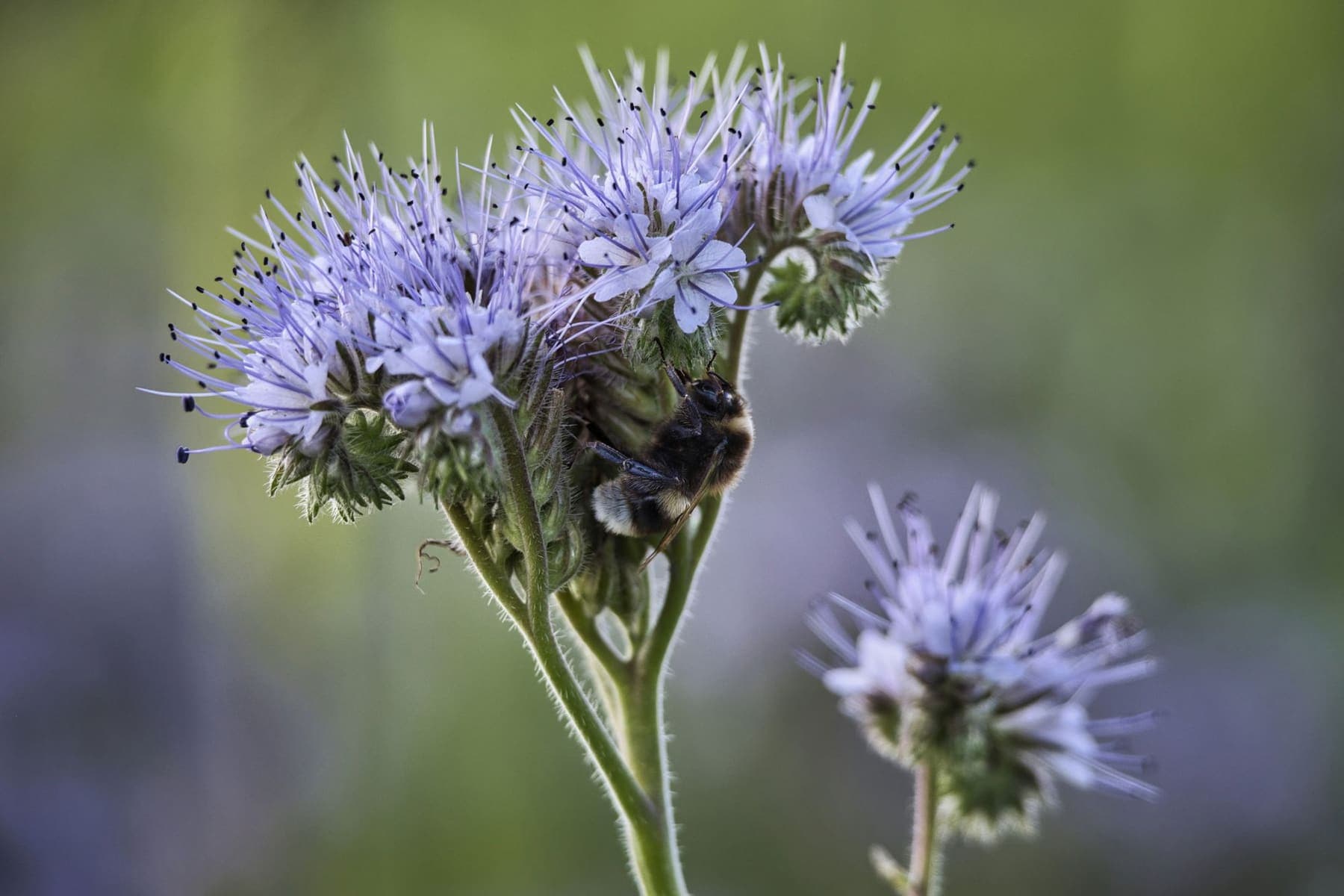
A shelter is useless without a larder. Sow or let a varied range of local flowering plants establish, succeeding one another from spring to autumn: willows and fruit trees early in the season, then viper's bugloss, sages, clovers, knapweeds, borage, and ivy late in the season. A wildflower meadow rounds out the offer: our guide to plants for pollinators helps you choose. Ban pesticides and herbicides, including on the surfaces near the shelter.
Maintenance and common mistakes
Don't open or move the shelter in winter: the larvae are still developing inside. After two to three years, gradually renew the stems or logs to limit the build-up of parasites, keeping tunnels that are still sealed until their occupants emerge.
The most common mistakes:
- facing the shelter north or placing it in the shade;
- exposing it to driving rain;
- offering tunnels that are too short or open at both ends;
- varnishing or staining the wood;
- installing a fine hotel in the middle of a close-mown lawn, with no flowers at all.
These steps also benefit birds, whose broods feed on insects: see our guide to attracting blue tits. Shelters for solitary bees and bumblebees are featured in our Pollinators section.
Sources
Frequently asked questions
Where should I put an insect hotel?
Facing south or south-east, raised up and fixed firmly to a stable support, sheltered from rain and prevailing winds, with local flowers close by.
What depth and diameter should the holes be?
A range of diameters of around 2 to 10 mm and a depth of 10 to 15 cm, tunnels closed at the back with sanded edges. In wood, drill into the side of the log, perpendicular to the grain.
Are the bees from an insect hotel dangerous?
Solitary bees don't defend a colony and rarely sting. A shelter can be installed near a terrace or vegetable patch, simply avoiding standing right in front of the entrances.