





The robin in the garden: spot it, feed it, house it
A solitary, territorial bird that sings in midwinter and feeds on the ground. How to recognise it for certain, which open-fronted nest box to put up, what to offer at the feeder and what to get wrong.
In this guide
The European robin is known by its orange breast, which runs right up to the forehead and looks the same on male and female. It does not nest in a box with an entrance hole but in an open-fronted box, ideally fixed to a wall, between 1.5 and 3 m up and well hidden in vegetation. At the feeding station in winter it looks mainly on the ground: a low tray of small oil-rich seed and porridge oats suits it far better than a hanging fat ball.
Recognising it without any doubt
The robin is one of the few garden birds you identify at first glance, provided you know three details.
- The breast is not red but orange, and it spreads well beyond the throat: throat, breast, cheeks and forehead. A blue-grey border separates it from the olive-brown of the back.
- Male and female look identical. No visual feature separates them in the field, unlike the house sparrow or the blackbird.
- The young of the year has no orange breast. It is speckled all over in brown and buff, which often gets it taken for another species until its first moult at the end of summer.
Its outline is round, set on thin legs, and it readily holds itself upright, head raised. Its large black eye gives it the alert look that makes it so easy to photograph.
A loner that sings in December
The robin is territorial all year round, which explains almost everything about its behaviour in the garden.
Males and females each defend a separate winter territory, and that is why it can be heard singing in November, December and January, when most other songbirds fall silent. That song is no courtship display: it is a warning aimed at its own kind.
There is a practical consequence. Two robins cannot be drawn into the same small garden. Fights between neighbours are real and sometimes violent. Putting up several open-fronted boxes a few metres apart therefore achieves nothing; one well-chosen position is better.
That territoriality comes with a busy calendar. Breeding starts early, often as soon as March, and a pair commonly raises two broods in the season, sometimes three. The young are fed solely on invertebrates during their fortnight or so in the nest, then stay dependent on the adults for a few days more after fledging. A garden without insects therefore cannot raise a brood, however good the nest box.
Its tameness comes from an old habit: it follows wild boar and other large mammals that turn the ground over, taking the invertebrates they bring to the surface. A gardener digging plays exactly that role, which is why it will land a metre or two away with no apparent fear.
The open-fronted box, not the one with a hole
Most shop-bought boxes are closed models, meant for hole-nesters such as tits. The robin nests in a widely open recess: a hollow in a bank, a stump, a log pile, thick ivy, a shed left ajar.
| Closed box with an entrance hole | Open-fronted box | |
|---|---|---|
| Front | Solid, with a calibrated hole | Open across its upper half |
| Species | Tits, sparrows, common redstart, starling | European robin, black redstart, wren, spotted flycatcher, wagtails |
| Recommended support | Trunk, wall, post | Wall, ideally |
| Mounting height | At least 2 m for tits | 1.5 to 3 m |
| Aspect | Hole facing east or south-east | Quiet, covered spot, sheltered from driving rain |
These figures come from the LPO factsheet on nest boxes for passerines. The decisive point for the robin is not height but plant cover: an open-fronted box in plain view stays empty, because the brood would be at the mercy of cats, magpies and crows. Back it against ivy, a climbing rose or the far end of a lean-to.
The rest of the rules common to every nest box — solid timber left rough inside, no treatment, put up in autumn, a fixing that does not damage the support — are set out in Which nest box should I choose?. The annual clean happens after the breeding season and never during it: the method is in cleaning a nest box.
What it eats, and how to offer it
The robin is first and foremost an insect eater: earthworms, spiders, small beetles, larvae, topped up with berries and small fruit in autumn. It does not shell large seeds, which its fine bill cannot open.
At the feeding station in winter, three things suit it:
- Oil-rich seed that is already accessible: sunflower hearts above all, which it carries off one at a time to eat apart.
- Raw porridge oats, neither cooked nor sweetened.
- Mealworms, dried or live, in small amounts, much appreciated in frosty weather.
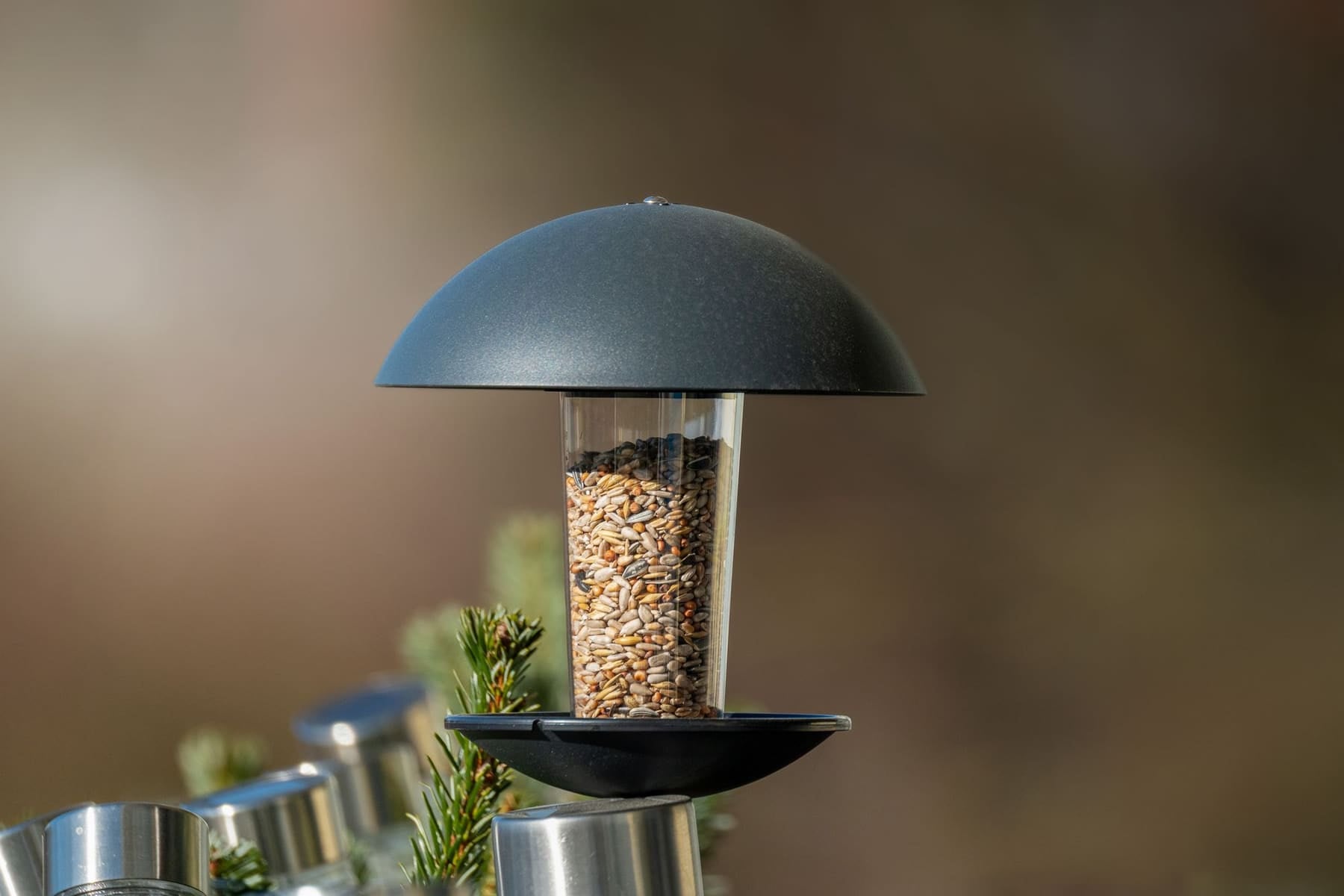
The problem is the shape of the station rather than the food. The robin feeds on the ground or just above it and will not cling to a mesh feeder or a hanging fat ball. A tray set 20 or 30 cm off the ground, or simply a clean slab sheltered from rain, serves it much better. Put that station 2 or 3 m from a bush, out of reach of cats, and put out only what will be eaten during the day so that rodents are not drawn in.
The bans are the same as they are across every species: no bread, no milk, no salty leftovers and no cooked fat. The useful feeding period, the quantities and the hygiene of the stations are covered in feeding birds in winter.
The garden it settles in
A resident robin asks little, but it needs these four things together:
- Living soil. Dead leaves left under the hedge, a compost heap, ground turned over now and again: that is its larder. A close-mown, treated lawn offers nothing.
- Low, dense cover. An informal hedge of local species, a log pile, ivy on a wall. It nests, roosts and takes shelter there.
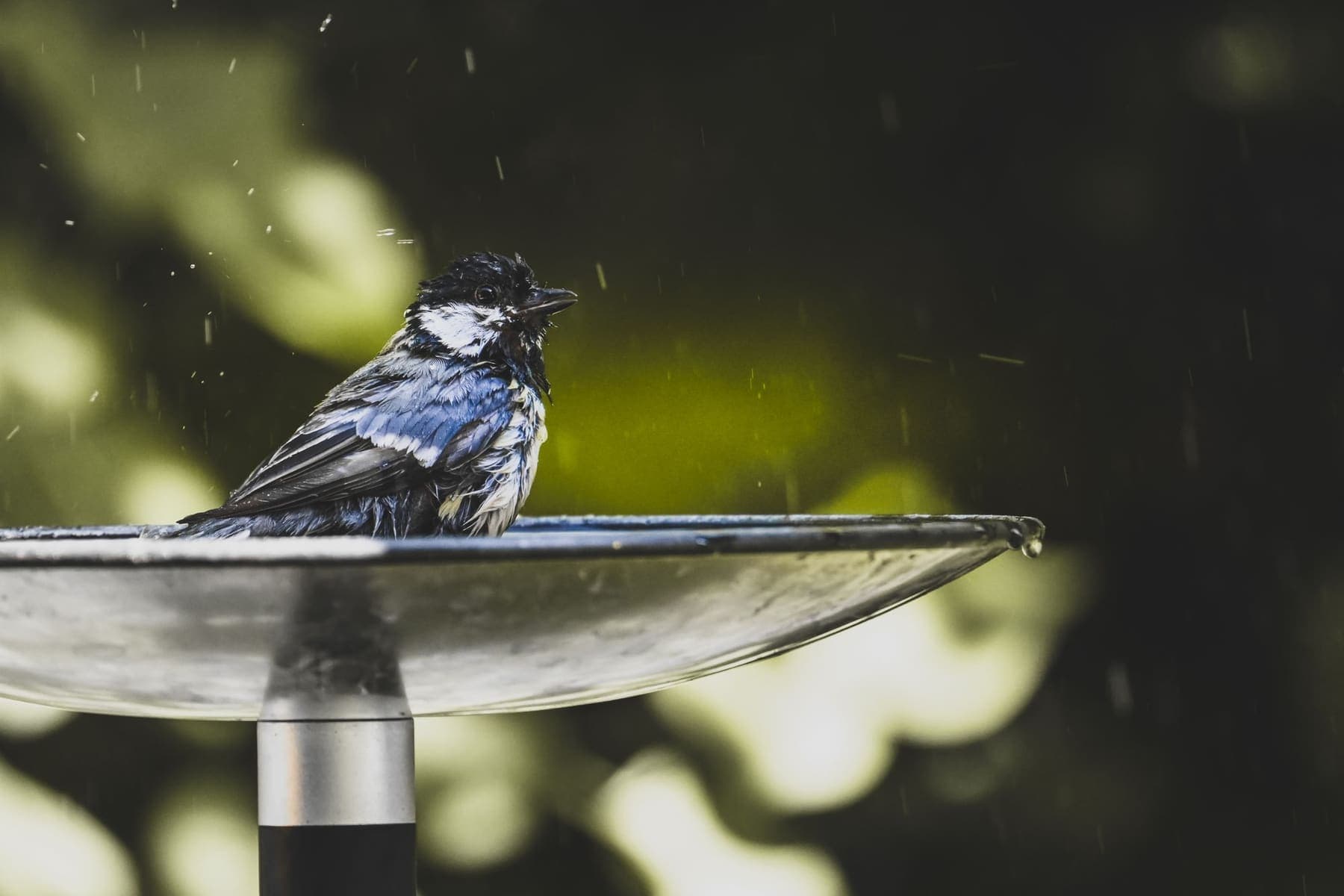
- Water all year. A dish with a sloping edge, 2 to 4 cm of water at its deepest and a flat stone in the middle, refreshed every two or three days. Never salt or antifreeze in winter. The subject is taken further in water for garden birds.
- No pesticides. Insecticides and slug pellets remove its food directly, and contaminated slugs sometimes end up in its bill.
The commonest mistakes
- Putting up a 32 mm hole box and hoping for a robin. It will not take it; tits or sparrows will move in instead.
- Fitting the open-fronted box in full view, with no cover. This is the leading cause of failure, well ahead of the model or the height.
- Cutting the hedge or the ivy in spring. From March to August a trim can destroy a nest. The order of 29 October 2009 prohibits destroying the nests and eggs of protected birds, and deliberately disturbing them during the breeding season. Trimming is done outside that period.
- Trying to hand-feed it. Its tameness is real, but it gets the bird used to approaching people and, by extension, cats. Better to watch it from a distance.
- Clearing the whole garden in autumn. Dead leaves, dry stems and log piles hold the invertebrates it will feed on in January.
Nest boxes, feeders, seed and drinkers are gathered in the Birds section.
Sources
Frequently asked questions
How do I tell a male robin from a female?
You cannot, at least not with the naked eye. Both sexes carry the same orange breast and the same olive-brown plumage, with no size difference you can pick out in the field. Only behaviour in spring gives a clue: it is the female that builds the nest and sits on the eggs. The young of the year, by contrast, stands out clearly, because it is speckled all over and has no orange breast yet.
Why does the robin sing in winter?
Because it is defending a wintering territory, not because it is looking for a mate. Males and females each hold their own territory from autumn onwards and advertise it by singing, which makes the robin one of the few voices in the garden in December and January. That winter song is softer and more wistful than the spring one.
Is it the same robin I see all year?
Not necessarily. Some of our robins stay put, but the species is a partial migrant: birds from northern and eastern Europe come south to spend the winter, which is why sightings rise sharply from October to March. The bird in the garden in January is therefore not always the one that nested there in May, even though its orange breast looks identical.
What if a robin nests somewhere inconvenient?
You have to wait for the young to fledge: the robin is a protected species, and moving or destroying an occupied nest is against the law. The brood holds the site for about a month between laying and fledging. Mark the area off, suspend any work or use of the spot, then remove the nest once the place is empty for good, in autumn.