Indoor cactus care: light, watering and winter rest
Plenty of light, very little water, a cool, dry winter, a free-draining substrate: the steps to keep indoor cacti healthy, and the mistakes that make them rot.
In this guide
An indoor cactus needs plenty of light, very little water and a cooler, drier winter. Place it as close as possible to a bright window. Water only when the substrate is dry all the way down. Too much water is the first danger for a cactus.
Light: as close to the window as possible
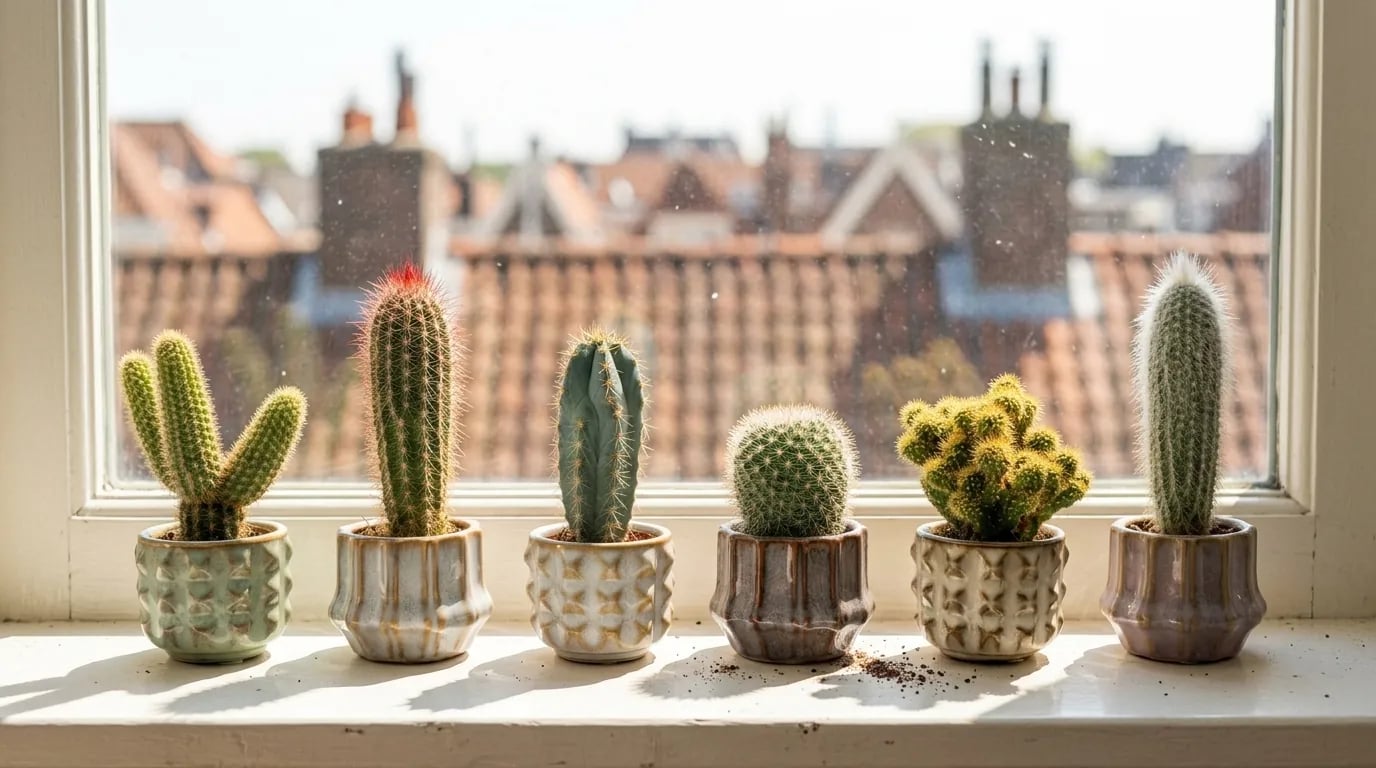
A cactus needs bright light all year. Place it as close as possible to a south-, east- or west-facing window. The RHS also recommends a sunny windowsill for most indoor cacti.
Without enough light, the plant stretches and turns pale. The RHS describes weak, distorted growth. A stretched part does not return to its original shape, even when the light comes back.
There are exceptions. Tropical forest cacti, such as the Christmas cactus (Schlumbergera), Epiphyllum or Rhipsalis, prefer an east- or west-facing window. According to the RHS, a south-facing window only suits them behind a net curtain. Our sets are mixes of cacti not identified by species.
Turn the pot a quarter turn from time to time. The cactus then grows straight, instead of leaning towards the window.
Watering: infrequent, on dry substrate
A cactus stores water in its stem. It copes with being forgotten. It does not cope with substrate that stays wet.
- In spring and summer: a few spoonfuls of water per plant every two to three weeks, when the substrate is dry all the way down.
- In autumn and winter: once a month at most, or not at all in a cool room.
To check, push a wooden stick down to the bottom of the pot. If it comes out moist, wait. If in doubt, do not water. Pour the water at the foot of the plant. The RHS points out that a cactus pot must never stand in water.
The drainage hole
A pot that holds water is the first danger for a cactus. Illinois Extension says that potted plants without a drainage hole are more at risk of root rot.
The manufacturer does not say if our pots have a drainage hole. This applies to the 5.5 cm plastic pots as well as the ceramic pots. Check when they arrive. If the pot has no hole, water with even more care. Empty any water left at the bottom by tilting the pot, and do not put the pot in a cover pot that holds water.
Winter: the rest period
In winter, light drops and the cactus grows little. The RHS recommends a rest period from November to early March, for most indoor cacti and succulents. During this rest, nights should stay between 8 and 10 °C. Watering is cut to a minimum: just enough to stop the plant from wrinkling.
The RHS explains why. Watering during this rest gives weak growth. On the other hand, a cool, dry winter, with as much light as possible, helps the cactus flower.
In a heated living room, these temperatures are rarely reached. Then keep the cactus as close to the window as possible, and water once a month at most. If you have a cool, bright room, such as a bedroom with little heating, it is the best place for the winter.
Substrate, repotting and fertilizer
A cactus needs a substrate that dries quickly. The RHS recommends a cactus compost, or a potting compost lightened with grit. Grit can make up to 30% of the volume. It also recommends covering the surface with a thin layer of grit.
Our cacti arrive already potted, ready to display. Repotting becomes useful when the roots stick out, usually after a year or two. The RHS recommends repotting in spring, when the roots fill the pot. Choose a pot that is only slightly larger: a pot that is too large holds too much wet soil, and the roots rot.
To hold the cactus, fold a strip of newspaper into several layers and wrap it around the stem. A thick kitchen glove also works. This is the RHS method.
For fertilizer, the RHS recommends feeding once a month, from April to September. It mentions a high-potassium liquid fertilizer, such as a tomato feed, or a cactus fertilizer. Nothing in winter.
Cacti in a terrarium: open only
A cactus dreads the stagnant humidity of a closed terrarium: the base rots. Use an open, well-ventilated terrarium, or leave it in its pot. Our succulent terrarium tutorial covers the build, and our closed or open terrarium comparison explains the difference.
Do not mix cacti and woodland plants in the same container. They do not need the same watering. If you like succulents that accept softer light, read our guide to haworthia.
Our cactus sets
All our sets are mixes put together by the grower. The selection changes with each shipment.
- Set in plastic pots: 6 or 12 cacti, each in a 5.5 cm plastic pot, 8 to 12 cm tall pot included.
- San Juan set: 6 cacti in ceramic pots 7.2 cm in diameter and 6.3 cm tall, 8 to 12 cm tall pot included.
- Barcelona set: 6 cacti in the same ceramic pots, 8 to 16 cm tall pot included.
- Set of 3 in red pots: 3 cacti in red ceramic pots 6 cm in diameter and 6 cm tall.
- Mini pot trio: 3 cacti in 6 cm ceramic pots, white or blue as you choose.
The spines prick. Keep the cacti out of reach of young children and curious pets.
The mistakes that make a cactus rot
Watering too often. This is the most common mistake. The RHS lists damaged roots, stunted growth, blisters on the stem and rot.
Leaving water at the bottom of the pot. Even infrequent watering becomes too much if the water stagnates. Check the drainage.
Watering in winter as in summer. During the rest period, the plant drinks very little.
Lack of light. The cactus stretches and turns pale. Move it closer to the window.
Ignoring mealybugs. The RHS lists them among the common pests. They form white, cottony clusters. Remove them as soon as you see them, and isolate the plant.
If you are away, a cactus copes well with a few weeks without water. Our guide Terrariums and holidays gives the steps to take before you leave.
In short
- As close as possible to a bright window, facing south, east or west.
- A few spoonfuls of water every two to three weeks in season, on substrate that is dry all the way down.
- A cool, dry winter: once a month at most, or not at all in a cool room.
- A pot that does not hold water, and a free-draining substrate.
- An open terrarium only, never a closed one.
Sources
- Cacti and succulents: growing indoors, Royal Horticultural Society
- Houseplants: Get Started, Illinois Extension
- Manufacturer data sheets (dimensions of the plants and the pots, contents of the sets)
Frequently asked questions
How often should I water an indoor cactus?
In spring and summer, a few spoonfuls of water per plant every two to three weeks, when the substrate is dry all the way down. In autumn and winter, once a month at most, or not at all in a cool room.
Where should I place a cactus in the home?
As close as possible to a bright window, facing south, east or west. Without enough light, the cactus stretches and turns pale. A few forest cacti, such as the Christmas cactus, prefer an east- or west-facing window.
Why is my cactus going soft?
Most often, it is too much water: the roots rot, then the base softens. Stop watering, let the substrate dry and check that the pot does not hold water at the bottom. A black, soft part cannot be saved.
How do I repot a cactus without getting pricked?
The RHS recommends holding it with a folded strip of newspaper, or with a thick kitchen glove. Repot in spring, when the roots fill the pot, into a pot that is only slightly larger.