Watering plants while on holiday: the methods by length of absence
A few days, two weeks, a month: how to prepare your plants before you leave, and when to use a wick, the bathtub, a clear bag or a watering globe.
In this guide
To water your plants while you are on holiday, start from how long you will be away. For a few days, a good watering before you leave is enough for most plants. For one to two weeks, give them a water reserve: a wick, the bathtub, a clear bag or a watering globe. For longer, ask someone you trust to drop by. In every case, move the plants out of direct sun before you leave.
By length of absence
| Length | What to do |
|---|---|
| A few days | Water thoroughly before you leave, and move the plants out of the sun. |
| One to two weeks | Add a water reserve: bathtub, gravel tray, clear bag or globe. |
| Two to four weeks | A wick connected to a reserve, or a visit from someone you trust. |
| More than a month | Leave the plants with someone, or arrange a visit at least once a week. |
The sources do not all set the same limit. The Royal Horticultural Society (RHS) advises asking for help beyond two weeks. The University of Florida service (UF/IFAS) puts this threshold at four weeks, with a wick in the meantime. For a fragile plant or a small pot that dries out fast, use the shorter limit.
Before you leave: four steps
- Water thoroughly. The soil must be moist, not soggy. The RHS and UF/IFAS give this advice for every method.
- Empty the saucers once the water has drained. A plant that sits with its roots in water for several days risks rot.
- Move the plants away from hot windows and direct sun. UF/IFAS explains that in softer light, a plant uses less water. The RHS also advises a cooler room.
- Remove faded flowers and damaged leaves.
In winter, the RHS says that a week or two without care is fine, as long as the room does not get too cold. Then move the plants away from cold windowpanes.
If you are not sure how to judge the soil, our guide watering indoor plants explains how to check with your finger or by the weight of the pot.
The bathtub and the gravel tray
These two methods give about one more week, according to UF/IFAS. They suit pots with drainage holes in the bottom.
The bathtub holds a group of plants:
- Pour about 5 cm of water into the bathtub.
- Spread old towels over the bottom.
- Set the pots on the towels.
- Leave the bathroom light on, as UF/IFAS advises.
The capillary mat, recommended by the RHS, follows the same idea. Lay a mat on the draining board of the sink, and soak one end in the sink filled with water. Press the pots onto the wet mat. The RHS points out that a terracotta pot must be well watered first. The mat works poorly if the bottom of the pot holds crocks.
The gravel tray is for a single plant. Fill a deep saucer with gravel, add water, and set the pot on top.
The wick: for two to four weeks
A wick links a water reserve to the soil. The water slowly rises into the pot.
- Fill a large container with water.
- Set it higher than the plants, on a chair or a table. It must not stand between the plants and the window.
- Put one end of each wick in the reserve.
- Push the other end into the soil of each pot.
- Water the plants before you leave.
UF/IFAS uses cotton cords. The RHS uses a strip of capillary mat. According to UF/IFAS, the wick keeps the soil moist for about two more weeks.
Two traps, pointed out by the RHS:
- A reserve that is too small runs dry before you come back.
- A wick that is not pushed in far enough slips out of the pot, and the water no longer gets through.
The clear bag: for one week
The University of Illinois suggests a simple method. Cover the plant with a large clear plastic bag. Set it in a shallow tray, with gravel and a little water. According to this source, the plant lasts 7 to 8 days this way.
The water that evaporates stays in the bag and falls back onto the plant. The RHS advises keeping the bag away from the leaves, with stakes, and reusing a bag you already have. This method is for short absences.
Watering globes
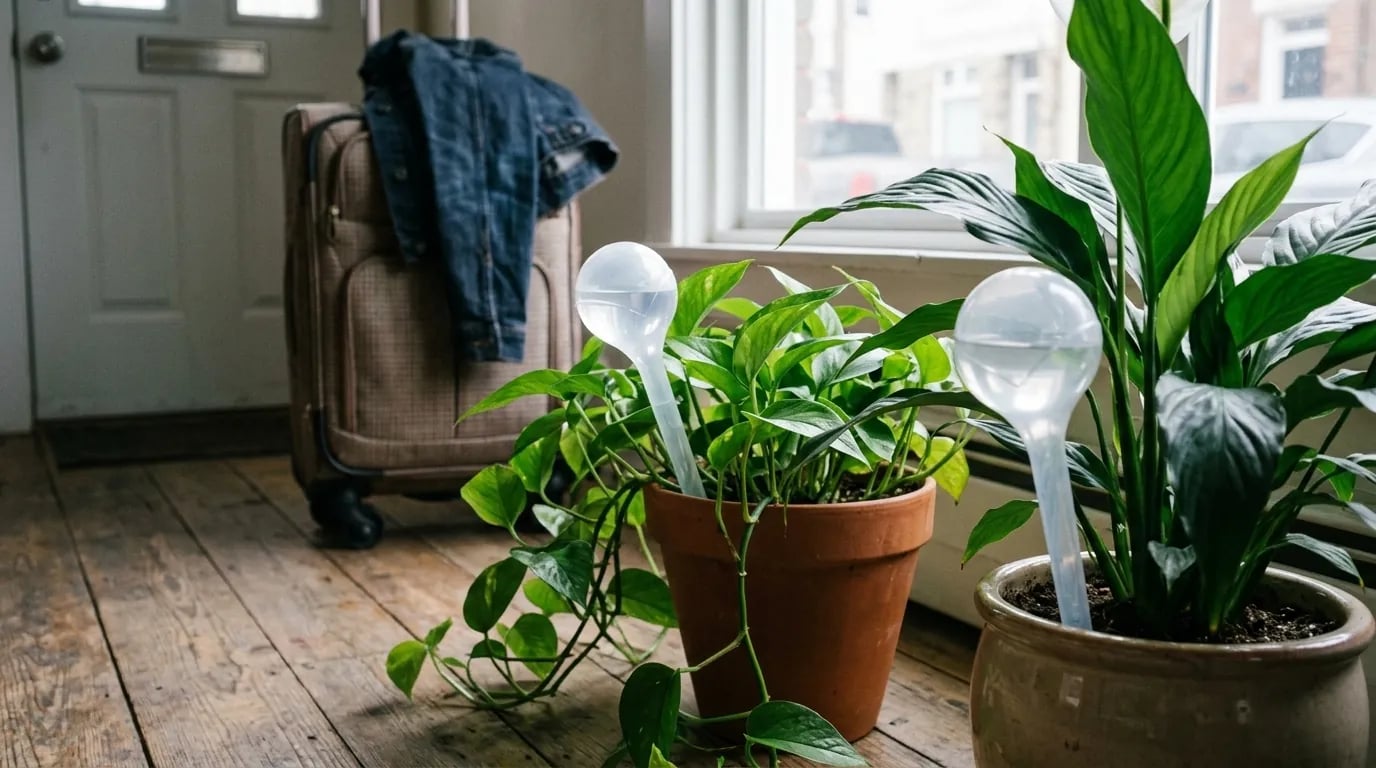
A watering globe is a reserve pushed into the soil. It releases water on its own, as the soil dries, according to the supplier.
- Fill the globe with water.
- Push it into the soil at an angle, 5 to 10 cm from the stem.
- Check the level through the clear plastic.
Our globes are sold in pairs and are about 20 cm long. The supplier intends them for potted plants whose soil must stay slightly moist. It gives no duration. So run a test one week before you leave: fill the globe and note how many days it lasts in your pot.
Plants that need nothing
Cacti and succulents store water in their thick leaves or stems. The RHS says they cope longer without water. They are the only houseplants the RHS leaves out of holiday watering. Do not give them a water reserve: just move them out of direct sun.
A closed terrarium recycles its water. It needs no watering before you leave. Our guide terrarium and holidays explains what to check, and the trap of the “just in case” watering. Watering globes are not made for a closed terrarium.
Too much water does as much damage as too little
The RHS warns in both directions. Waterlogged soil encourages rots, such as grey mould. Roots that are too dry encourage powdery mildew and spider mites.
So do not combine methods. A pot set on wet towels does not need a globe as well.
Self-watering pots are another case. The RHS recommends them as a year-round way of growing plants that like constantly moist soil. Do not repot a plant into one just to go away for a week.
When you come back
- Touch the soil before watering. If it is still moist, wait.
- Remove the bags and take the pots out of the bathtub.
- Let them drain, then put each plant back in its usual place.
- Remove yellow or dry leaves.
A watering can with a long, thin spout reaches the base of the plant without wetting the leaves. For large pots, a bigger can with a removable rose is faster.
In short
- A few days: water thoroughly and move the plants out of direct sun.
- One to two weeks: bathtub, capillary mat, clear bag or watering globe.
- Two to four weeks: a wick connected to a large water reserve.
- Longer, or for fragile plants: someone you trust.
- Do not give a water reserve to cacti, succulents or a closed terrarium.
Sources
- Houseplants: holiday care, Royal Horticultural Society
- Vacation plant care, University of Florida IFAS Gardening Solutions
- Houseplant care, University of Illinois Extension
- Manufacturer data sheets (dimensions, materials and instructions for the globes and watering cans)
Frequently asked questions
How long can a houseplant go without water?
It depends on the plant, the pot and the heat. The Royal Horticultural Society says most houseplants can manage a few days without help. Beyond a week, plan a water reserve. Cacti and succulents last longer.
Should I water a lot before leaving?
Water thoroughly, then let it drain and empty the saucers. The soil must be moist, not soggy. A plant that sits in water for several days risks root rot.
How long does a watering globe last?
The supplier of our globes gives no duration. It depends on the size of the pot and how fast the soil dries. Run a test one week before you leave, and note how many days the globe lasts.
Who should water my plants if I am away for a month?
Beyond two weeks, the Royal Horticultural Society advises asking someone you trust. The University of Florida service puts this threshold at four weeks, with a wick in the meantime. If the plants are too big to move, UF/IFAS advises a visit at least once a week.