

Identifying garden birds: ten common species
Size, key feature, behaviour and where to look: everything you need to name the ten commonest birds of French gardens without hesitating, and to avoid the classic mix-ups.
In this guide
Ten species cover the great majority of the birds seen in a garden in mainland France: great tit, blue tit, house sparrow, robin, blackbird, chaffinch, greenfinch, goldfinch, dunnock and wren. Three clues nearly always separate them — the size, one detail of the plumage, and where the bird is standing. Here are those ten portraits, and the mix-ups that come up most often.
Three reference points before you start
Size is judged by comparison, not in centimetres. In the field it is more useful to ask whether the bird is smaller than a sparrow, the size of a sparrow, or clearly bigger. The lengths given below, from the tip of the bill to the tip of the tail, mainly serve as a mental marker.
Behaviour is often worth more than a detail of plumage. A tit hangs upside down from a thin branch; a sparrow never does. A robin hops along the ground, pauses and lifts its head; a dunnock creeps along at ground level, almost shuffling. A blackbird runs across the lawn and stops dead. These habits are visible from a distance, even without binoculars.
Place counts. The hanging seed feeder, the bird table, the ground under the feeder, the hedge and the bird bath do not receive the same species. Knowing where you are looking already halves the list.
The ten species in one table
| Species | Length | Key feature | Where to see it |
|---|---|---|---|
| Great tit | 13.5 to 15 cm | White cheeks, black head, black stripe running down a yellow belly | Hanging feeders, nest boxes with a 32 mm hole |
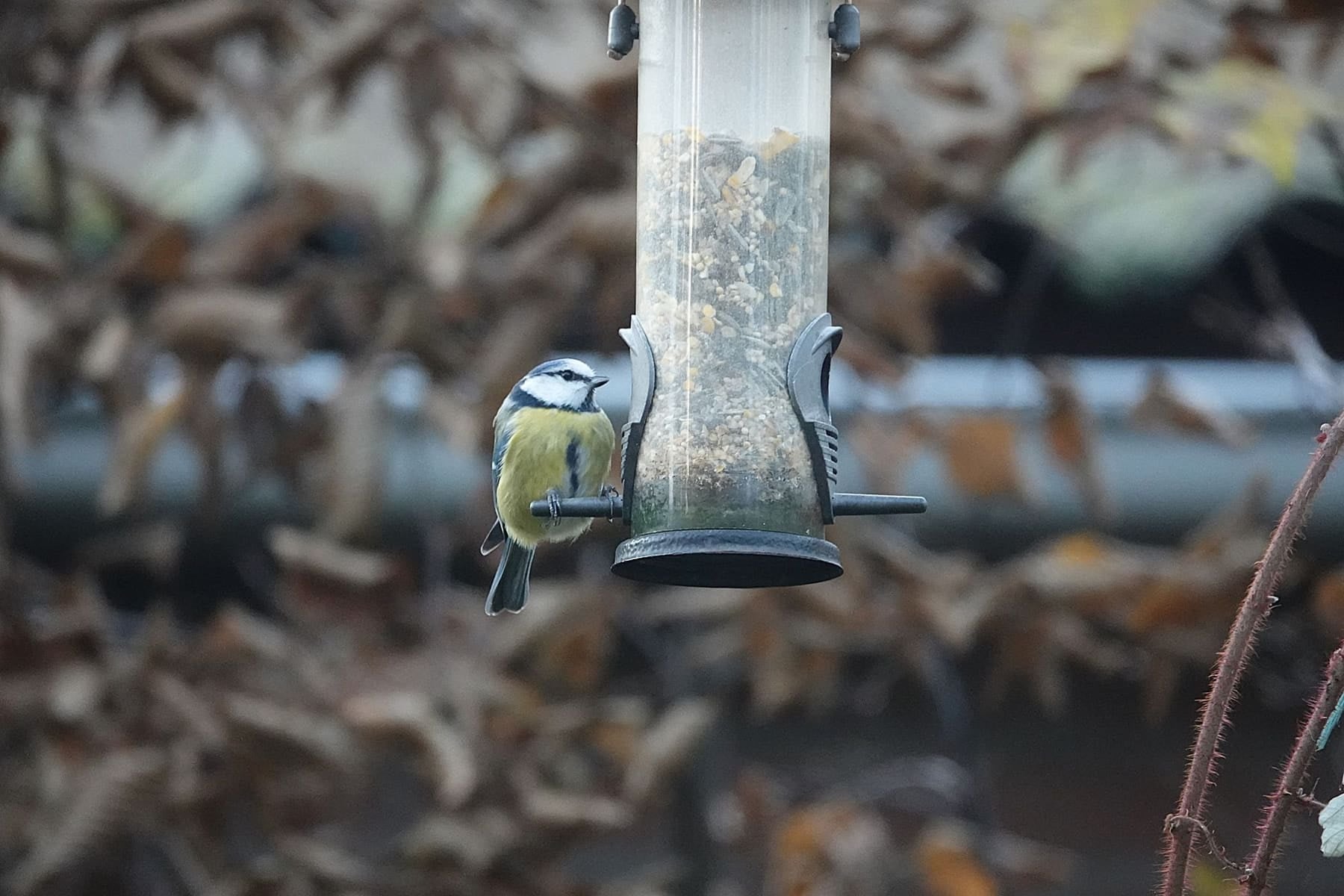
| Blue tit | 10.5 to 12 cm | Blue cap and black line through the eye, yellow belly | Tube and hopper feeders, acrobatic on thin branches |
| House sparrow | 14 to 16 cm | Male with grey cap and black bib, female streaked buff | In flocks, on the ground and on bird tables, near buildings |
| Chaffinch | 14 to 16 cm | Double white wing bar, very obvious in flight | On the ground under the feeder, along edges and in hedges |
| Greenfinch | 14 to 16 cm | Olive green, bright yellow on the wing and tail edge, thick pale bill | Sunflower seed feeders, which it happily monopolises |
| Goldfinch | 12 to 13.5 cm | Red face, black and white head, broad yellow bar on the black wing | Seed feeders, thistles and dried flower heads |
| Blackbird | 23.5 to 29 cm | Male all black with an orange bill, female dark brown | Lawn, fruit put out on the ground, under hedges |
| Robin | 12.5 to 14 cm | Orange breast running up over the face, rounded outline | Alone, on the ground or on a post, in the same corner all year |
| Dunnock | 13 to 14.5 cm | Slate grey head and breast, streaked back, fine pointed bill | At ground level, under the feeder, very unobtrusive |
| Wren | 9 to 10.5 cm | Tiny brown ball, tail held vertically | Log piles, ivy, the base of hedges; a very loud song |
The regulars at the feeder
The great tit is the largest of our garden tits and the most self-assured. Its black stripe, broader in the male than in the female, runs from the chin to the bottom of the belly. It often carries a seed off to eat it apart, wedged between its feet.
The blue tit is clearly smaller and quicker. Its blue cap and the black line across its eye leave little room for doubt. It is the acrobat of the garden: it regularly feeds hanging upside down.
The greenfinch is heavy-set and olive green, with a thick pale bill that lets it open the hardest seeds. In flight, the yellow along the wing edge is the best marker. It tends to drive smaller birds off the feeder.
The goldfinch resembles nothing else: the red face and the yellow wing bar are visible from a distance. It likes seed feeders and flower heads left standing into autumn.
The house sparrow lives in noisy flocks, on the ground as much as on bird tables. The male has a grey cap and a black bib; the female, streaked buff with no clear markings, is often taken for some other small bird.
The chaffinch keeps rather to the ground, under the feeder, picking up what falls. Its double white wing bar flashes out the moment it takes off.
A hanging seed feeder with several ports lets you watch tits, goldfinches and greenfinches side by side, and compare their real sizes.
The ones that prefer the ground and the hedges
The robin is known by its orange breast, which runs up over the face and forehead. It lives alone and defends its territory all year round, male and female alike. Young birds of the year, speckled brown and with no orange, are a regular source of confusion in summer.
The dunnock is the most unobtrusive on the list: grey and brown, it slips along at ground level under the feeder. Its fine pointed bill, that of an insect eater, tells it apart from the thick conical bill of a female sparrow.
The blackbird is the largest of the ten. The male is entirely black with a bright orange bill and eye ring; the female is dark brown, with a paler, speckled throat. It runs across the lawn in short bursts, head tilted, listening for worms.
The wren fits in the palm of a hand: a small brown ball that carries its tail almost vertically. It is heard far more often than it is seen, its song having a power out of all proportion to its size. It frequents log piles, ivy and the base of hedges, and sometimes roosts in a nest box on cold nights.
The most frequent mix-ups
- Blue tit and great tit. Size and head settle it: blue cap and black eye stripe on one side, white cheeks framed in black and a black belly stripe on the other. The point is developed in blue tit or great tit.
- Female house sparrow and dunnock. Look at the bill: conical and thick in the sparrow, fine and pointed in the dunnock, which also shows slate grey on the head and breast.
- Female blackbird and song thrush. The female blackbird is plain brown; the thrush has a breast clearly spotted with dark marks on a cream ground.
- Young robin and female redstart. The young robin, speckled and without orange, keeps the rounded outline and the behaviour of the adult: hopping on the ground and frequent pauses.
- House sparrow and tree sparrow. The tree sparrow is smaller, with an entirely brown cap and a distinct black spot on a white cheek.
Watching without disturbing, and keeping a record
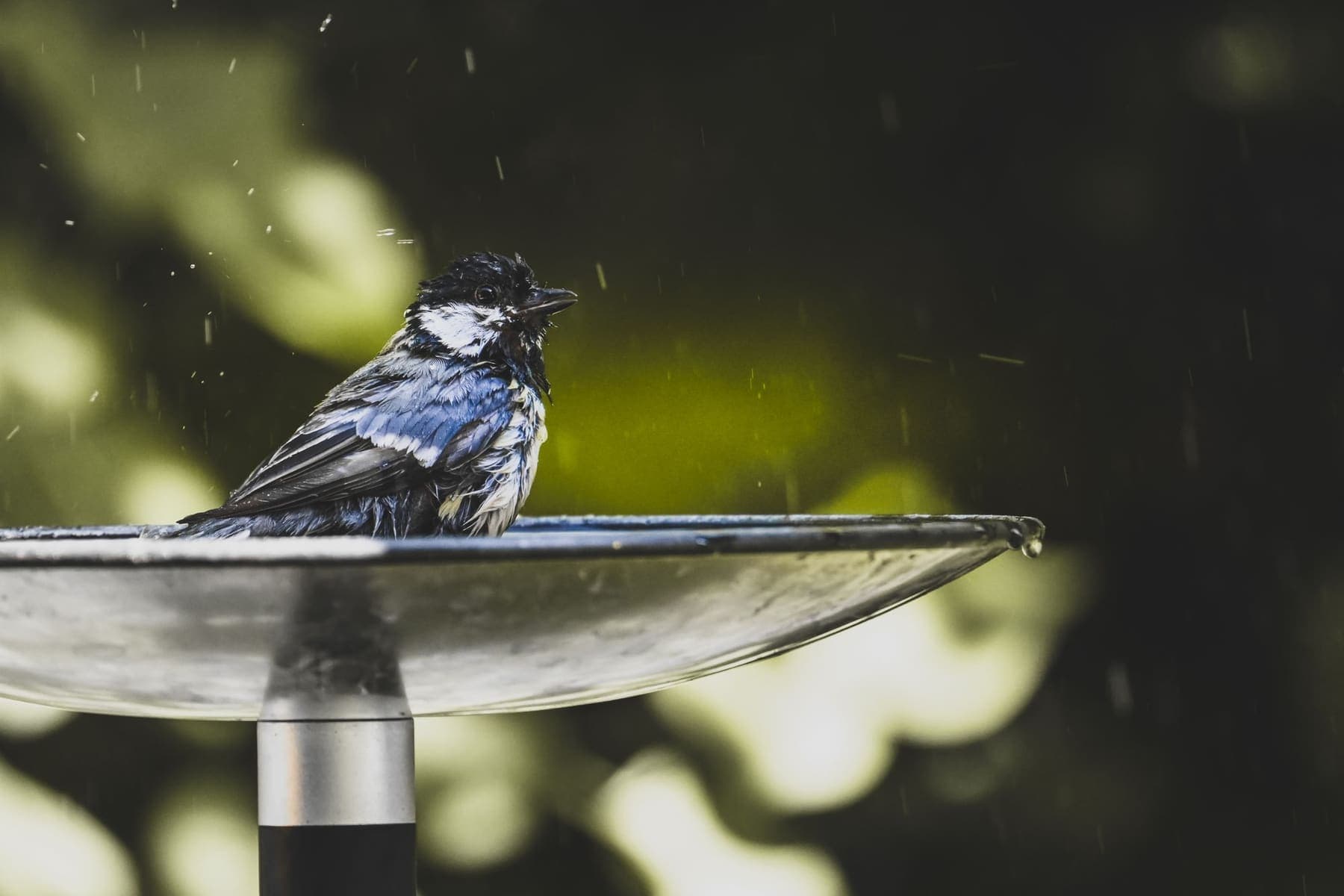
Three stations are better than one. The feeding station gives the seed eaters in winter; the bird bath also draws in those that never eat seed, such as the robin or the warblers, and that is often where the list grows — see a water source for garden birds. The hedge, finally, reveals the most secretive species.
A few rules apply. You watch from a distance, through binoculars, without trying to get closer. You never approach a nest, and you do not play recorded song to draw a bird in: it disrupts the defence of its territory. Feeding is limited to the hard season, from mid-November to the end of March, and never bread or milk — the detail is in feeding garden birds in winter.
Writing down what you see changes everything: the date, the time, the species, the number. After one season the notebook shows arrivals, departures and each bird's habits, and identification becomes far quicker. An illustrated guide paired with a notebook covers exactly that need, as a family or on your own.
To go further with the species easiest to attract, read how to attract tits to the garden. Watching equipment is gathered in the Observation section.
Sources
Frequently asked questions
Which is the commonest bird in French gardens?
The house sparrow, the great tit, the blue tit and the blackbird are among the most widely present species, in towns as much as in the countryside. The exact mix varies with the region, the altitude and the planting around you: a garden surrounded by trees takes more tits, a built-up area more sparrows.
How do I tell a male from a female among garden birds?
It depends on the species. In the blackbird and the house sparrow the difference is obvious: a black male with an orange bill against a brown female, a male with a black bib against a plain buff female. In the great tit the male's belly stripe is broader. In the robin and the wren, the two sexes look identical to the eye.
Which garden birds stay all year round?
Most of those presented here are resident in mainland France: tits, blackbird, robin, sparrow, wren, dunnock. Their numbers do change in winter, though, as birds arrive from the north or the east. The chaffinch is the best example: winter flocks are often swollen by migrants.
Do I need binoculars to identify garden birds?
Not for the ten species in this guide, which are often recognised by outline and behaviour. A light pair of binoculars is still useful for the details, such as a dunnock's bill or a chaffinch's wing bar, and above all for watching without getting closer, which remains the rule.