





Build a hedgehog house: plan, materials and siting
A dimensioned plan, a cutting list, a step-by-step build and where to put an untreated timber hedgehog house: a chamber of at least 30 × 30 cm, a 13 × 13 cm entrance and a baffled tunnel against predators.
In this guide
An effective hedgehog house comes down to four measurements: a chamber of at least 30 × 30 cm, an entrance of 13 × 13 cm, a baffled tunnel 25 to 30 cm long that stops dogs and cats reaching inside, and a sloping roof with an overhang. All of it in untreated timber 18 to 20 mm thick, built in two or three hours, and set in the quietest corner of the garden before autumn. Once it is in place the rule is simple: you do not open it again.
What a hedgehog looks for, and what it avoids
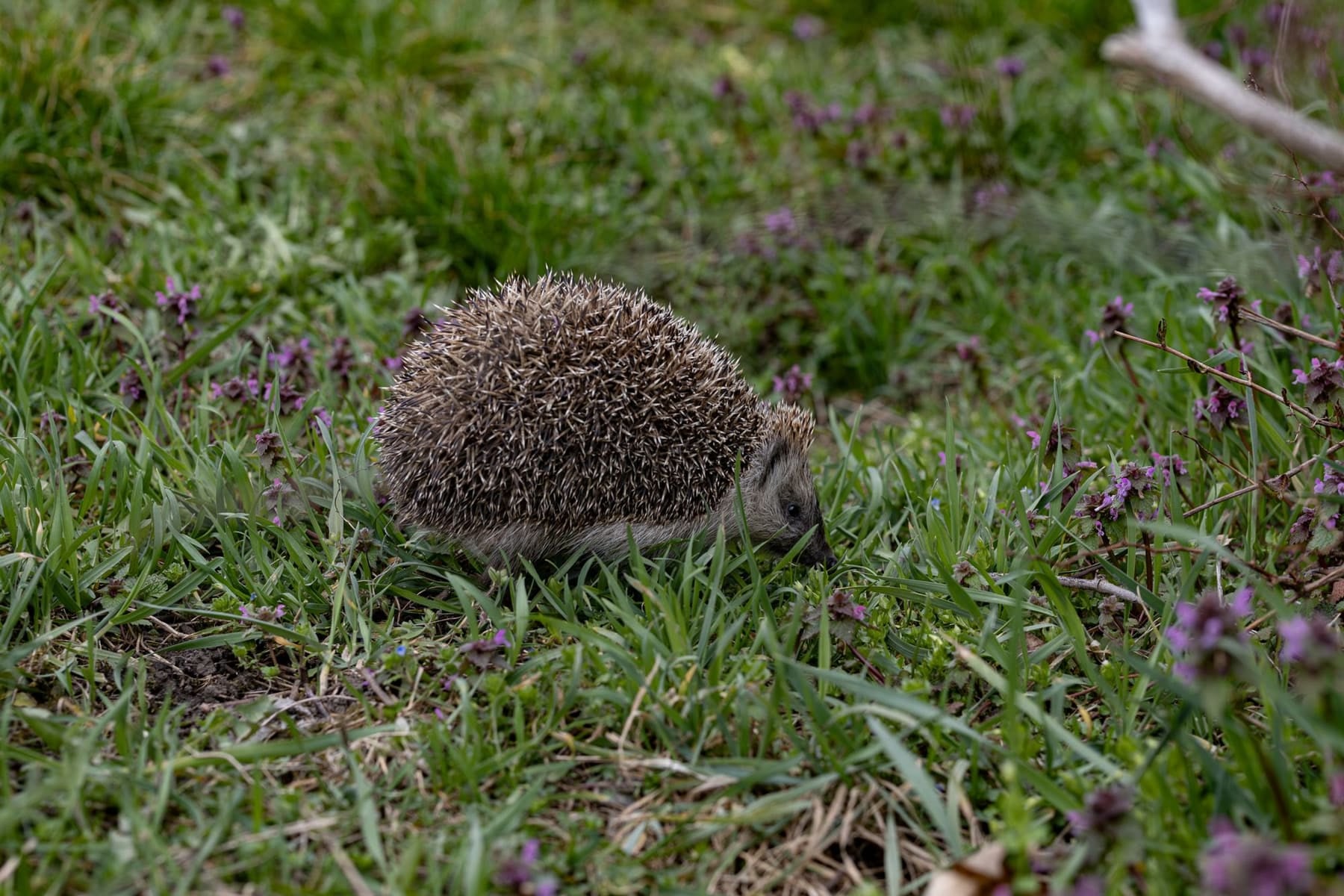
A hedgehog uses three kinds of nest over the year: a day nest through the warm months, a breeding nest in summer, and a hibernation nest from November to March. In a closely tended garden the natural hiding places — leaf piles, hollow stumps, the base of a hedge — have usually gone, and that is the gap a purpose-built house fills.
What it needs: dry, dark, quiet, and a narrow entrance. What it avoids: standing damp, draughts, frequent traffic, and anything that smells of wood treatment.
A word on the law: the hedgehog is a protected species in France under the ministerial order of 23 April 2007. Capturing it, killing it, moving it or deliberately disturbing it is forbidden. A house is offered, it is never closed on an animal, and you do not try to install a hedgehog by force.
The plan and the cutting list
The design below gives an inner chamber of roughly 40 × 44 cm, 25 cm high, reached through a tunnel 13 cm wide and 28 cm long formed by a single internal partition. The dimensions assume 18 mm boards.
| Part | Dimensions | Quantity |
|---|---|---|
| Base | 48 × 44 cm | 1 |
| Sides | 48 × 25 cm | 2 |
| Front and back panel | 40 × 25 cm | 2 |
| Internal partition (baffle) | 28 × 25 cm | 1 |
| Roof | 54 × 50 cm | 1 |
| Battens to raise the base, 25 × 25 mm | 48 cm | 2 |
The rest of the shopping list: 40 mm stainless steel screws, a piece of roofing felt for the roof, a small square of fine wire mesh for the vents, and nothing else. No wood stain, no varnish, no paint, no pressure-treated timber.
The choice of timber matters as much as the dimensions. Untreated spruce, pine or larch 18 to 20 mm thick all work: the thickness insulates the chamber against frost and heat. Avoid ordinary plywood and chipboard, which swell in the first wet season, and any treated timber, whose compounds stay in contact with the animal for months.
Building it, step by step
- Cut and sand every part. Take the sharp edges off, above all around the entrance: a hedgehog goes through it several times a night.
- Cut the entrance in the front panel: a square of 13 × 13 cm, its lower edge flush with the base, pushed up against one of the sides. Round the top corners slightly.
- Screw the two sides onto the base, then the front and back panels between the sides. Screwed, never nailed: no point should come through on the inside.
- Fit the internal partition at right angles to the front panel, 13 cm from the side where the entrance is, running 28 cm deep. The hedgehog goes in, follows this tunnel, then turns to reach the chamber. It is this baffle that makes the inside unreachable for a dog, a cat or a fox.
- Drill two 20 mm vent holes high in the back panel and staple the fine mesh over them on the inside. Without ventilation, condensation sets in; with an unprotected hole, so do wasps and rodents.
- Screw the two battens under the base, parallel to the 48 cm sides. They lift the floor 2 to 3 cm and keep it clear of damp ground.
- Prepare the roof: lay the roofing felt over the 54 × 50 cm board, stapled along the edges, then screw two locating battens underneath that sit inside the walls. The roof stays removable, with an overhang of about 3 cm all round and a slight fall towards the back.
- Weigh the roof down with a flat stone or a brick. It must neither blow off nor be liftable by a dog.
Allow two to three hours for the whole build, and a modest materials budget if you use offcuts of untreated board.
Lining the house, without getting it wrong
A handful of dry dead leaves or straw is enough, dropped into the chamber. The hedgehog will finish the nest itself with whatever it finds nearby.
What never goes in:
- Fabric, wool, cotton or wadding: claws catch in it, and damp stays in it.
- Glass or mineral wool, irritant and dangerous.
- Damp or mouldy hay, a source of respiratory trouble.
- Food. It draws rodents, ants and predators right to the entrance. Feeding stations belong some distance away, and the subject is covered in what to feed a hedgehog.
Where to put it, and how to hide it
The position decides whether it is used, far more than the quality of the woodwork.
- The quietest corner of the garden: under a hedge, against a log pile, behind a border, away from traffic and children.
- On dry, free-draining ground, never in a hollow where water sits after rain.
- Entrance facing south or south-east, back to the prevailing wind, and never facing north.
- Out of reach of an automatic sprinkler and outside the run of a robot mower.
- Camouflaged under branches, dead leaves and perhaps a board leaned against it, leaving the entrance and the vents completely clear. Do not wrap the house in a plastic sheet: the felt on the roof is enough, and plastic makes condensation.
A house on its own is no use if the hedgehog cannot get into the garden. It covers something like 1 to 2 km a night — about a mile, or 1.6 km, according to the British campaign Hedgehog Street — and solid fencing breaks that territory up. Leave openings of about 13 × 13 cm at ground level, the same size as the entrance of the house: big enough for any hedgehog and too small for almost every pet.
Talk to the neighbours: a hedgehog highway is only worth cutting if it opens onto a welcoming garden, and several of them end to end make a real corridor. The full set of features, the hazards to remove and the right response to an animal in trouble are covered in welcoming hedgehogs into the garden.
When to put it out, and when to leave it alone
Put the house out in late summer or early autumn, ideally in September or October. That gives the hedgehog time to find it before hibernation, which runs from November to March depending on the region and the weather.
After that, the rule is one sentence: you do not open it to check. A hedgehog woken in mid-hibernation burns reserves it will not rebuild, and a disturbance during breeding can lead a female to abandon her young, or even to kill them.
- November to March: hibernation. No intervention, and no noisy work close by.
- May to September: births, and young still dependent on their mother. Again, nothing is touched.
- In April, once hibernation is over and before the first litters, a check is reasonable: approach quietly, listen, and lift the roof only if nothing suggests an occupant. Take out the old lining, brush it dry, put fresh dry leaves back, and close it up.
To find out whether the house is being used without opening it, read the outside signs: dark shiny droppings, tracks in the dew, leaves packed down around the entrance. These signs are set out in spotting the signs of a hedgehog in the garden.
The ready-made alternative
Building takes time and assumes a minimum of tools. A shop-bought model in untreated timber, with a built-in baffle and a removable roof, meets the same specification.
The siting rules are exactly the same: quiet corner, dry ground, entrance to the south, camouflage, a lining of dry leaves, and no opening between November and March. A dish of fresh water nearby is useful all year round; never milk, which hedgehogs digest badly.
Houses, highways and accessories are gathered in the Hedgehogs section.
Sources
Frequently asked questions
What should I do if a hedgehog is out in broad daylight?
A hedgehog moving about in the open during the day is almost always in trouble: weakened, injured, dehydrated or orphaned. Handle it no more than you must and do not attempt any treatment yourself, since the species is protected. Contact a wildlife rescue centre, which will tell you what to do. In the meantime leave it undisturbed, in the shade, with a dish of water and never milk.
Which timber should I use for a hedgehog house?
Untreated spruce, pine or larch, in boards 18 to 20 mm thick. The thickness insulates the chamber against swings in temperature, and untreated wood avoids any prolonged contact with chemicals. Rule out ordinary plywood and chipboard, which fall apart in damp, along with pressure-treated timber. The outside can be left bare: only the roof needs roofing felt.
How can I tell the house is occupied without opening it?
The clues are all on the outside: dark, elongated, shiny droppings a few metres away, leaves packed down or moved around the entrance, tracks in the dew or on soft ground first thing in the morning. A trail camera set for the night settles the question with no disturbance at all. Lifting the roof to check is the one thing genuinely to avoid.
Does a hedgehog house sometimes stay empty?
Yes, and that is common in the first year. A hedgehog moves between nests often and only settles where the spot really suits it: quiet, dry, hidden and reachable from neighbouring gardens. Leave the house where it is for at least two or three seasons before drawing conclusions. If it stays empty, move it to a quieter corner and check that there is a gap at the bottom of the fences.