

Attracting sparrows to the garden: what makes them stay
The sparrow lives in colonies and nests in cavities: a 32 to 40 mm entrance hole, several neighbouring boxes, seed in winter, insects in spring, shallow water and a dense hedge. What brings them in, and what drives them away.
In this guide
Three things keep sparrows in a garden: cavities to nest in, insects in spring to raise the young, seed and water for the rest of the year. In practice: a nest box with a 32 to 40 mm entrance hole fixed between 3 and 8 m up, a dense hedge, a patch of grass left to run to seed and a dish holding 2 to 4 cm of water. And one detail that changes everything: the house sparrow lives in colonies, so several neighbouring boxes are worth more than a single one.
Two sparrows in the garden, not one
Before putting anything up, you need to know which of the two is about: they do not ask for the same things.
| House sparrow | Tree sparrow | |
|---|---|---|
| Top of the head | Grey in the male, edged with brown | Entirely chestnut brown |
| Cheek | Pale, with no distinct patch | White with a well-marked black patch |
| Male and female | Clearly different: the female is dull brown with a pale eyebrow | Alike |
| Habitat | Towns, villages, farms, buildings | Farmed countryside, orchards, woodland edges, hedgerow country |
| Entrance hole of the box | 32 to 40 mm | 32 mm |
| Mounting height | 3 to 8 m | 2 to 6 m |
The box dimensions come from the LPO factsheet on passerines; the recommended internal floor is 14 × 14 cm for both species.
Both are protected birds. The French order of 29 October 2009 forbids killing them, destroying their nests and their eggs, and disturbing them deliberately during the breeding season. Blocking up an occupied cavity under a roof is therefore not merely damaging: it is illegal.
One nest box, but several at a time
The house sparrow nests naturally in the gaps of buildings: under a tile, a putlog hole, a roller-shutter box, a cornice. These cavities disappear with every renovation, and that is the first reason it has become scarce in towns.
It nests in colonies, unlike tits, which defend a territory and have to be spaced 15 to 20 m apart. Sparrow boxes can be fixed side by side, or brought together in one unit with two or three compartments under the same roof. An isolated box has far less chance of being adopted.
The mounting rules stay those of every closed nest box:
- Solid timber, thick and rough on the inside, about 2 cm thick, never varnished or treated with preservative.
- No perch below the hole: it serves predators only.
- Entrance hole facing east or south-east, back to the prevailing winds, neither in full sun nor in deep shade.
- Box tilted slightly forward, so that the rain does not get in.
- Put it up in autumn or early winter, so that it is found before spring.
The dimensions species by species, and the fixings that do not harm the tree, are set out in our guide Which nest box should you choose?.
A 32 mm hole sits at the bottom of the house sparrow's range and matches the tree sparrow's exactly. It is also the great tit's diameter: the box will be taken by whichever species finds it first, and that is not something you can decide.
Seed for the adults, insects for the young
The adult sparrow is a seed-eater. But during their first days of life, the chicks are fed on insects: aphids, small caterpillars, spiders. A garden without insects produces no young sparrows, even with a full feeder. That is why insecticides, including those sold for household use, act indirectly on the broods.
As for seed, sparrows look above all for small pale seeds. White millet, hulled sunflower and hulled oats are eaten; wheat and rice, often present in cheap mixes, are largely left and rot on the ground.
Three things to rule out, for every species: no bread, which swells and brings nothing; no milk; no salted, cooked-fat or seasoned leftovers. Feeding is concentrated from November to March; in spring and summer it comes down to small amounts when the weather turns hard. The periods, the quantities and feeder hygiene are set out in feeding birds in winter.
Water, and the dust bath everyone forgets
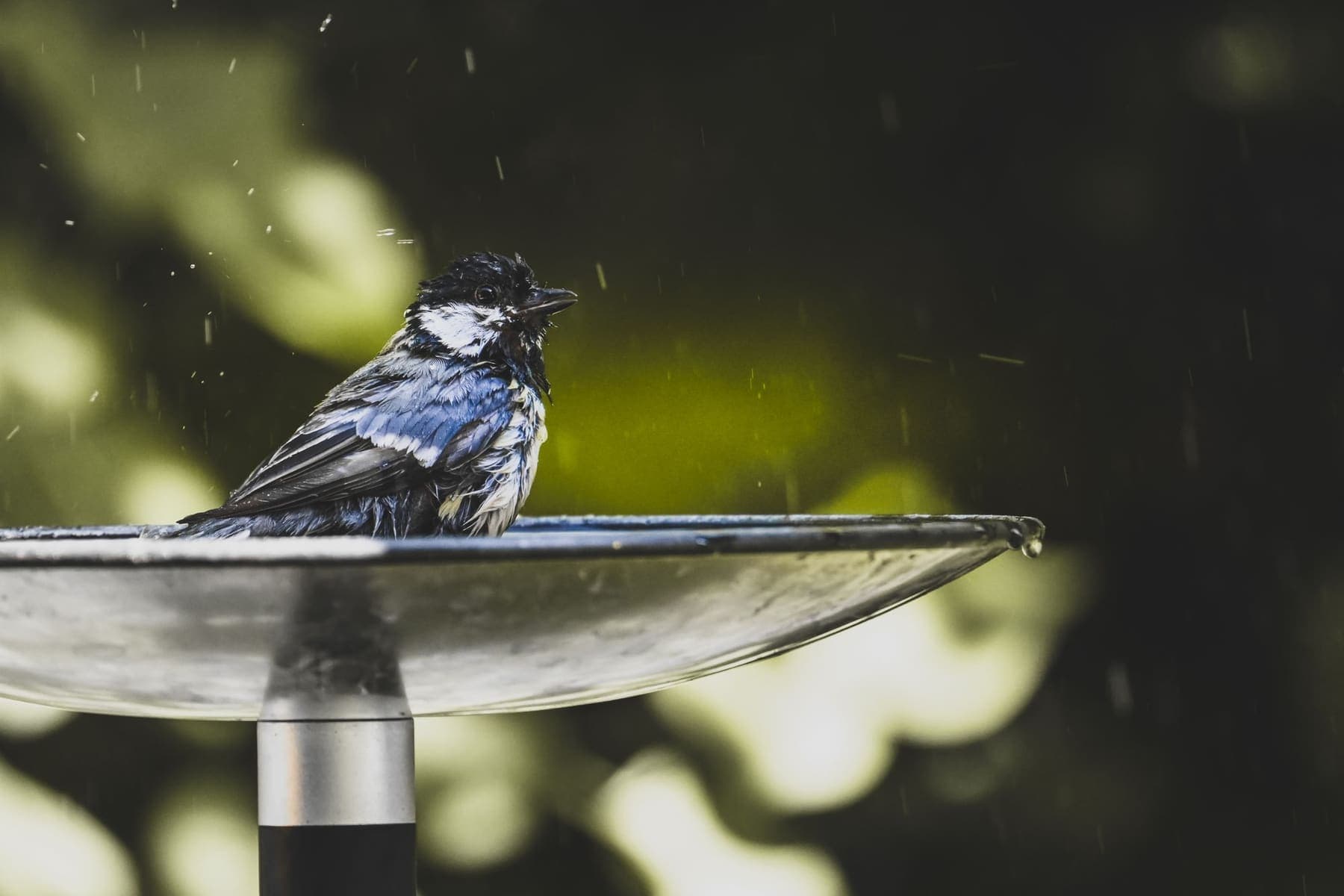
Sparrows drink and bathe every day, winter included.
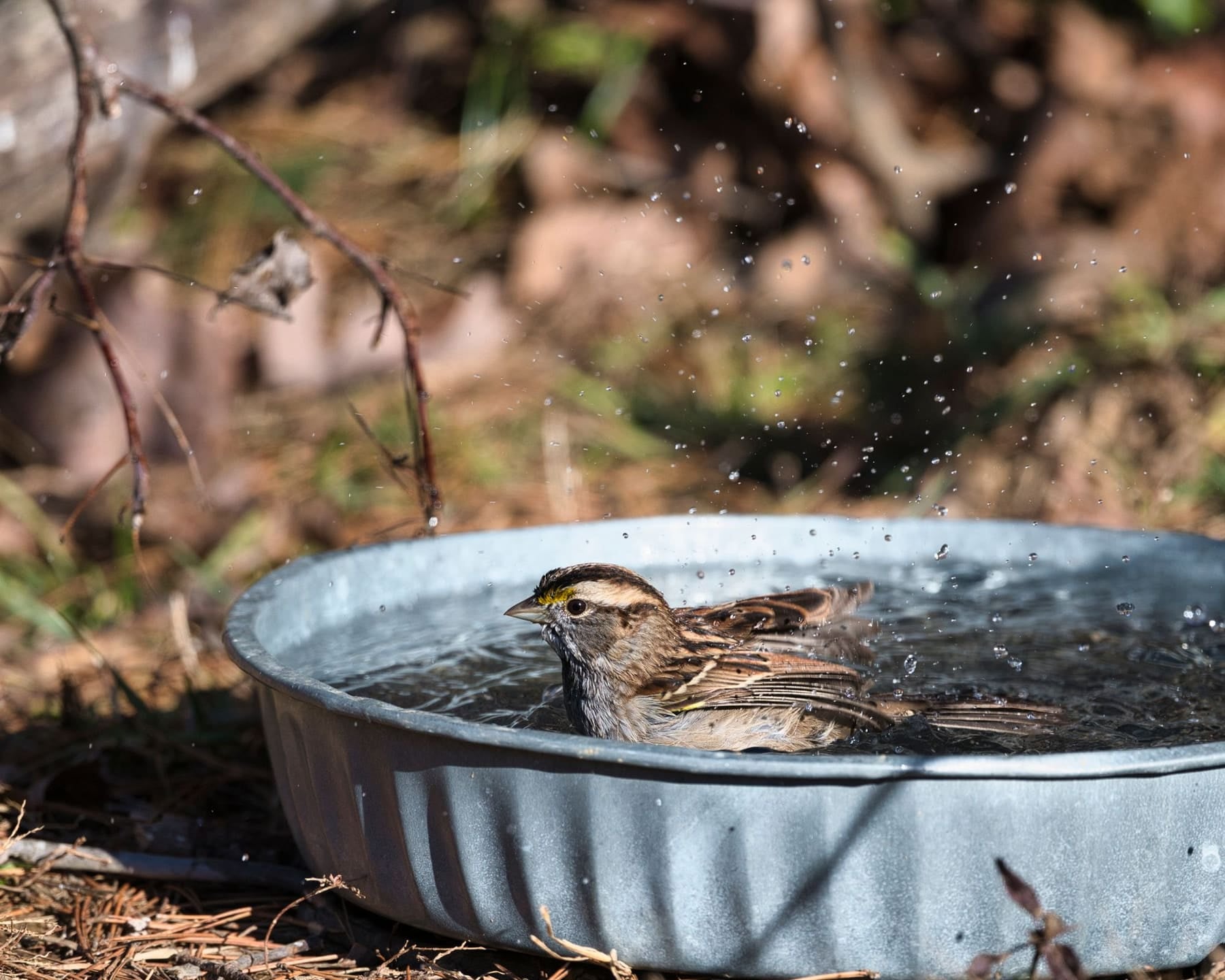
- Set out a wide dish with sloping sides, with 2 to 4 cm of water at its deepest, and a flat stone in the middle so that small birds keep their footing.
- Place it 2 or 3 m from a bush, close enough for them to take cover, far enough that a cat cannot pounce.
- Change the water every two or three days in summer, and scrub the dish in hot water without detergent.
- In winter, break the ice or change the water. Never salt, antifreeze or glycerine: these products damage the plumage and are toxic.
Sparrows also take dust baths, which rid them of part of their parasites. A patch of dry earth or fine sand about 40 × 40 cm, in the sun and left bare, is enough. Setting up a lasting water point is covered in a water point for birds.
The garden that keeps them
The sparrow is gregarious and wary. It needs dense cover to dive into at the first sign of danger and to roost in as a group.
- A hedge of local species, hawthorn, privet, hornbeam, blackthorn, rather than a row of conifers.
- Ivy on a wall or a trunk: a roost in every season, a refuge, and a late flowering much visited by insects.
- A corner of grass left to run to seed, even a single unmown square metre at the end of the garden.
- No pesticides, neither insecticide nor slug pellets.
One last point, often overlooked: sparrows travel very little. They generally range a few hundred metres around their colony, and the essential part of their life fits inside that radius. If the neighbourhood has none left, a nest box will not make them appear; where a colony survives nearby, on the other hand, a well-stocked garden sees it spread fairly quickly.
These principles hold for all the small wildlife of a garden: free-growing hedges, layers of vegetation, no treatments, areas left undisturbed. They are the foundation everything else is grafted onto, and a nest box put up in a sterile garden stays an empty nest box.
What drives them away
Work on façades and roofs is the most frequent cause of a colony being abandoned. Schedule it outside the nesting season, that is, outside the period running from March to August, and provide replacement boxes when cavities are closed for good.
Cats take birds mainly around feeders and low nest boxes. Enough height, a clear trunk and no horizontal branch serving as a gangway cut the risk sharply.
A nest box that is never cleaned ends up serving no purpose. The annual clean is done after the breeding season, in autumn, never during nesting: the method is described in cleaning a nest box.
And lastly, patience. A colony does not move in one season. Allow two or three years before judging a site, and move the box only if it has stayed empty all that time.
Nest boxes, feeders and drinkers are gathered in the Birds section.
Sources
Frequently asked questions
Why have the sparrows disappeared from my neighbourhood?
Three causes usually add up: the loss of nesting cavities when façades and roofs are renovated, the decline of the insects the chicks depend on, and the hard-surfacing of gardens, which removes hedges, rough grass and water. A nest box on its own does not make up for those three gaps; all three have to be addressed at the same time.
Is the sparrow a protected species?
Yes. Both the house sparrow and the tree sparrow are among the birds protected by the French order of 29 October 2009. It is forbidden to kill them, to destroy or remove their nests and their eggs, and to disturb them deliberately during breeding. Work that seals up occupied cavities must therefore be moved outside that period.
Can sparrows use a tit box?
Yes, as soon as the entrance hole reaches 32 mm, which is the great tit's diameter and the bottom of the sparrow's range. A 26 to 28 mm hole, meant for the blue tit, stays out of reach for them. You do not get to choose the species that moves in: first come, first served.
Should sparrows be fed all year round?
No. Feeding is useful from November to March, when natural resources run short. In spring and summer the parents need to find insects for their chicks, and a continuous supply of seed does not help them do that. Small amounts remain possible during spells of hard weather, as long as the feeder is kept clean.