

Red Cherry shrimp breeding: male or female, eggs and young
Telling a male from a female, spotting a berried female, providing the right conditions and protecting the young: the guide to supporting a Red Cherry colony.
In this guide
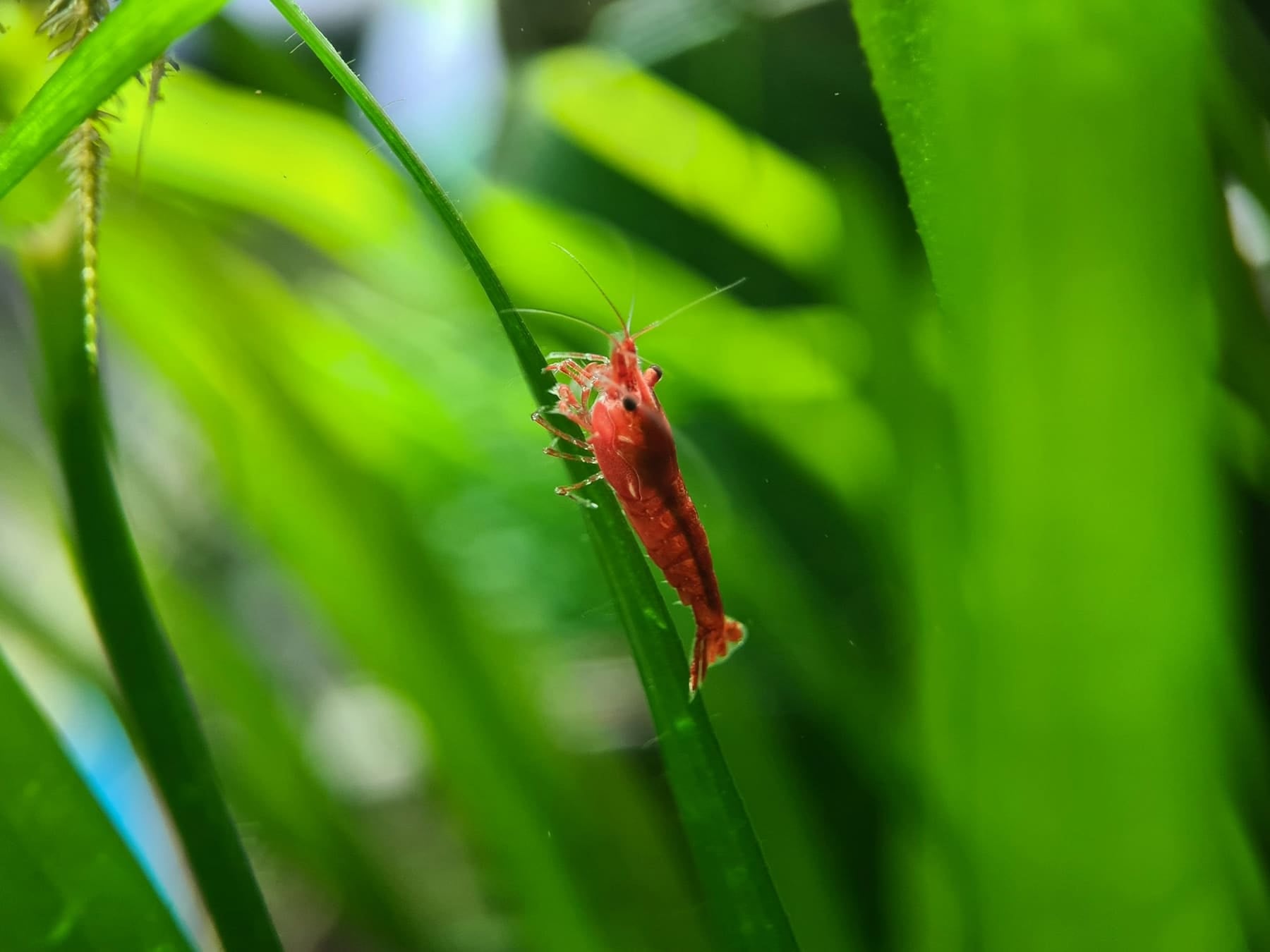
Red Cherry shrimp (Neocaridina davidi) breed on their own in a freshwater aquarium, without any special equipment: they need a cycled tank, stable water and adult males and females. The female is recognisable by her slightly larger size and by the "saddle", a yellow or greenish patch visible on her back. Once fertilised, she carries her eggs under her abdomen for around three weeks, then the young hatch already fully formed, like miniature shrimp. Here's how to recognise each stage and support the colony.
How do you tell if a Red Cherry is male or female?
In young shrimp, it's impossible to tell by eye. In adults, three clues combine.
Size and shape
Females are larger. A summary from the U.S. Fish and Wildlife Service gives an average size of around 25 mm for females and 20 mm for males. The female also looks stockier, with a wider abdomen: that's where she'll carry her eggs. The male is slimmer and more elongated.
The saddle
This is the most reliable clue. The female's developing ovaries are visible through the shell, behind the head, as a yellow or green patch. Aquarists call it the "saddle". A female carrying a saddle is preparing to spawn. A male never has one.
Colour
In red varieties, adult females are often more intensely coloured than males, which look paler or more translucent. It's a useful clue, but less reliable than the saddle: colour also varies with age and bloodline.
What does a berried female look like?
A shrimp is said to be "berried" when she's carrying eggs. They form a tight cluster under her abdomen, between her swimming legs. The female regularly fans these legs to oxygenate and clean her brood. According to the same US summary, a clutch generally holds 43 to 60 eggs.
A few habits to adopt:
- Don't move her. Catching her with a net and a sudden water change stresses her, and a stressed female can drop her eggs.
- Keep the water stable. No large water changes, no new products during incubation.
- Watch the heat. In a study published in PLOS One, females kept at 32°C all lost their eggs. A hot summer in an attic room is a real risk for a small volume.
A young female may sometimes lose her first clutch. This isn't a cause for concern if the following ones make it to term.
What conditions favour breeding?
Red Cherry shrimp don't need any special setting to breed. Above all, they need to be left undisturbed.
- A tank that has finished its cycle. No trace of ammonia or nitrites. Our guide to the nitrogen cycle explains how to check.
- A stable temperature, within the species' usual range. There's no need to heat strongly to "stimulate" the shrimp. The data is even mixed: in experimental breeding, a temperature of 28°C gave the best results, while a study on wild populations found the highest proportion of berried females between 15 and 20°C. What matters is the absence of sudden swings and excess heat.
- Both males and females. A group of ten shrimp gives good odds of having both sexes. With three or four individuals, nothing guarantees it.
- Varied food, without excess. Biofilm on plants and rocks makes up most of their diet. A supplement, in small amounts eaten within a few hours, is enough.
- No copper at all. Check the composition of fertilisers and treatments: copper is toxic to shrimp.
After a female moults, it's common to see males swimming excitedly all over the tank. They're searching for her: a sign that mating is about to happen.
From egg to young shrimp: how long does it take?
Incubation
Eggs hatch after 16 to 19 days according to the U.S. Fish and Wildlife Service summary. The PLOS One study shows that this duration depends on temperature: around 21 days at 24°C, less when the water is warmer. So allow about three weeks.
Birth
Neocaridina have direct development: there's no larval stage. The young emerge from the eggs already in their final form, tiny and translucent, and immediately head to the bottom to graze on biofilm. This is what makes their breeding so simple in an aquarium. In experimental breeding, a female produced a little over twenty young per clutch on average.
Growth
The young grow by moulting regularly and take on their colour over the weeks. Sources differ on the age of first breeding: around one month according to one summary, around fifty days for the first berried females in the PLOS One study. Keep in mind that the next generation can breed within a few weeks to a few months. One published estimate puts their lifespan at around ten to fifteen months.
How do you protect the young shrimp?
The filter
A young shrimp only a few millimetres long can be sucked into a filter intake. Cover the water inlet with a fine sponge, or choose a sponge filter. Our comparison Which aquarium for freshwater shrimp? covers the options in detail.
Hiding places
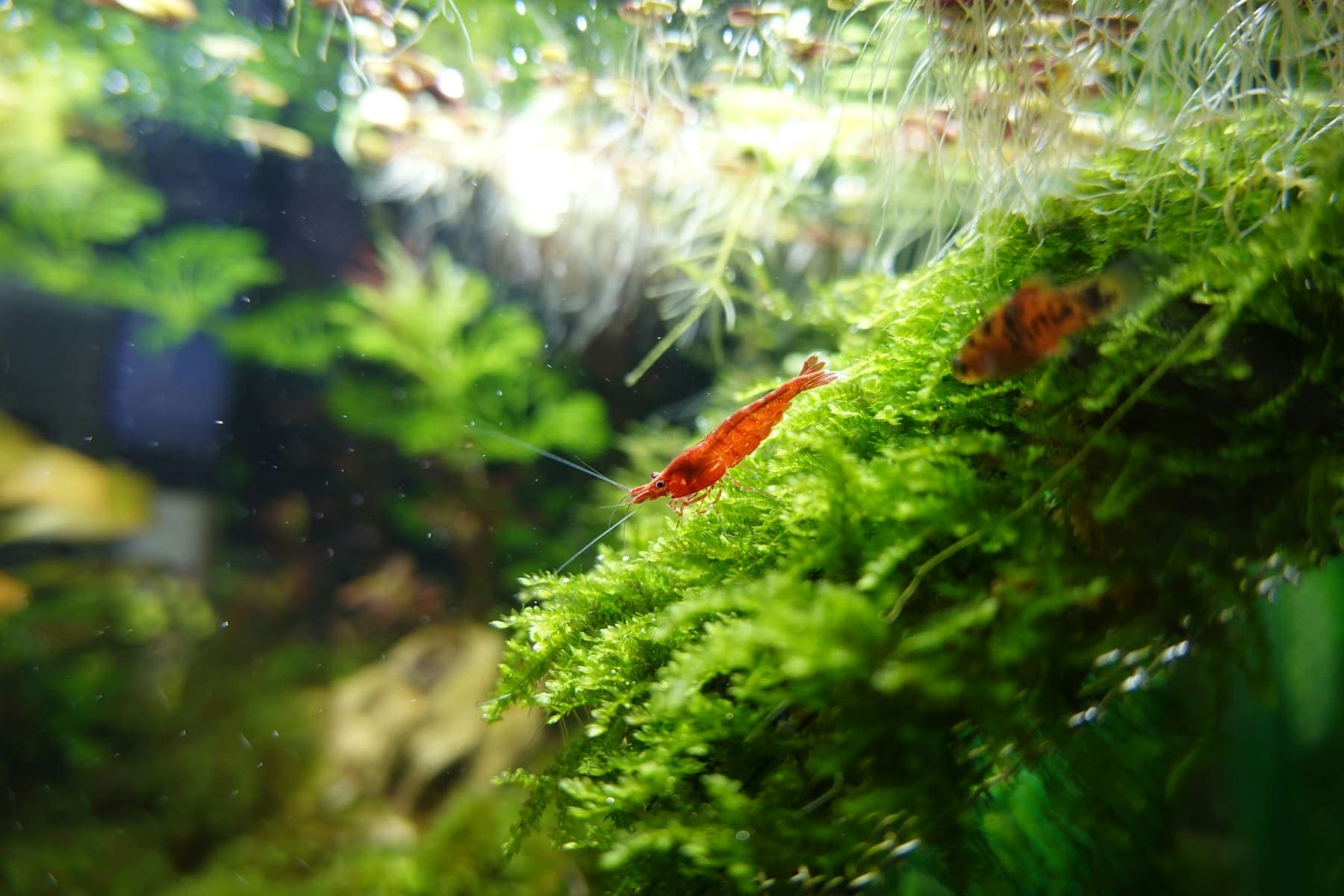
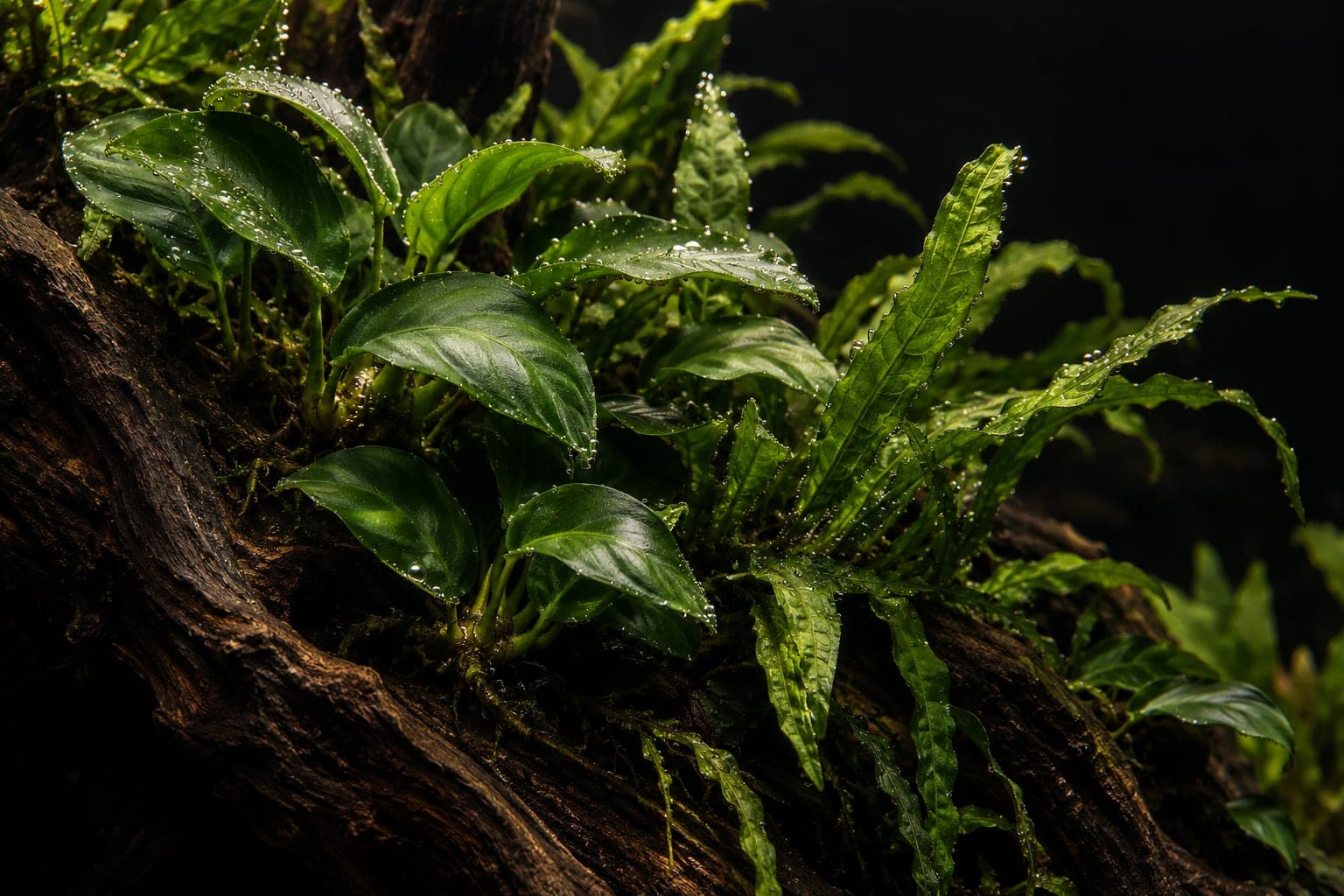
Dense planting protects the young and gives them something to eat. Java moss is ideal: it attaches to a rock or root, holds biofilm, and forms a refuge that the manufacturer Tropica specifically recommends for breeding tanks.
Fish
Most fish, even small ones, eat young shrimp. If you want to watch a colony grow, keep a shrimp-only tank. In a shared aquarium, only the young hidden in the densest plants will survive.
Maintenance
Change the water in small amounts, with conditioned water at the same temperature. When siphoning, watch the tube: a young shrimp easily gets drawn into it. Filter the removed water into a clear bucket before pouring it away.
Why aren't my Red Cherry shrimp breeding?
- Only one sex in the tank, especially with a small group.
- Shrimp that are too young: give them a few weeks after arrival.
- A tank that's too new or unstable: temperature or water-quality swings slow breeding.
- Water that's too warm: clutches abort.
- Fish eating the young as soon as they're born, which can wrongly make you think there are none.
- A product containing copper, in a fertiliser or treatment.
Equipment for a colony
To get started, a batch of ten shrimp in a cycled, well-planted tank is enough. Java moss provides both hiding places and biofilm for the young.
The project A nano shrimp tank brings together the tank, substrate, plants and start-up steps.
The shrimp section presents suitable animals and food. If you're still unsure about the species, read our comparison Neocaridina or Caridina.
What should you do when the colony grows too large?
In a tank that suits them, Red Cherry shrimp eventually become numerous. Several solutions exist:
- Give away or trade your shrimp with other aquarists, a club or at a swap meet.
- Set up a second tank, also cycled, to move part of the colony into.
- Never mix in another colour to "refresh" the group: Neocaridina varieties interbreed, and the offspring revert towards the wild form's colour, translucent or brownish-green.
Never release shrimp into the wild, not into a pond, a stream, or down the toilet. Populations of Neocaridina davidi have already established themselves outside their native range, including in France, in the thermal waters of Juvignac near Montpellier. These shrimp can also carry parasites: a microsporidian shrimp parasite has been detected in a wild population established in Germany. For advice on choosing a species and a starting number, also see Which shrimp for a nano-aquarium?.
Sources
Frequently asked questions
Can a Red Cherry shrimp breed without a male?
No. An isolated female may show a saddle, since her ovaries are developing, but without mating with a male there will be no young. A group of around ten shrimp gives good odds of having both sexes.
Should you isolate a berried female Red Cherry?
It isn't necessary, and it's often counterproductive: catching her and changing the water stresses her and can make her drop her eggs. In a tank with no fish, leave her where she is.
Can you keep Red Cherry with Blue Dream or Yellow shrimp?
Better to avoid it. These are varieties of the same species, and they interbreed. Over generations, the young lose their parents' colour and revert towards a brown or translucent shade.
How many Red Cherry shrimp do you need to start a colony?
About ten adults is a good start for a well-planted, cycled tank of 20 to 30 litres. The colony will then grow on its own if the water suits it.