

Attracting ladybirds, the answer to aphids
Recognising the larva, telling the seven-spot from the harlequin ladybird, planting the umbellifers that bring them in and leaving them somewhere to overwinter: how to settle this beneficial insect in the garden for good.
In this guide
Ladybirds turn up on their own as soon as three conditions are met: aphids to eat, pollen and nectar flowers for the adults, and somewhere to spend the winter. So the most effective thing you can do is not to buy any, but to stop using insecticides and to leave a corner of dead leaves and dry stems in the garden. The second thing, just as useful: learn to recognise the larva — long, dark and spotted with orange — which is far too often crushed in the belief that it is a pest.
What a ladybird really eats
The seven-spot ladybird, like most native species, preys on aphids at every stage of its life. It also eats scale insects, mites and the eggs of other insects.
The figures get quoted a great deal and they vary enormously. You will commonly read 50 to 100 aphids a day for an adult, and several hundred eaten by a larva over the course of its growth. Those values depend on the species, the temperature, the size of the aphids and how many there are: read them as an order of magnitude, not as guaranteed performance.
One practical consequence matters more than the figure: the ladybird arrives after the aphids, never before. The female lays precisely where a colony is already established, because her larvae move very little and have to find food on the spot. A garden without a single aphid in spring will have no ladybirds in June. Tolerating the first colonies is therefore the condition for any balance.
Recognising the larva, the one crushed by mistake
It is the larva that does most of the work, and it is the larva that almost nobody identifies.
| Stage | Appearance | Indicative duration |
|---|---|---|
| Egg | Small yellow-orange spindle, standing upright, laid in batches of 10 to 50 under a leaf | 3 to 8 days |
| Larva | Elongated, grey-black, bristly, marked with orange spots; 1 to 10 mm depending on age | 2 to 4 weeks, over three or four moults |
| Pupa | Motionless, rounded, orange and black, stuck to a leaf or a stem | about 1 week |
| Adult | Domed, coloured wing cases; pale and without clear spots in the first few hours | several months |
The durations are given as ranges because they depend above all on temperature: the full cycle takes four to eight weeks in summer, longer in cool weather. Two or three generations usually follow one another in a season.
Fix the outline of the larva in your mind: a small dark alligator, spotted with orange, moving quickly along stems covered in aphids. It does not bite, it eats no plant material, and it disappears at the first spray.
Seven-spot or harlequin ladybird?
Two species dominate our gardens today, and confusing them has consequences.
- The seven-spot ladybird, a native, measures 5 to 8 mm, red with seven black spots and two small white marks either side of the head. Its pattern is consistent.
- The harlequin ladybird, introduced into Europe for biological control and since naturalised, measures 6 to 8 mm and comes in highly variable forms: orange to black, with 0 to 19 spots, often with a black M-shaped mark on the white pronotum. It gathers in large numbers inside buildings in autumn, and it competes heavily with several native species.
The direct consequence: do not buy larvae without knowing which species they are, and never release harlequin ladybirds. Releases of beneficial insects, even native ones, are in any case rarely lasting in an ornamental garden: the adults scatter quickly if the supply of aphids and flowers is not already there. Building the habitat gives firmer results than repeating purchases.
The flowers that bring the adults in
Adult ladybirds top up their diet with pollen and nectar, particularly before laying and on coming out of winter. They look for flat flowers with short, accessible corollas.
- Umbellifers first of all: dill, fennel, coriander, wild carrot, yarrow. Let a few plants in the vegetable bed run up to flower instead of harvesting them all.
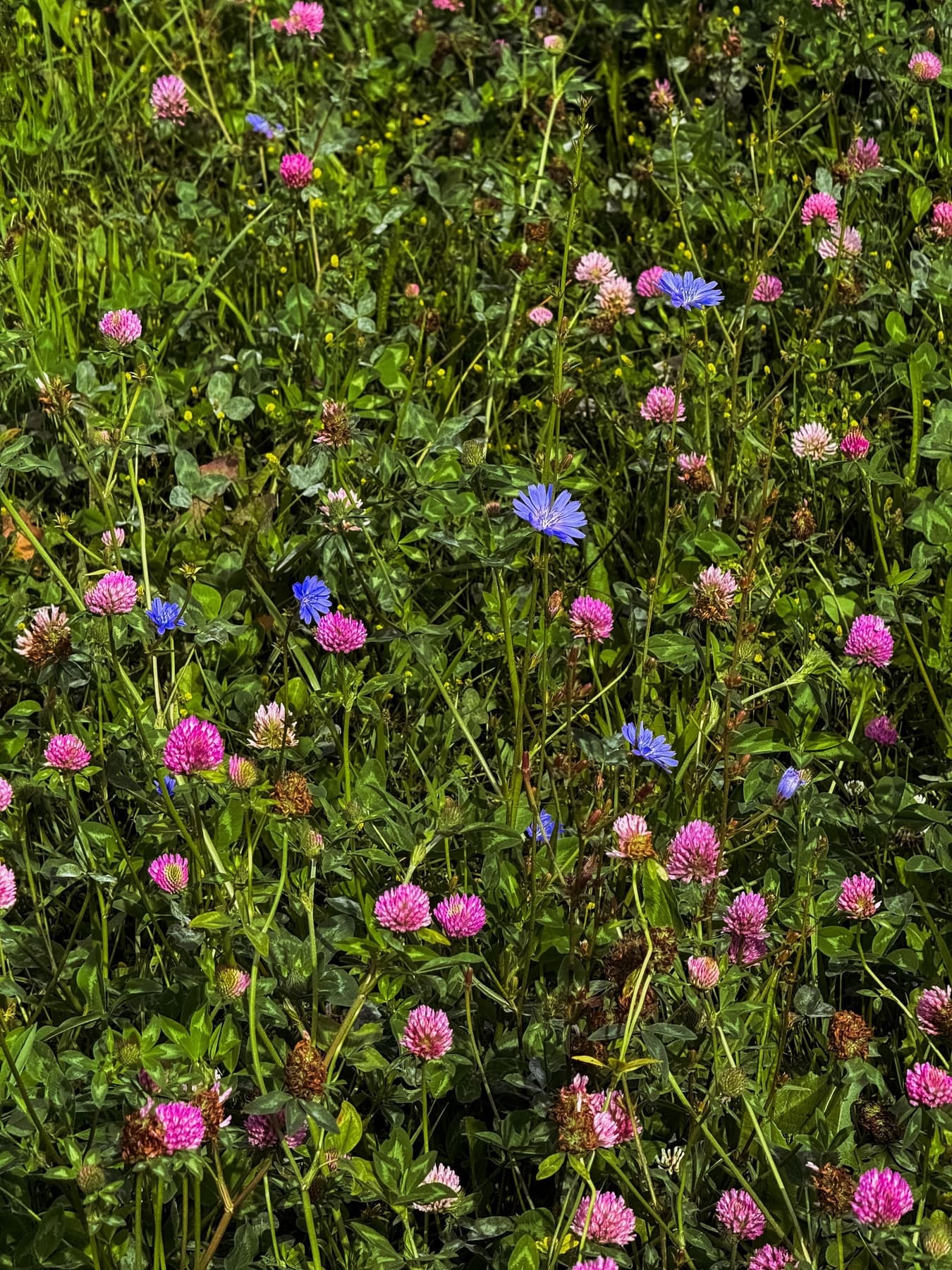
- The flowers of poor grassland: knapweed, field scabious, oxeye daisy, oregano, clover.
- The nasturtium, which plays a different role: it attracts black aphids and acts as a trap plant where ladybirds find somewhere to lay, away from your crops.
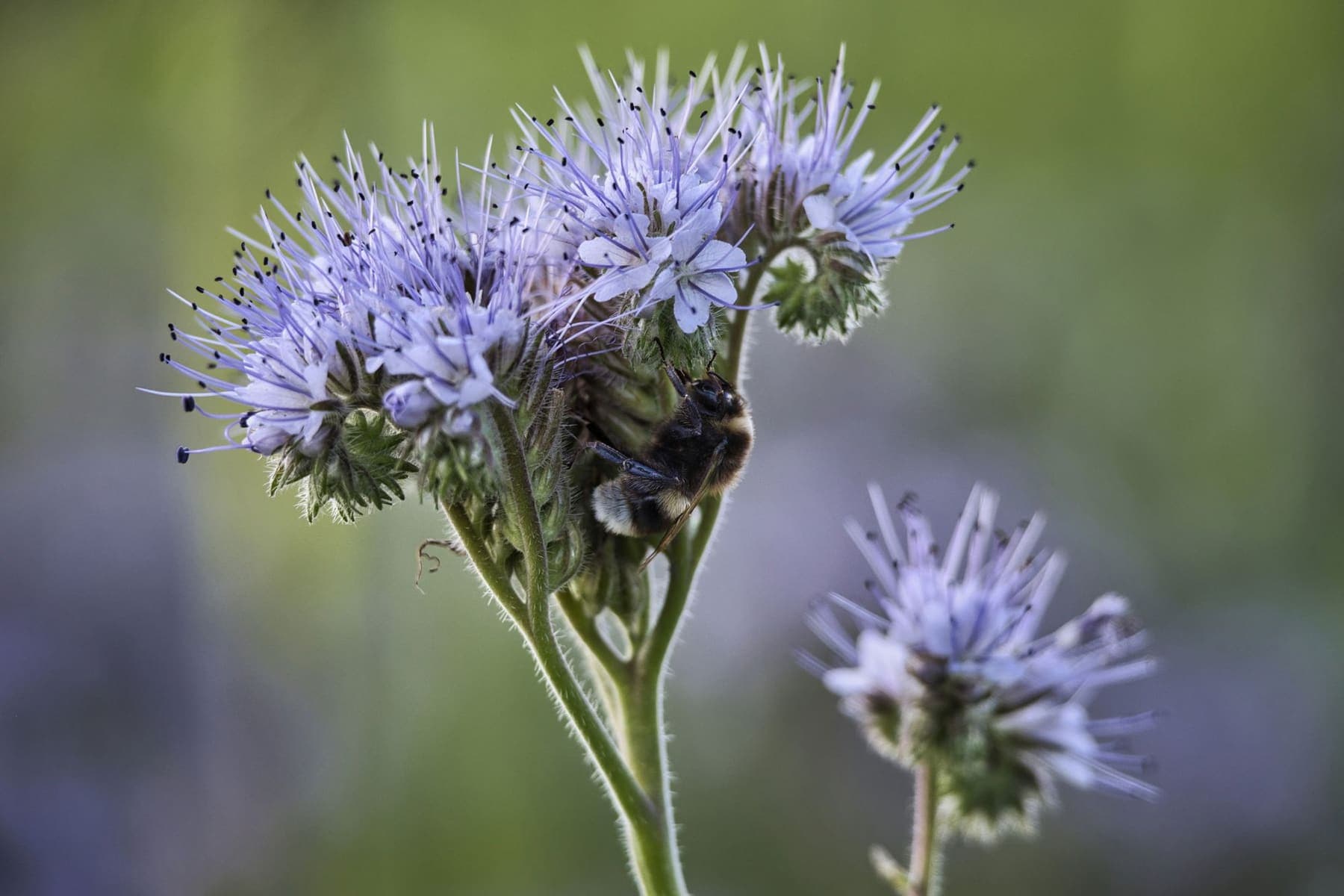
- Phacelia, much visited for its pollen and nectar, and easy to sow in a strip along a vegetable bed.
It is sown from March to September, broadcast at 1 to 1.5 g/m² and covered with about 1 cm of soil; germination takes 7 to 10 days and flowering comes six to eight weeks after sowing. Sowing in succession keeps the supply going all summer. One point of honesty: phacelia comes from California, it is not a native species. For a lasting base of native plants, pair it with a wildflower mixture, as explained in plants for pollinators and sowing a nectar-rich wildflower meadow. Its use in the vegetable garden as a green manure is covered in phacelia as a green manure.
Where they spend the winter, and why you should not tidy everything away
Adult ladybirds overwinter, often in groups of several dozen individuals, sheltered from frost and damp: under loose bark, in leaf litter, in the heart of a tussock of dry grass, inside a hollow stem, under a stone or in a crack in a wall.
The things that count come down to four lines:
- Do not clear the garden thoroughly in autumn. Dead leaves under the hedge, the dry stems of perennials, a log pile: that is where winter survival is decided.
- Leave a strip of long grass along a hedge or a wall, cut once a year and no more.
- Keep bark and dead wood rather than carting them away.
- Do not move an overwintering group found in a garden shed: it would burn its reserves for nothing.
An insect hotel can add to these natural shelters, as long as you remember what it is: a supplement, placed among flowers, not a substitute for a wild corner of the garden.
Its slotted panels act as a winter refuge for ladybirds and lacewings, while the hollow stems take solitary bees. Position is everything: face south or south-east, back to the prevailing wind, the lowest compartments about 1 m off the ground, near nectar-rich flowers. The most common siting mistakes are reviewed in setting up an insect hotel properly.
What makes them disappear
- Insecticides, without exception. Pyrethrum and pyrethroids kill ladybirds and their larvae just as surely as they kill aphids, and leave the garden with no natural regulation afterwards.
- Insecticidal soft soap sprayed over a whole colony. It is useful as a very localised treatment, but applied everywhere it also wipes out the beneficial larvae on the same stems.
- Wiping out every last aphid, which deprives ladybirds of their food and of their egg-laying sites.
- Ants, which actively farm and defend aphid colonies against predators. A grease band round the trunk of a fruit tree, outside periods of frost, limits their access without any product.
- The close-shaved garden, with no wildflowers and no untended area.
All the shelters and features for beneficial insects are gathered in the Insects section.
Sources
Frequently asked questions
Is it worth buying ladybird larvae to deal with aphids?
In an ornamental garden it is rarely the best investment. Adults from a release scatter quickly if flowers and shelter are missing, and the effect lasts no more than a season. At the very least, check which species is being sold and refuse any harlequin ladybird. Planting umbellifers, sowing a wildflower meadow and keeping a corner of dead leaves gives a longer-lasting result for far less money.
Do ladybirds sting or bite?
They do not sting. Some species, and the harlequin ladybird above all, can nip the skin lightly with their jaws when held in the hand, with no consequences. Disturbed, a ladybird does release a yellow, strong-smelling droplet from its leg joints: that is a defensive fluid, which stains light-coloured fabric but is otherwise harmless. Better to set the insect down on a leaf than to pick it up.
Are the ladybirds that come indoors in autumn a problem?
They are almost always harlequin ladybirds, which gather on pale walls and work their way into lofts or window frames to overwinter. They do not sting and they damage nothing, but they can stain walls. The simplest answer is to collect them gently with a glass and a sheet of paper, and put them in a dry, unheated shelter outside.
Are ladybird houses any use?
Their effectiveness is modest, and they are often ignored in favour of natural shelters. A litter of dead leaves, a piece of loose bark or a tussock of dry grass offers better overwintering conditions. A shop-bought shelter can have educational value or round out an insect hotel, but it is no replacement for a corner of the garden left alone.