Artificial terrarium: a good idea? How to make it look real
Artificial plants, preserved moss and glass: a terrarium with no water or light. Where it is the right answer, how to put it together, and its limits.
In this guide
An artificial terrarium is a good idea where a living terrarium would fail: a windowless room, an office where nobody waters, full sun that would cook plants under glass. You make it with realistic artificial plants, preserved moss and a glass container, with no water or soil. Its only upkeep is dust. Its limit: it does not move or grow, and a careful eye spots it up close.
Living or artificial: the table
| Criterion | Living terrarium | Artificial terrarium |
|---|---|---|
| Light | Bright, no direct sun | None |
| Water | Rare, but necessary | None |
| Maintenance | Pruning, occasional airing | Dusting |
| Change over time | Grows, changes, fills out | Stays the same |
| Container | Closed or open, depending on the plants | Open or cloche, no constraint |
| Where to put it | Near a window | Anywhere, except prolonged direct sun |
If you are unsure, our comparison artificial or real plant goes through every room in the house.
Making an artificial terrarium that looks real
- Choose simple glass: a cloche, a globe, a low bowl. The glass sets the scene, it should stay plain.
- Make a ground: sand, small gravel or bark, 2 to 3 cm deep. A bare bottom gives the game away.
- Lay preserved moss in irregular patches, not as a uniform carpet.
- Add the artificial plants at different heights, the tallest at the back.
- Leave empty space: a third of the surface with nothing, as in a real landscape.
- Finish with a natural detail: a stone, a piece of driftwood, a pine cone.
Mini artificial succulents work well for this: their shapes are close to the real thing, and a succulent stays still even when alive.
Preserved reindeer moss gives the green relief of woodland, with no water.
Our guide realistic artificial plants lists the seven details that make people believe it is real.
The container
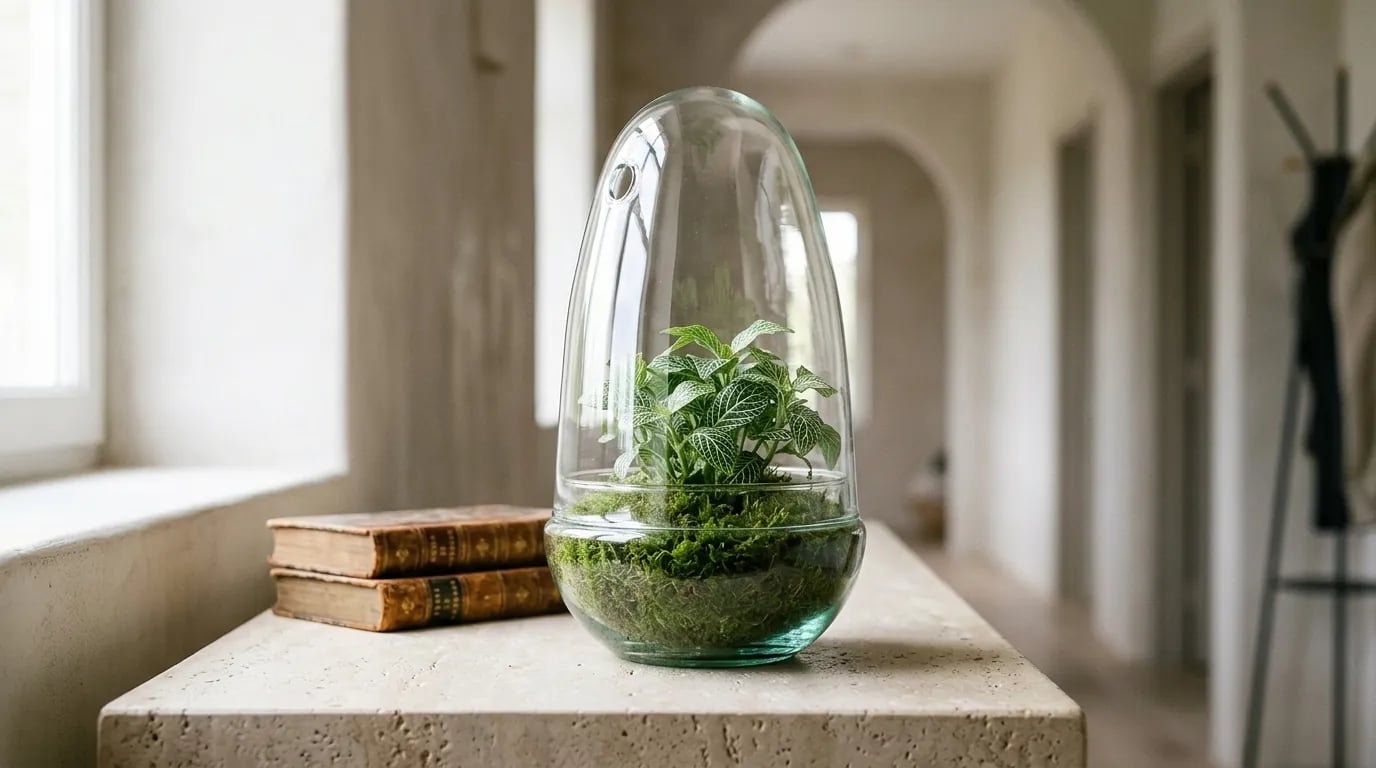
A glass cloche is the simplest container: you arrange everything on a tray and put the cloche over it. Our Egg cloche is 25.5 cm tall.
Display ideas are in our guide to decorative glass cloches.
Maintenance
- Dust once a month with a dry brush or a hairdryer on the cold setting.
- Do not wet preserved moss: water stains and hardens it.
- Avoid direct sun behind a window for months: some materials fade.
And if you want something living without the fuss
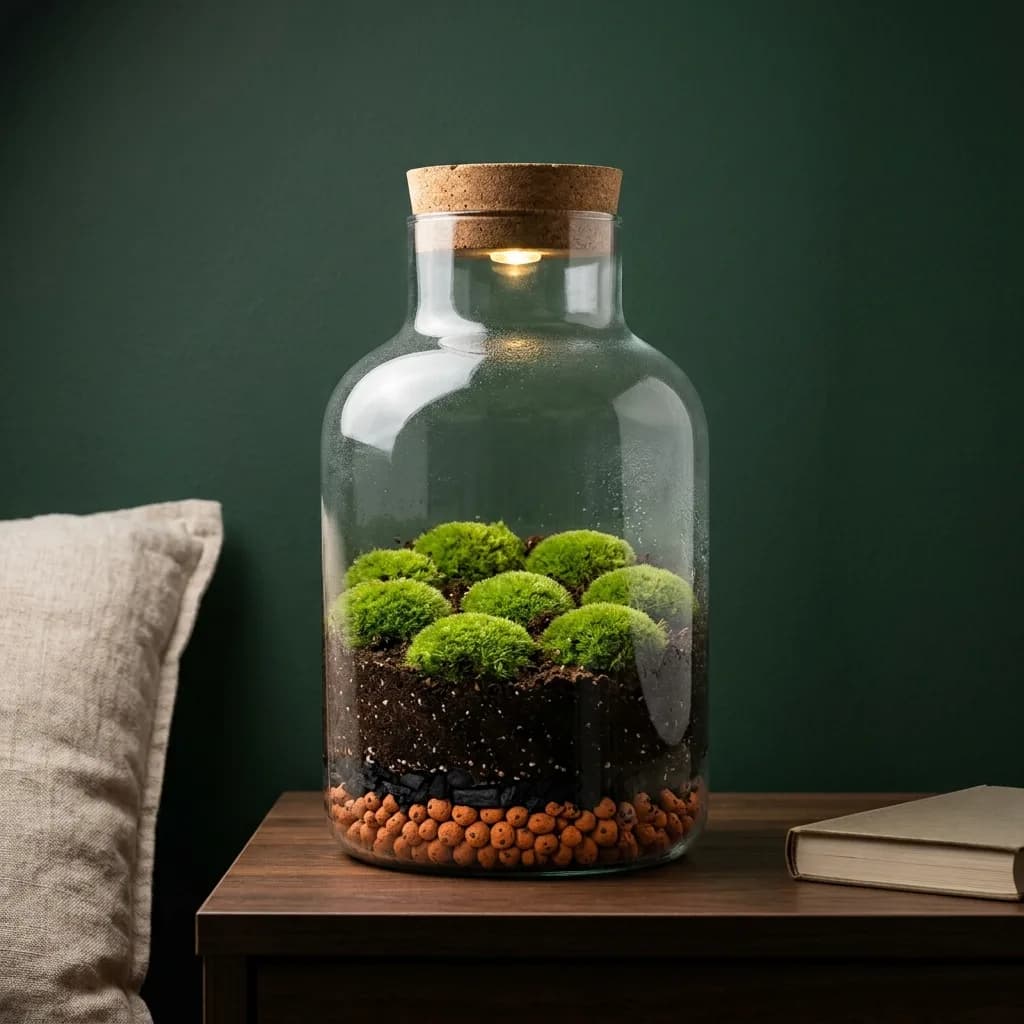
Live moss is the most tolerant terrarium plant: it copes with little light and needs no watering in a closed jar. Our Mousse & lumière kit is the easiest living terrarium to get right, with an LED cork for the evening.
Our guide live or preserved moss helps you choose between the two.
In short
- An artificial terrarium suits places where a living one would not last.
- Ground, preserved moss in patches, different heights and some empty space: that is what makes it believable.
- Maintenance: dust, nothing else.
- No humidity: it is not sealed like a living jar.
Frequently asked questions
Does an artificial terrarium need maintenance?
Almost none: no water, no light, no pruning. You just need to dust it from time to time, with a dry brush or a hairdryer on the cold setting. Preserved moss must not get wet.
Where should you put an artificial terrarium?
Where a living terrarium would not last: a windowless room, a high shelf, a shared desk, a shop, full sun. Just avoid prolonged direct sun, which can fade some materials.
Can you mix artificial and living plants?
In an open terrarium, yes, if the living plant stays dry, like a succulent. In a closed terrarium, humidity damages preserved moss and some artificial plants: keep them apart.