Plant moisture meter: insert the probe, read the dial, know when to water
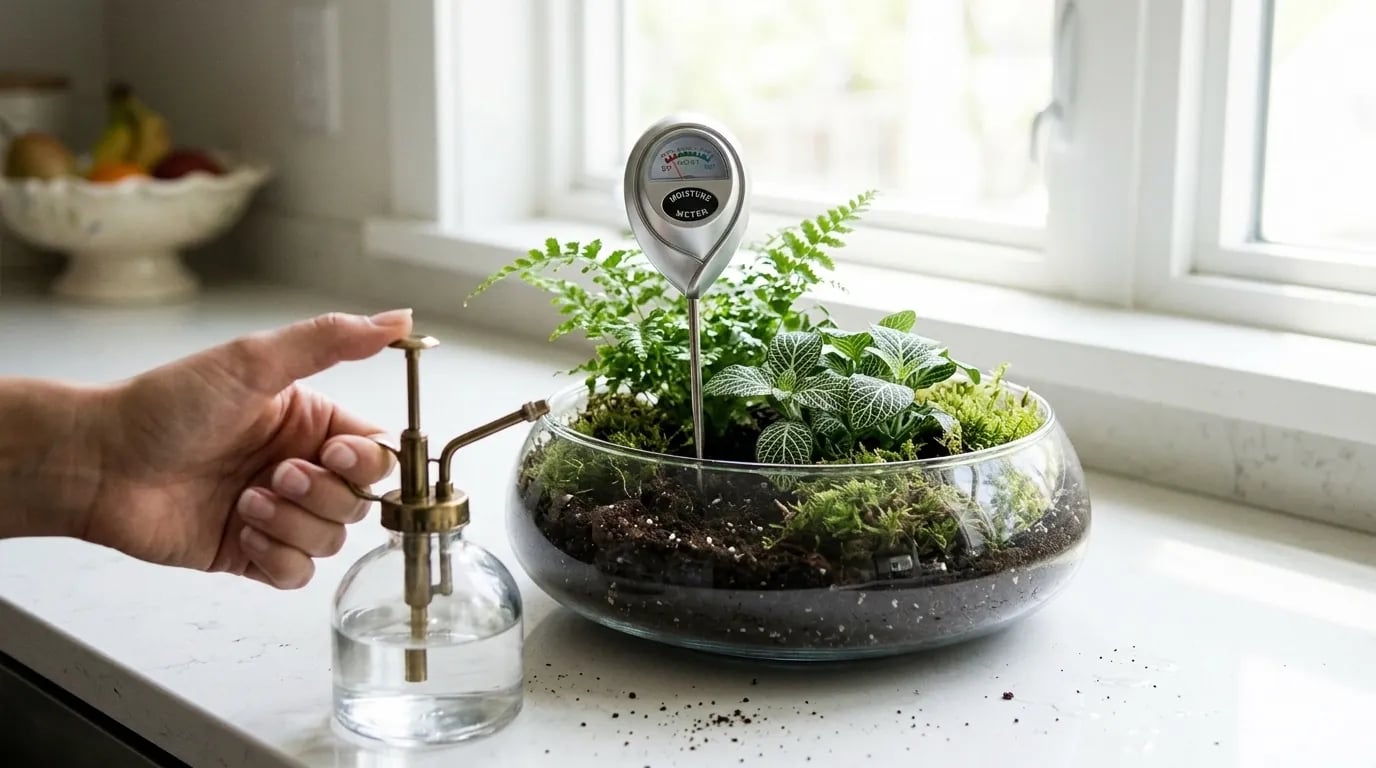
How to use a moisture meter, or soil moisture tester, in a pot or an open terrarium: where to insert the probe, how to read the dial, and when not to trust it.
In this guide
A moisture meter, also called a soil moisture tester, is a probe that you push into the soil to find out if it is dry or moist. Push it in to two thirds of the height of the pot, read the dial, then pull it out. Water when the needle shows the level that suits your plant. The reading is a useful guide, to be checked from time to time with your finger.
What a moisture meter is for
The surface of a pot often dries before the bottom. Your finger goes no deeper than a few centimeters. The probe measures lower down, where most of the roots are.
It is most useful in three cases:
- a deep pot, where your finger cannot reach the roots;
- a plant that suffers from too much water, such as a cactus or a succulent;
- an open terrarium, where the substrate is hard to touch without damaging the moss.
The probe measures the moisture in the soil. It says nothing about the humidity of the air: for the air, you need a hygrometer. The two devices have similar names, but they do not answer the same question.
Our moisture meter
Our model is 28 cm tall. It is made of ABS and copper. It needs no setup and no adjustment: you push in the probe, then you read the result on the dial. The dial goes from "dry" to "wet".
The supplier does not give any specific operating range. The device is designed for potted plants and open terrariums.
Where and how to insert the probe
- Choose a point halfway between the stem and the edge of the pot.
- Push the probe in gently, straight down, to two thirds of the height of the pot.
- If you feel resistance, do not force it: a large root or a stone is in the way. Try another point.
- Wait for the needle to settle, then read the dial.
- Pull out the probe and wipe the tip with a dry cloth.
The probe is long. In a small 6 cm pot, do not push it in all the way: it would go through the root ball and hit the bottom. Two thirds of the height of the pot is enough, which is a few centimeters.
In a large pot, take two or three readings at different points. The soil does not dry at the same pace everywhere, especially near a window.
Read the dial and know when to water
The right time to water depends on the plant. Some like soil that stays slightly moist. Others want soil that is dry all the way down.
If your dial also has a scale from 1 (dry) to 10 (soaked), here are our reference points:
| Plant | Water at around |
|---|---|
| Succulents and cacti | 1 or 2 |
| Herbs and foliage plants | 3 or 4 |
| Ferns | Keep between 5 and 7 |
If your dial only shows "dry" and "wet", follow the same logic. For a cactus, wait until the needle is fully on the dry side. For a foliage plant, water when it enters the dry zone. For a fern, do not let it get there.
After watering, the needle rises. Take another reading over the next few days: you will see how fast your pot dries. After a few weeks, you will know the rhythm of each plant. Our guide Watering indoor plants covers the other ways to check.
The limits of the reading
A probe gives a guide, not an exact value. Illinois Extension notes that a watering probe can be useful, but is not always reliable. Iowa State University Extension still considers the finger the simplest and most reliable method.
Fertilizer skews the reading. Colorado State University Extension explains that these inexpensive devices are somewhat inaccurate. In soil rich in fertilizer, the needle leans towards "wet". In poor soil, it leans towards "dry". The same source recommends learning, through experience, how to read the device for each soil.
A very free-draining substrate gives a less meaningful reading. A mineral cactus mix, made of gravel or pumice, contains little soil. Check with a wooden stick pushed down to the bottom: if it comes out moist, wait. For cacti, also read our guide to indoor cactus care.
The dial does not replace drainage. Iowa State University Extension points out that every pot must have a drainage hole. An accurate reading does not save a plant whose pot holds water at the bottom.
The probe wears out. Left permanently in moist substrate, it gets damaged. Pull it out after each reading and wipe the tip. If the reading seems wrong, compare it with your finger.
In an open terrarium
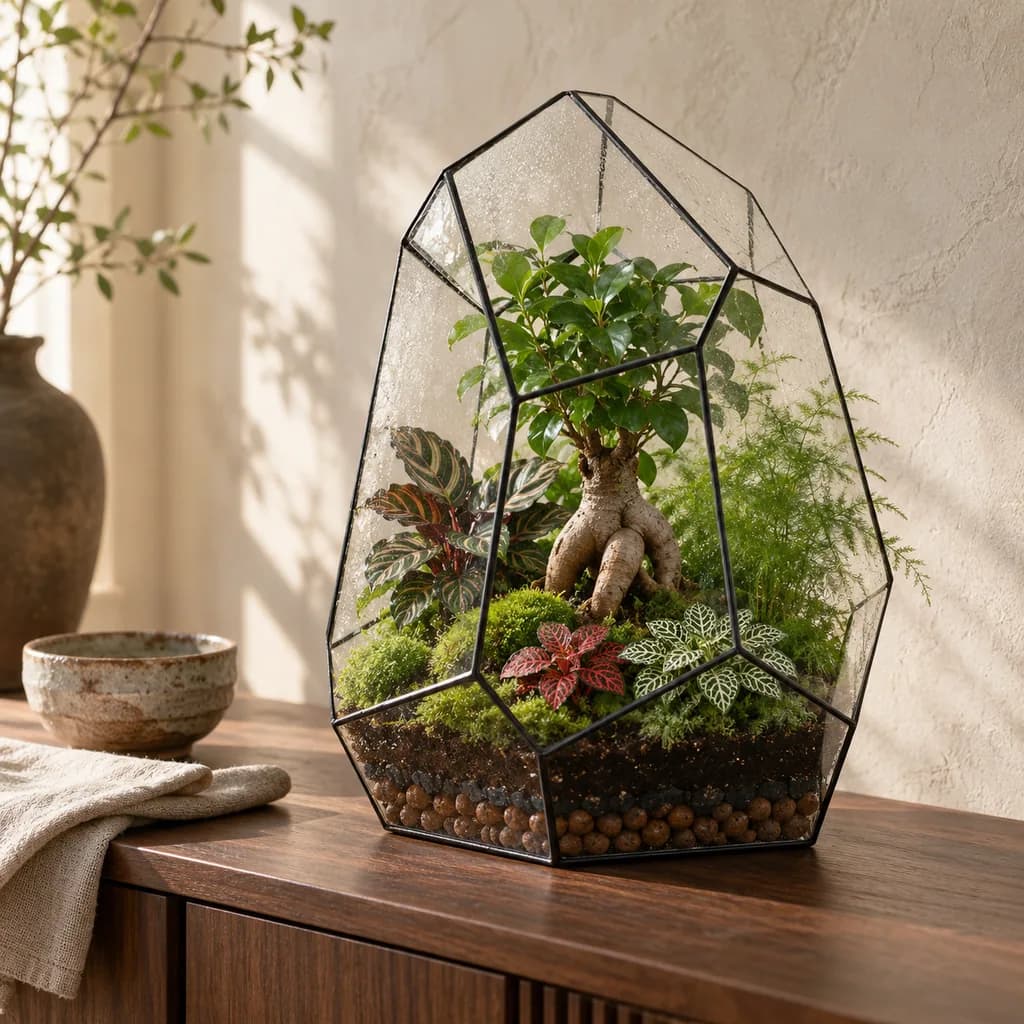
An open terrarium is often built in layers: clay balls at the bottom for drainage, then the substrate. Push the probe into the substrate layer only. In the clay balls, the reading means nothing.
Choose a point with no moss and no roots, near the edge of the glass. After the reading, close the small hole with your finger.
If the surface is dry while the probe shows "wet" lower down, do not water. A fine mist is enough to rehydrate the moss and the surface of the substrate. Our 300 ml mister, in clear glass, is made for this. It is sold empty. The glass is fragile: lay it down flat.
The mist only wets the surface. It does not replace watering, and the needle of the probe barely moves after misting. To learn more about this tool, read our guide to the plant mister.
In a closed terrarium
In a closed terrarium, the water goes round in a cycle. It evaporates from the substrate, settles on the glass and falls back. The condensation on the glass usually tells you enough. Our guide to condensation explains how to read it.
If you still want to check the substrate, take a quick reading through the neck, then pull out the probe. Never leave it in the terrarium. It would get damaged in a substrate that stays moist, and it would stop you from closing the container.
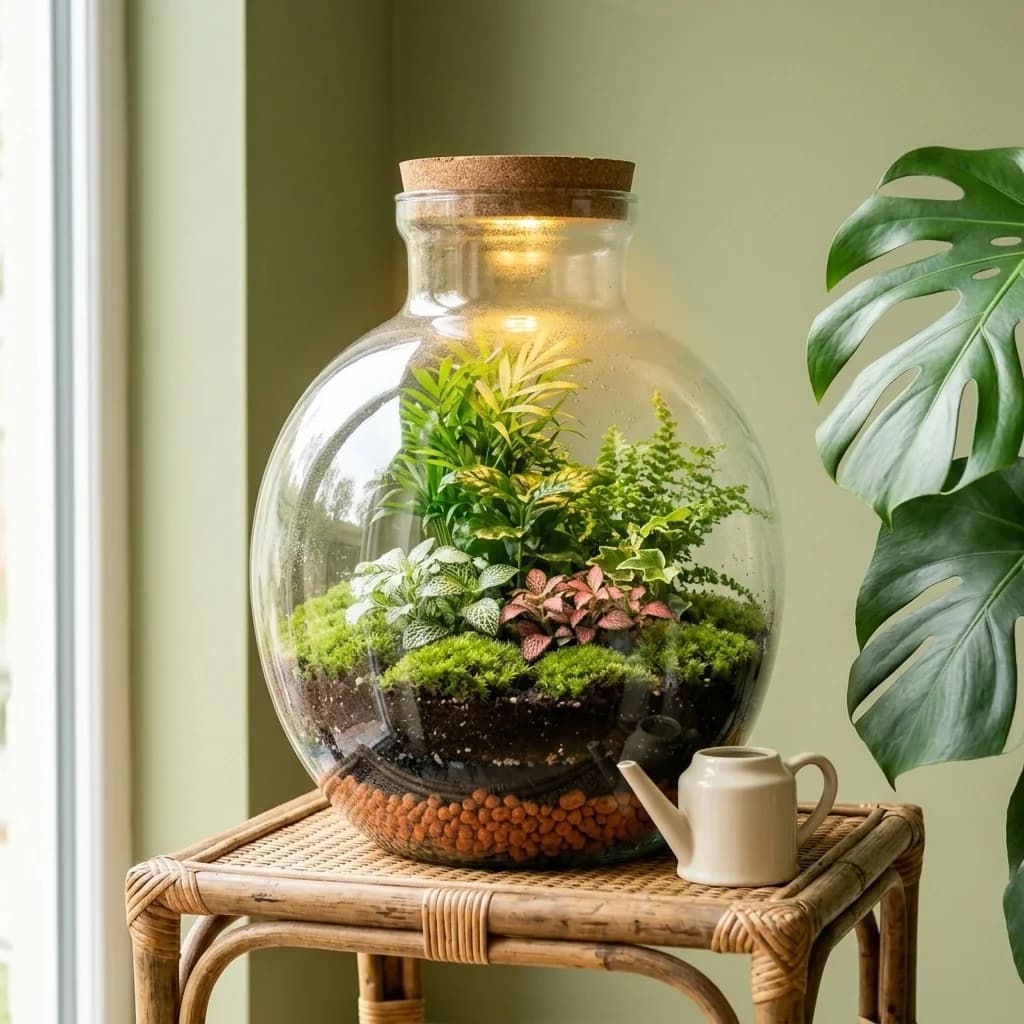
Our 7-liter bottle lets the probe through: its neck is 12 cm wide. It is 25 cm in diameter and 26.5 cm tall. With the cork lid on, the humidity stays inside and the ecosystem regulates itself.
The Jungle kit uses this bottle, with five living plants: a palm, a fern, a coffee plant, a white fittonia and a red fittonia. As a closed terrarium, it is watered once or twice a year. The probe is only useful there if you are in doubt.
In short
- A moisture meter measures the moisture in the soil, not in the air.
- Push the probe in to two thirds of the height of the pot, halfway between the stem and the edge.
- Water according to the plant: dry for a cactus, the start of the dry zone for a foliage plant.
- Pull out the probe after each reading, and wipe the tip.
- Check with your finger from time to time: fertilizer and very free-draining substrates skew the reading.
- In a closed terrarium, look at the condensation on the glass first.
Sources
- Watering, Illinois Extension
- How to Care for Houseplants, Iowa State University Extension
- Vegetables (CMG GardenNotes 710), Colorado State University Extension
- Manufacturer data sheets (height and material of the moisture meter, capacity of the mister, bottle dimensions, kit contents)
Frequently asked questions
Does a moisture meter measure the humidity of the air?
No. The probe measures the moisture in the soil, where you push it in. For the humidity of the air, you need another device, a hygrometer. To decide when to water, the soil is what counts.
Can I leave the moisture meter in the pot?
No. Push in the probe, read the dial, then pull it out. Left permanently in moist substrate, it gets damaged. Wipe the tip after each reading.
Is a soil moisture tester reliable?
It gives a good guide, not an exact measurement. Illinois Extension notes that a probe can be useful but is not always reliable. Colorado State University Extension adds that soil rich in fertilizer makes the needle lean towards "wet". Check from time to time with your finger or a wooden stick.
Can I use a moisture meter in a closed terrarium?
Only for a quick reading, if the neck lets the probe through, and without leaving it inside. In a closed terrarium, the condensation on the glass is usually enough to follow the water balance.