Fireplace decor: styling the mantel, whether or not the fire is in use
One tall object, a group of vases, empty space between the two: how to decorate a mantelpiece, symmetrical or not, and what does not like heat when the fire is lit.
In this guide
To decorate a fireplace, place one tall object and a group of two or three lower objects on the mantel, with empty space between them. Before you choose the objects, answer one question: is the fire still in use? The answer changes what you can put there.
First: is the fireplace in use?
It is in use
The mantel gets warm, and the air above it is hot and dry. Some objects do not belong there when the fire is lit.
- Dried flowers and branches. They catch fire very easily. Keep them away from the hearth.
- Artificial plants and flowers. They are made of synthetic material. Keep them away from the heat.
- Living plants. Hot, dry air damages them.
- Candles. Wax softens in the heat.
- Anything that hangs in front of the hearth: garlands, fabrics, trailing branches.
What remains: porcelain, ceramic, glass, metal, stone. A porcelain vase is fired at a very high temperature: the heat of a mantel does not harm it. Put it there empty.
The distance to keep between the fire and the objects depends on your appliance. Follow its instructions, or ask your chimney sweep.
It is no longer in use
You are free. The mantel is decorated like a shelf, and the hearth becomes a niche to fill. Both are covered below.
Symmetry or asymmetry
A fireplace sits in the centre of a wall. It calls for symmetry, but that is not an obligation.
Symmetry
The same object at each end of the mantel, and one object in the centre: a mirror, a painting, a clock. The result is classic and calm.
Two identical plants make very good end pieces. Our artificial Vanda orchids are sold in pairs. They are about 60 cm tall, and each comes in its own pot. One on each side of a fireplace that is not in use, they frame the mirror all year round.
Asymmetry
A group of objects on one side, and a single, lower object on the other. The result is livelier. It is the right choice if the mantel already carries a mirror or a painting off to one side.
A rule for balance: the group and the single object should have about the same weight for the eye. Three small vases on one side answer one large vase on the other.
A trio of vases on the mantel
Three vases of three heights make the easiest group to get right. On a mantel, which is narrow, place them in a line, from smallest to tallest, or with the tallest in the middle.
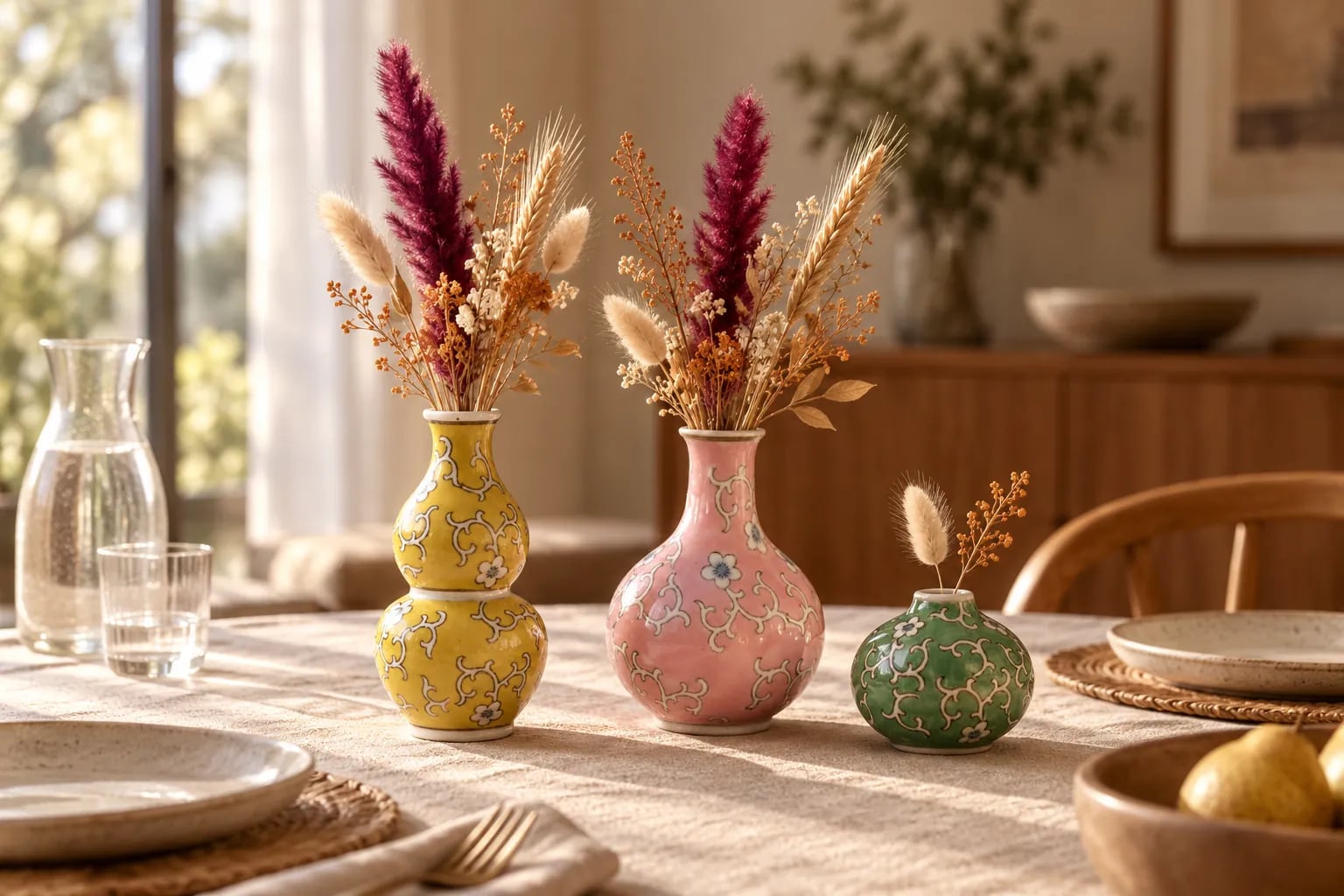
Our three yellow Mingus porcelain vases are 15, 18 and 20.5 cm tall. Their diameter is 9 to 10 cm: measure the depth of your mantel before you order.
To answer the trio on the other side, take a single, larger vase. Our large pink vase is 27.5 cm tall and 17.5 cm in diameter. It needs a mantel that is deep enough.
The rules for height and colour are in our guide to arranging a duo or trio of vases.
Dried flowers, with the fire out
Dried flowers go well with a fireplace: their straw and rust tones recall wood. They also go in porcelain vases, which are made for a dry display.
Two precautions:
- Never near a lit fire. If the fireplace is used in winter, take the bouquets away for the season, and leave the vases empty.
- Only one filled vase per group. The others stay empty.
Our guide to dried flowers in a vase explains how to arrange them and keep them.
The hearth that is no longer in use
An empty hearth makes a black hole in the wall. Three ways to fill it:
- Stacked logs, cut to the same length. This is the simplest solution.
- Lanterns in three sizes, with LED candles.
- An artificial plant. A hearth is dark: a living plant will not last there. An artificial plant needs no water and no light.
First have someone check that the flue is properly closed: soot and draughts quickly spoil a decor.
Above the mantel
- A mirror enlarges the room and sends the light back. Place it on the mantel, leaning on the wall, rather than hanging it: it looks less formal.
- A painting is best a little narrower than the mantel.
- Nothing. If the wall already has mouldings or an overmantel mirror, the objects on the mantel are enough.
Common mistakes
- Lining up ten small objects. The mantel becomes a shelf of souvenirs. Keep five objects at most.
- Everything at the same height. You need a high point.
- Forgetting the depth. An object that sticks out past the mantel falls at the first swipe of a cloth.
In summary
- Fire in use: only objects that do not burn.
- One tall object, one lower group, empty space between them.
- Symmetry for calm, asymmetry for life.
- Dried flowers only when the fire is out.
- Hearth not in use: logs, lanterns or an artificial plant.
To choose the size of the vases, read which design vase to choose. All the models are on the design vases page.
Sources
- How to dry flowers and foliage at home, Royal Horticultural Society
- The Bloom Room: Floral Design Basics, West Virginia University Extension
- Technical data sheets from the maker of the vases and the artificial plants (dimensions, materials, intended use)
Frequently asked questions
What should I put on a mantelpiece?
One tall object, such as a mirror or a large vase, and a group of two or three lower objects. Leave empty space between them. A mantel covered from end to end looks cluttered.
Can I put dried flowers on a fireplace that is in use?
No. Dried flowers catch fire very easily. When the fire is lit, keep them away from the hearth. Leave objects that do not burn on the mantel, such as empty vases.
How do I decorate a fireplace that is no longer in use?
Decorate the mantel like a shelf, and fill the hearth: stacked logs, lanterns, or an artificial plant. A hearth is dark, so a living plant will not last there.
Should fireplace decor be symmetrical?
Both work. Symmetry, with the same object on each side, gives a classic, calm living room. Asymmetry, with a group on one side only, gives a livelier one.