Arranging a duo or trio of vases: heights, colours and placement
Three vases work better than two, and never at the same height. Simple rules for grouping vases on a shelf or console table: odd number, steps, triangle, one filled vase.
In this guide
To arrange a group of vases, take three, at three different heights, place them in a triangle, and fill only one. These four rules are enough for a shelf, a console table or a windowsill.
Here is each of them, then the case of the duo.
Rule 1: an odd number
Florists learn it early: an odd number of items gives a balanced whole. West Virginia University says so in its flower arranging course: no fewer than three of each item, and odd numbers create balance.
With three vases, the eye finds a centre and two sides. With four, it makes two pairs and the group splits in two.
Rule 2: three heights, in steps
Three vases of the same height make a row. Three vases of different heights make an arrangement.
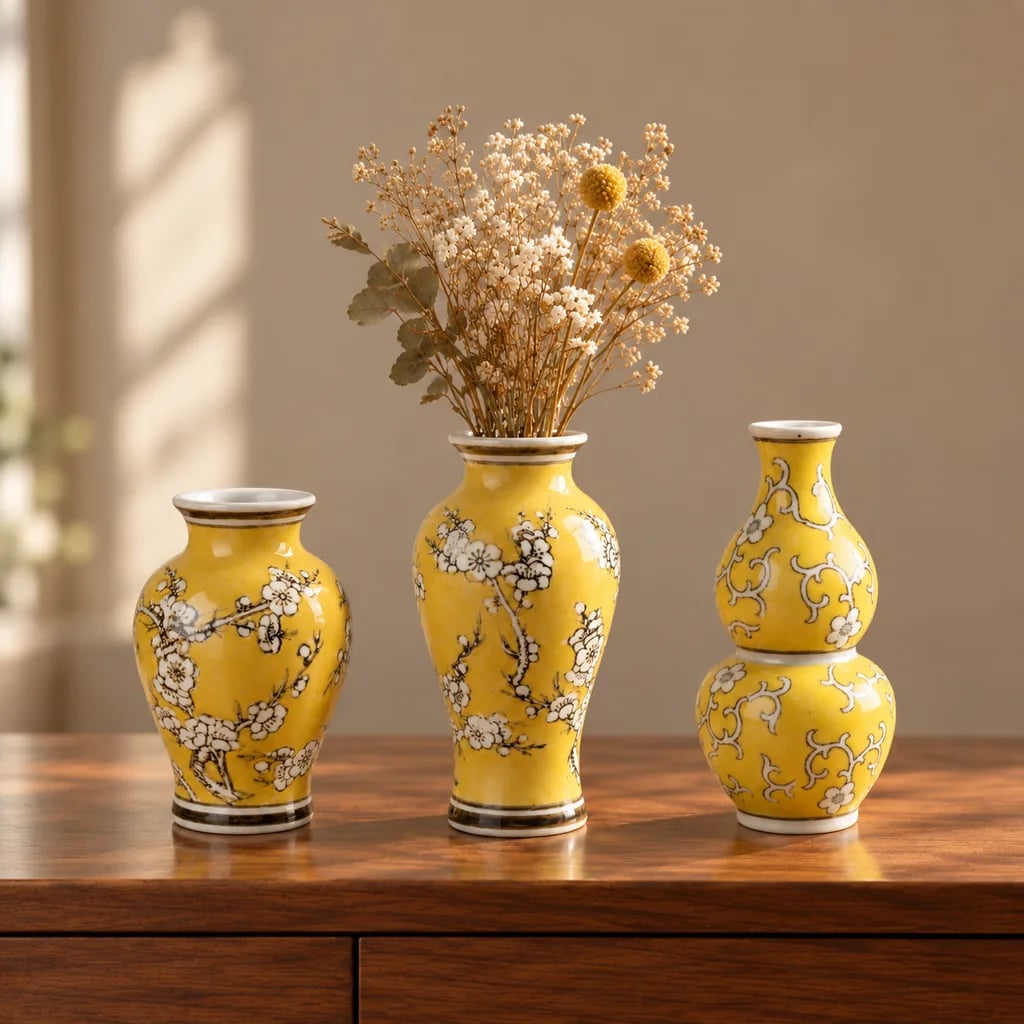
The difference must show without breaking up the whole: a few centimetres between each vase. Our three yellow porcelain vases are 15, 18 and 20.5 cm tall. They have the same colour and the same material: only the height changes, and that is what you look at.
Rule 3: in a triangle, not in a line
On deep furniture, do not put the vases in a single line. Place the tallest at the back, and the other two in front, one on each side. Seen from the front, the group has depth.
Bring them close together: the vases should almost touch, or overlap a little when seen from the front. Too far apart, they are three lone objects, not a group.
On a narrow shelf, a line is allowed. Then arrange the vases from smallest to tallest, or put the tallest in the middle.
Rule 4: only one vase filled
When all the vases carry a bouquet, nothing stands out any more. Fill a single vase, usually the tallest, and leave the other two empty.
For the height of the bouquet, keep the florists' guideline: about one and a half times the height of the vase. Our guide to dried flowers in a vase says more.
And colours?
Two paths.
A single colour
This is the safest. Three vases of the same colour read as one object with three heads. The colour is strong because it is repeated.
Several colours
This is more cheerful, and it needs a rule: one thing must bring the vases together. The same material, the same smooth finish, the same family of shapes.
A useful reminder from the same course: warm colours, such as yellow, red and orange, seem to come forward. Cool colours, such as green and blue, seem to recede. So put the cool colour at the back or on the small vase, and leave the warm colour in front.
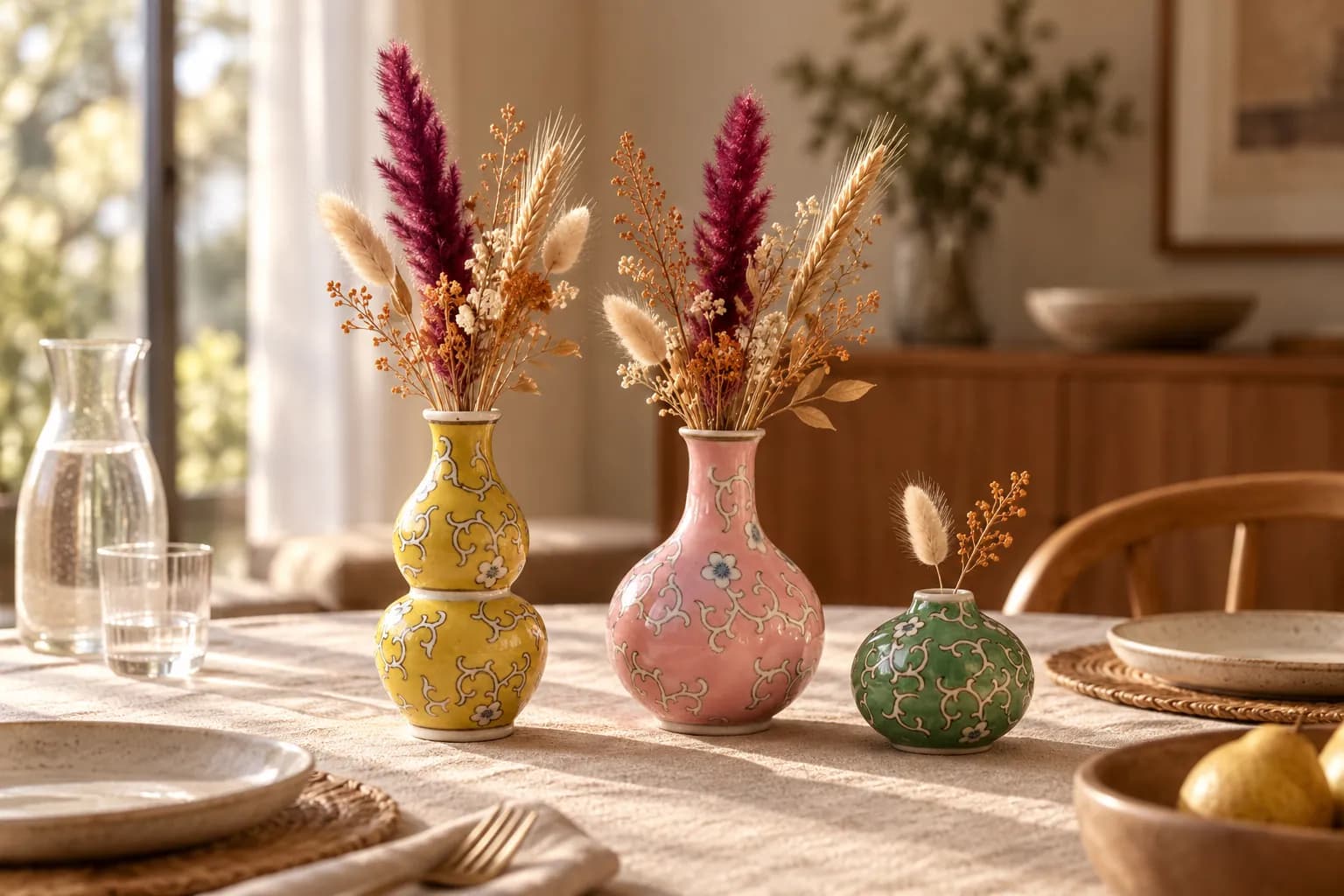
Our colour trio brings together a tall pink vase of 17.5 cm, a yellow vase of 15 cm and a small green vase of 10.5 cm. All three are in smooth porcelain: that is what brings them together. Here the steps are very marked, and the tall pink vase forms the back.
The case of the duo
Two vases work too, with two precautions.
- Two different heights. Two identical vases side by side make a symmetrical pair: that is another style, more classic. For a lively duo, take one tall and one small.
- A third object. Add a book lying flat, a candle or a small plant. You get the odd number back.
Our two yellow vases of 15 and 18 cm make this duo.
What is not grouped
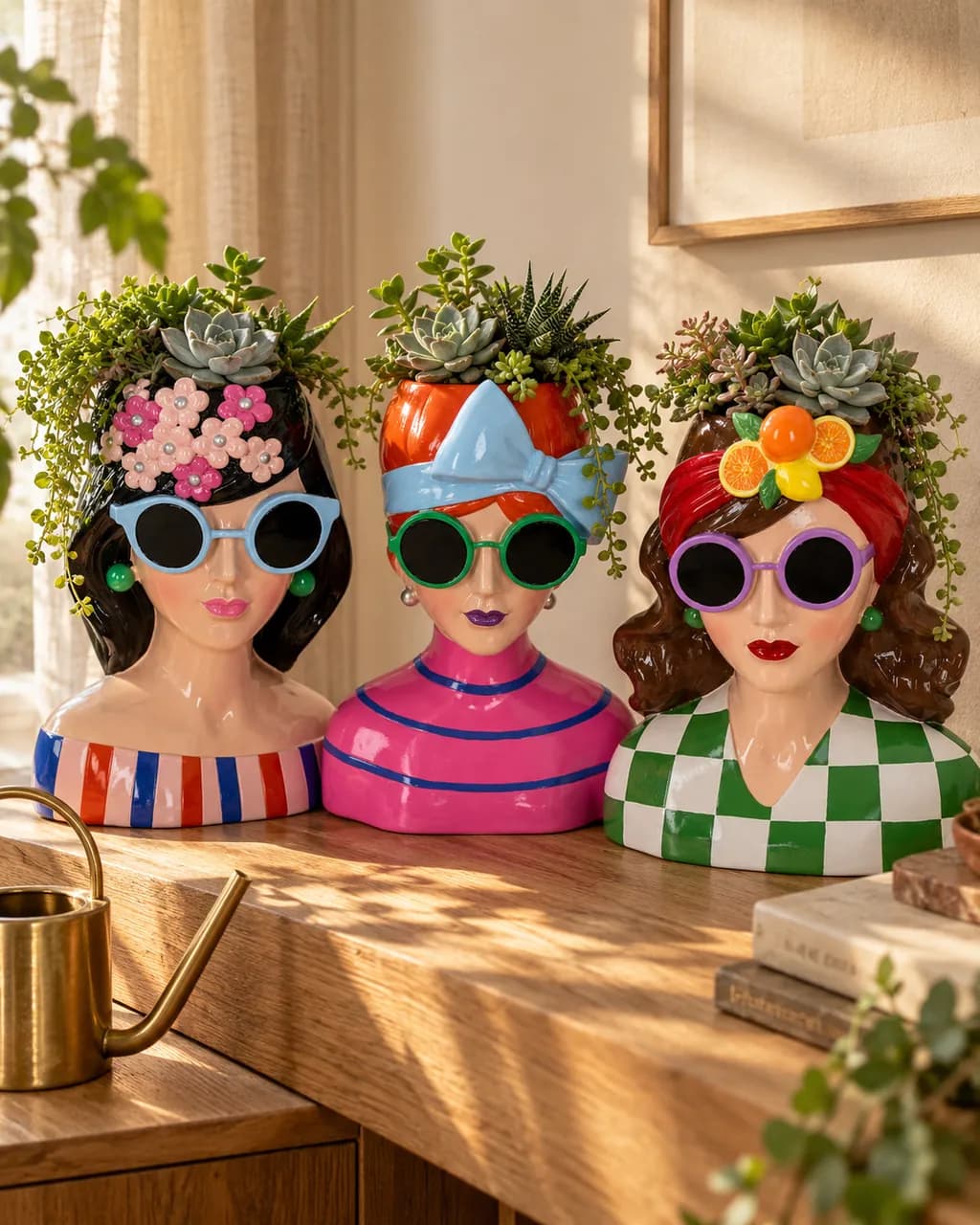
A vase with a strong personality stands alone. A face vase is one: with its glasses and its colours, it needs nobody. Our guide to planting succulents in a face vase is devoted to it.
Three common mistakes
- Filling the whole piece of furniture. A group of vases needs empty space around it. Leave at least half of the shelf free.
- Mixing three colours and three materials. Change only one thing at a time: the height, or the colour.
- Putting the group in the middle. Shifted to one side, with empty space on the other, it has more style.
In summary
- Three vases, or two and another object.
- Three heights.
- In a triangle, close together.
- A single bouquet.
For the size to suit your furniture, read which design vase to choose. The sets are on the design vases page.
Sources
- The Bloom Room: Floral Design Basics, West Virginia University Extension
- Vase manufacturer's technical data sheets (dimensions, materials)
Frequently asked questions
Why group vases in threes?
An odd number gives a balanced whole: the eye finds a centre and two sides. Two vases work too, as long as they are not the same height.
What height difference between the vases?
A difference that shows, without breaking up the whole: a few centimetres between each vase. Our three yellow vases are 15, 18 and 20.5 cm tall.
Should I fill every vase in a trio?
No. Fill just one, usually the tallest. The other two stay empty and go with it.
Can I mix several colours of vases?
Yes, if one thing brings them together: the same material, the same finish or the same family of shapes. Three colours and three materials at once is too much.