Artificial orchid: choosing a believable model, and where to put it
Vanda, Renanthera or Phalaenopsis: three orchids, three silhouettes. How to recognise a believable artificial orchid, why to buy two, and where to put it.
In this guide
A believable artificial orchid is recognised by four signs: flowers at several stages, shaded petals, a thin, curving spike, and real foliage at the base. Then choose the species by the silhouette you want: the Phalaenopsis is calm, the Vanda is full, the Renanthera is light and lively.
This guide explains the differences between these three orchids, then where to put yours.
Three orchids, three silhouettes
All three exist in nature. They do not look alike, and neither do their copies.
| Orchid | Foliage | Flowers | Effect |
|---|---|---|---|
| Phalaenopsis | A few broad leaves at the base | Large, flat, lined up on an arching spike | Classic, calm |
| Vanda | Narrow leaves in two rows, along a straight stem | Large and round, often purple, pink or bluish | Full, exotic |
| Renanthera | Leaves in two rows, along a stem | Numerous and smaller, on a branching spike, from yellow to red | Light, lively |
The Phalaenopsis, the one everyone knows
This is the florists' orchid. The American Orchid Society writes that it grows easily in front of a bright window, with little or no direct sun.
Let us be honest: if you have a bright windowsill, a real Phalaenopsis is a good choice. The artificial version makes sense away from windows.
The Vanda, the one you do not keep at home
The living Vanda grows in trees, with its roots in the air. It needs a lot of light and humid air. The American Orchid Society advises against growing it indoors.
So this is the orchid for which the artificial version holds up best. You get the silhouette of a plant that very few people manage at home.
Our artificial Vanda orchids are about 60 cm tall. They are sold in pairs, each in a black plastic pot of 13 cm in diameter. Their flowers are purple, on green foliage.
The Renanthera, the rarest
The Renanthera is less well known. Its spike branches and carries many flowers, in tones of yellow, orange and red. From a distance, it makes a cloud of warm colour.
It suits you if you find the Phalaenopsis overdone. Its colour goes well with wood, terracotta and warm tones.
Our artificial Renanthera orchids are about 56 cm tall. They are sold in pairs, each in its pot. Their flowers are orange-yellow.
The 4 signs of a believable artificial orchid
Check them on the photos of the product page, by zooming in.
- Flowers at several stages. On a real spike, the flowers do not all open on the same day. Open flowers and a few buds look more real than ten identical flowers.
- Shaded petals. A real petal is darker at the heart, or veined. A flat, plain colour shows.
- A thin, curving spike. The stem that carries the flowers is slim and it leans. A thick, perfectly straight stem looks like a shop-window prop.
- Foliage at the base. An orchid without leaves is a bouquet. The leaves must be thick, a deep green, with a fold down the middle.
A fifth point depends on you: the pot. A black plastic pot is discreet, but it does not look like a living room pot. Slip it into a ceramic or glass cache-pot. For a 13 cm pot, take a cache-pot of 14 to 15 cm inner diameter.
The same rules apply to all fake plants. They are detailed in our 7 signs of a realistic artificial plant.
Where to put an artificial orchid
An orchid of 55 to 60 cm sits on a piece of furniture, not on the floor. It should be at about eye level when you are seated.
- A console table or a sideboard. This is the most classic place.
- A bathroom. The orchid looks natural there, as we link it with humid air. In a bathroom with no window, it is even the only way to have one. Read our guide to the bathroom plant for the precautions.
- A bedside table or a desk, if the piece of furniture is wide enough so that the spike does not get in the way.
- A reception counter, in a shop or a practice.
Avoid two places. The first is full sun behind a window: the maker does not promise that the colours will hold in sun. The second is the dining table: at 60 cm, the orchid hides the guest opposite.
In pairs: how to use them
Our orchids are sold as a set of two identical plants. You have three ways to use them.
- In symmetry. One on each side of a mirror, a fireplace or a television. It is a neat decor, which suits an entrance.
- Together. The two pots side by side on a sideboard, or in the same long planter. The effect is full, like a florist's arrangement.
- In two rooms. One in the entrance, one in the bathroom. The colour answers from one room to the other.
In a symmetrical layout, turn the two spikes slightly in opposite directions. Two plants exactly alike, facing the same way, give away the copy.
Care
An artificial orchid needs no water, no light and no fertiliser. It stays in flower all year round.
Wipe a dry cloth over the leaves and flowers once a month. For the heart of the flowers, a dry, clean brush is more precise.
And if you want a real orchid?
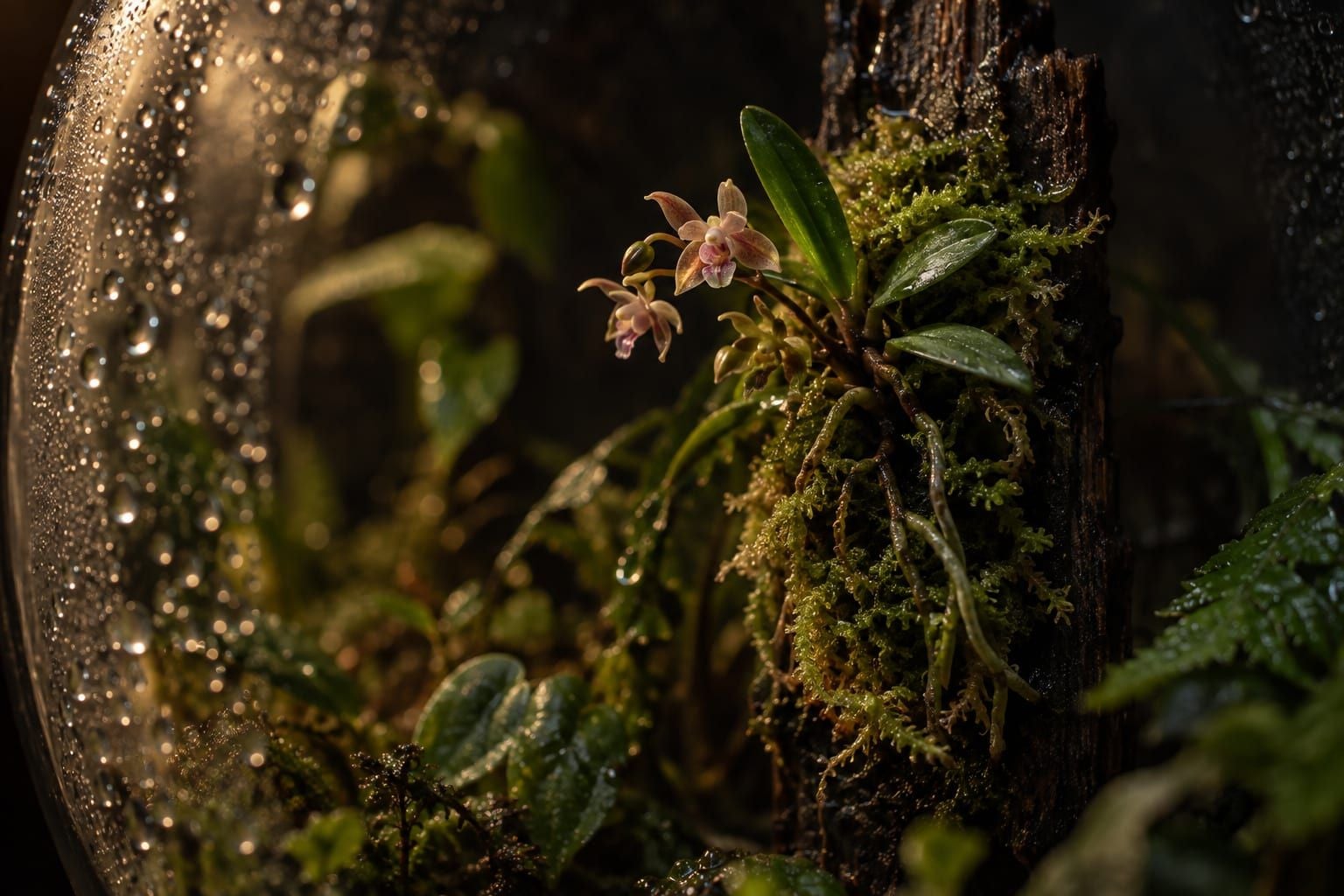
There are miniature orchids that live in a terrarium, in the humid air of the jar. It is a project for someone who already has a little experience. Our guide to the miniature orchid in a terrarium explains everything.
All our orchids are on the artificial plants page.
Sources
- Vanda Culture Sheet, American Orchid Society
- Phalaenopsis Culture Sheet, American Orchid Society
- Technical data sheets from the maker of the artificial orchids (heights, pots, colours, care)
Frequently asked questions
How do I choose an artificial orchid that looks real?
Check four points on the photos: flowers at several stages, shaded petals, a thin, curving spike, and foliage at the base. Then hide the plastic pot in a cache-pot.
What is the difference between a Vanda and a Phalaenopsis orchid?
The Phalaenopsis has a few broad leaves at the base and an arching spike. The Vanda carries narrow leaves in two rows along a straight stem, with large round flowers.
Why buy artificial orchids in pairs?
Two identical orchids allow a symmetrical decor: one on each side of a mirror, a fireplace or a sideboard. Placed together, they give a fuller effect.
Does an artificial orchid need care?
Almost none. It needs no water, no light and no fertiliser. Wipe a dry cloth over the leaves and flowers once a month to remove dust.