High-end artificial flowers: how to arrange a bouquet that looks real
What "Real Touch" means, and the five steps that make a bouquet of artificial tulips look real: odd number, uneven heights, curved stems, the right vase, the right place.
In this guide
High-end artificial flowers are recognised by the feel of the petal and its shades of colour. But half of the result comes from you. A bouquet looks real when it has an odd number of flowers, at uneven heights, on curved stems, in a vase of the right size.
This guide takes the tulip as its example, the easiest artificial flower to get right.
What "Real Touch" means
"Real Touch" is the name of a finish. The petal is not dry fabric. It is made of, or covered with, a soft material, which gives a feel under the finger close to a real petal.
Two honest notes.
- It is not a label. As far as we know, no body checks this name. Each maker uses it in its own way. So look at the close-up photos too.
- Our product pages do not detail the material. For our tulips, the maker states a "Real Touch" finish: the petal imitates the feel of a real tulip. It does not say which material is used.
The 3 signs of a well-made artificial flower
- The petal has shades. A real tulip is paler at the base, sometimes veined with green. A perfectly plain colour looks like plastic.
- The flowers are not all at the same stage. In a real bouquet, some flowers are open and others still closed.
- The stem and leaves are neat. A matt green stem, long leaves that curl a little.
Our deep red bouquet shows the second sign. It has 7 stems of 40 cm, in tones from deep red to burgundy. It mixes fully open tulips with smaller buds, still closed.
Arranging a tulip bouquet that looks real
An odd number
Five or seven tulips. With an even number, the eye forms pairs and sees a line-up. With an odd number, it sees a bouquet.
For a narrow vase, five are enough. For a wide vase, take seven.
Uneven heights
Flowers all at the same height make a shop-window bouquet. In a real bouquet, the tulips keep growing in the vase, each at its own pace.
Make three levels: two or three tall flowers in the centre, the others lower around them. To lower a flower, push its stem into the vase at an angle.
Curved stems
This is the step that changes everything. A real tulip never stays straight: its stem leans towards the light and droops a little over the rim of the vase.
Most artificial stems bend by hand. Our product pages do not say so for our tulips: try gently on a first stem. Give a slight, long curve, not an angle. Make the flowers at the edge lean outwards.
The right vase
Without water, every vase will do. That leaves the size.
Our guideline: the visible part of the bouquet is between one and two times the height of the vase. For tulips of 40 to 42 cm, that gives a vase 15 to 20 cm tall.
An opaque vase is simpler than a glass vase: you cannot see the stems, or the absence of water. In a clear vase, the lack of water shows.
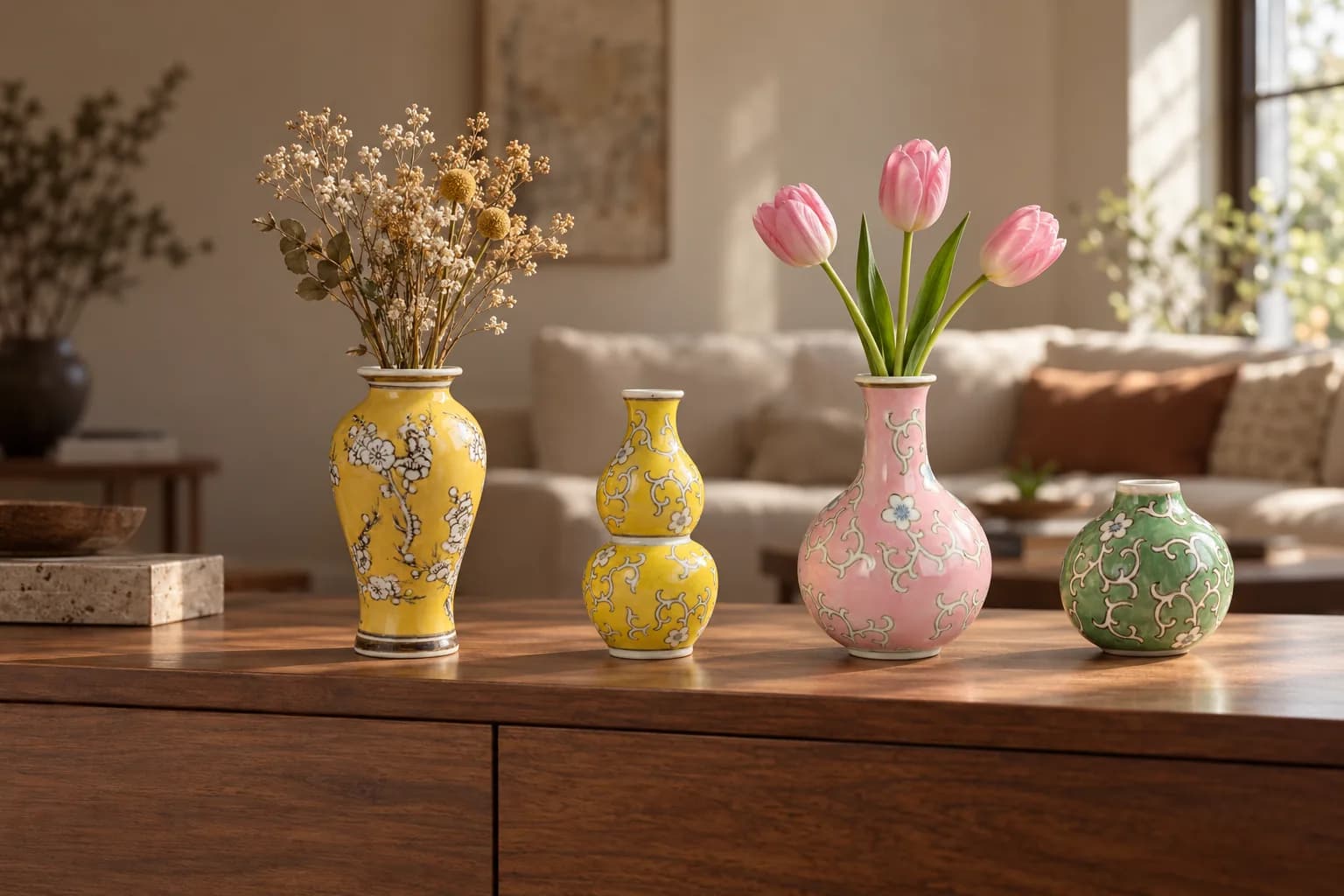
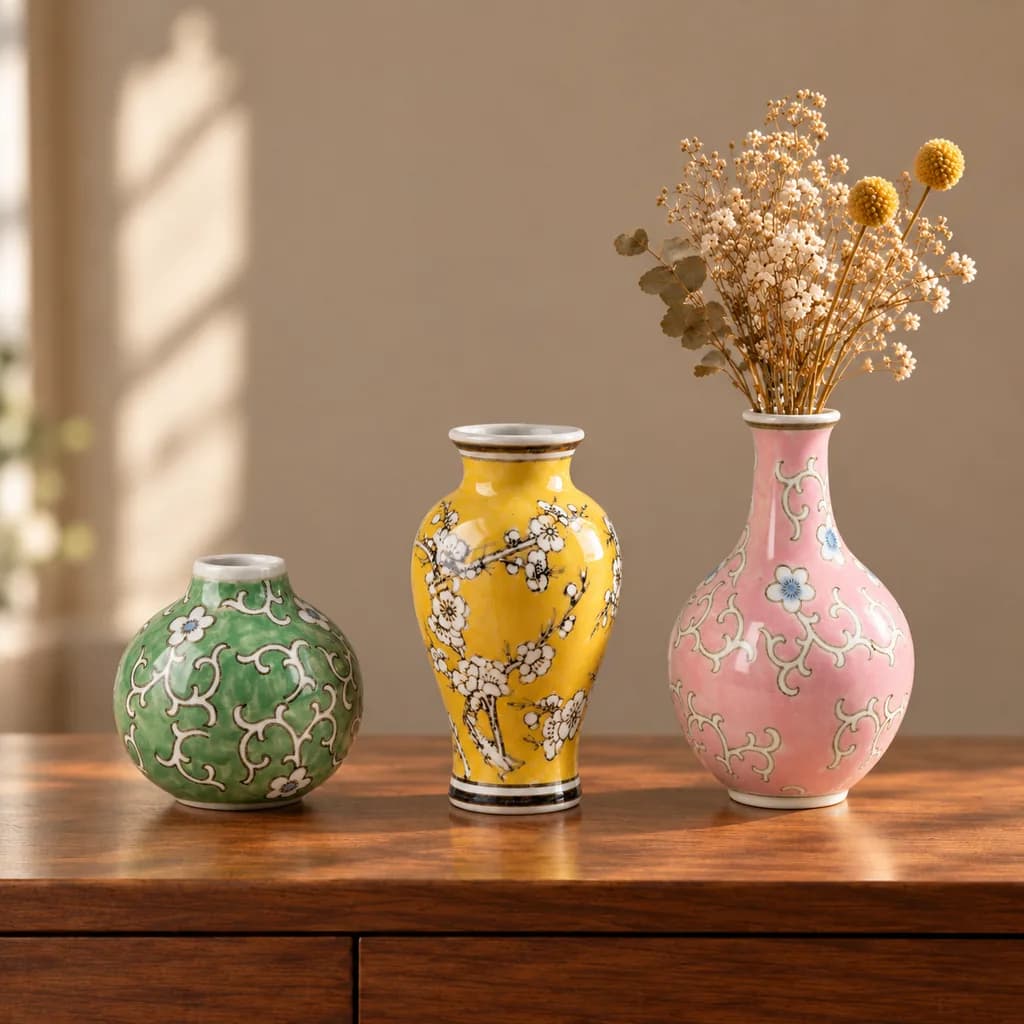
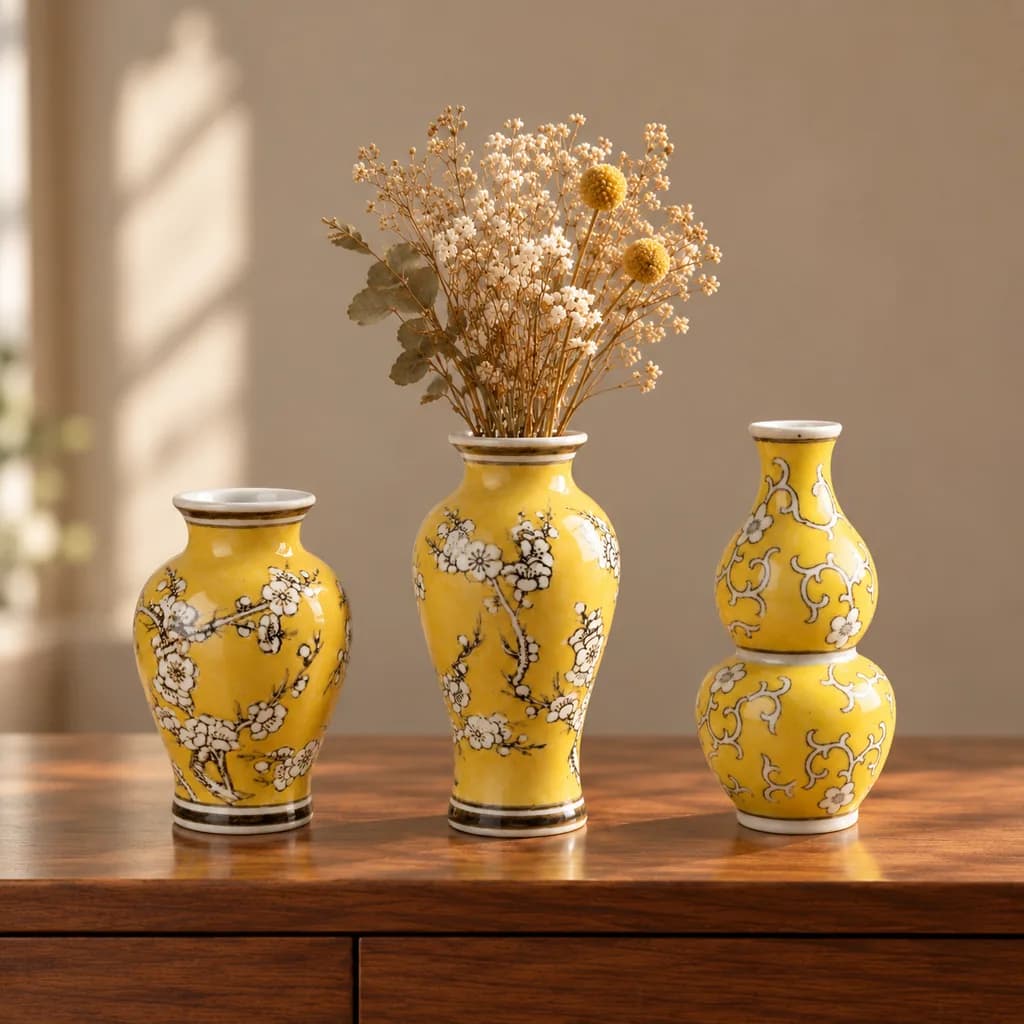
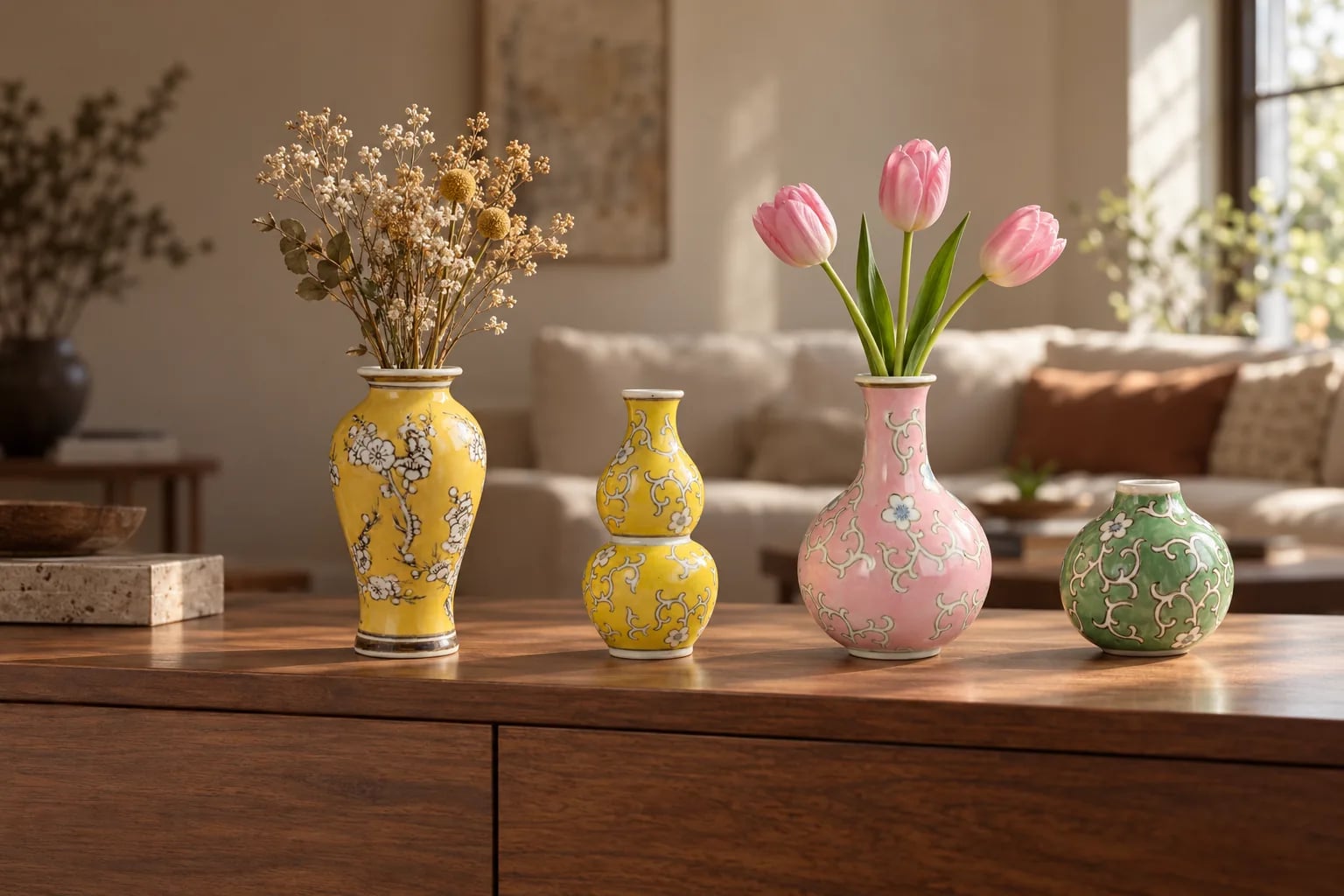
Coloured porcelain suits well. The maker gives it for a dry display: dried flowers, branches, artificial flowers. Our trio brings together three porcelain vases: a pink one 17.5 cm tall, a yellow one of 15 cm and a green one of 10.5 cm. Put the tulips in the pink or the yellow one, and leave the others empty. The set also exists in a version filled with 5 artificial tulips of 42 cm.
To go further on choosing the container, read which design vase to choose. To match several vases, see arranging a duo or trio of vases. All the models are on the design vases page.
The right place, and the right season
A bouquet of fresh flowers sits on a table, a console, a windowsill. Put yours in the same place.
Think about the season too. Tulips in the middle of August are surprising. If you want a believable decor all year round, put the tulips away in summer and bring them out at the end of winter. If you just want colour, leave them out on display: it is your home.
Which colour to choose?
- A single colour makes a calm, modern bouquet. It is the safest choice.
- Two neighbouring colours, such as pink and orange, make a market bouquet.
- White and green goes with all coloured vases.
Our bouquet of 5 tulips is 42 cm tall. It comes in four colours: orange, pink, yellow, or white and green. A bouquet holds five tulips of one colour. For a mix, take one bouquet of each colour you want. It is sold without a vase.
Then match the bouquet and the vase. A vase in a bright colour calls for flowers of a close colour, or white ones. A neutral vase accepts anything.
Care
- No water. Never in the vase: the porcelain is given for a dry display.
- Dust. A dry cloth or a clean brush, once a month.
- Sun. Keep the bouquet away from a window in full sun. The maker does not promise that the colours will hold.
Artificial flowers or dried flowers?
Both live without water, in the same vases. Dried flowers are real flowers, in tones of straw and rust. They are fragile and lose a little material over time. Artificial flowers keep bold colours, and can be handled without fear.
Our guide to dried flowers in a vase explains how to choose and keep them.
For foliage around the bouquet, see our guide to the realistic artificial plant. The whole range is on the artificial plants page.
Sources
- Technical data sheets from the maker of the artificial tulips (lengths, finish, colours)
- Technical data sheets from the maker of the vases (dimensions, materials, intended use)
Frequently asked questions
What does "Real Touch" mean for an artificial flower?
It is the name of a finish: the petal imitates the feel of a real flower, soft and slightly cool, instead of dry fabric. It is not a checked label. So judge by the photos as well.
How many artificial tulips in a vase?
An odd number: five or seven for a vase 15 to 20 cm tall. An odd number stops the eye from forming pairs, and the bouquet looks more natural.
Which vase for a bouquet of artificial flowers?
Any vase will do, as there is no water. For tulips of 40 to 42 cm, take a vase 15 to 20 cm tall: the visible part of the bouquet is then between one and two times the height of the vase.
How do I care for a bouquet of artificial flowers?
Without water. Remove dust once a month with a dry cloth or a clean brush. Keep the bouquet away from full sun: the maker does not promise that the colours will hold.