Outdoor artificial plant: which one to choose, and where to place it
What the sun does to an artificial plant, what “UV-resistant” means, our three models designed for outdoors, and the right steps for a balcony or a terrace.
In this guide
An artificial plant only goes outside if its manufacturer intends it to. At Small Eden, three models are: the 90 cm olive tree and two 26 cm begonias, whose material the manufacturer states is UV-resistant. All our other artificial plants are made for indoors. Even for these three models, the right spot reduces wear.
What the sun does to an artificial plant
An artificial plant is made of synthetic materials. The sun's ultraviolet rays, UV, damage them over time.
A review article published in the journal Polymers describes this ageing. Under UV, plastics change colour, then their surface cracks. They then lose their strength and end up breaking into fragments.
The same researchers tested anti-UV additives. These additives limit the damage, compared with untreated plastic. They do not eliminate it.
What to take away:
- An indoor artificial plant must not go outside. Its material is not designed for direct sun.
- “UV-resistant” means “ages more slowly”. The word does not promise a plant that lasts forever.
- The spot counts as much as the treatment. Less direct sun means less wear.
Our three models designed for outdoors
The 90 cm olive tree
The manufacturer states that its foliage is UV-treated. It lists it for a balcony, a terrace, a shop entrance or a very bright room. The tree has grey-green leaves and decorative olives, which are not edible. It arrives in a basic pot 15 cm in diameter. The cachepot is not included.
Our 140 cm olive tree, on the other hand, is made for indoors only. To compare the models, see our guide to the artificial olive tree.
The 26 cm begonia
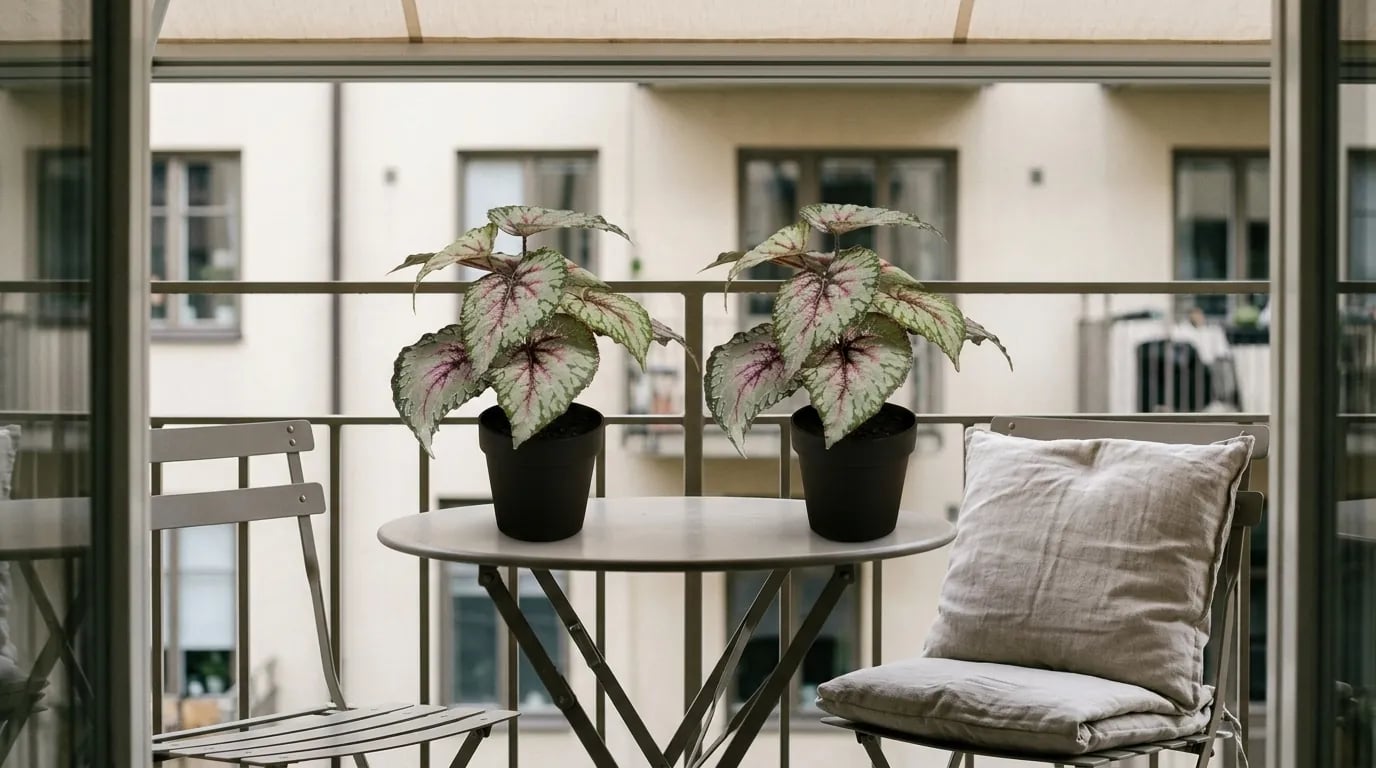
A small, compact begonia, with its leaves and flowers. The manufacturer states it is UV-resistant, for indoor and outdoor use. It goes on a balcony, a terrace or a windowsill. It arrives in a pot.
The begonia with grey-purple leaves
The same 26 cm format, chosen for the colour of its leaves: a grey-purple. Same use, according to the manufacturer: indoors or outdoors, without fading in the sun.
Two begonias side by side, one green and in flower, one grey-purple, make a simple contrast on a balcony table.
Where to place the plant outside
The Government of Canada gives guidelines on UV. They are written to protect the skin. We use them here for the plant, because they are the same rays.
- UV is strongest between 11 a.m. and 3 p.m., from April to September.
- Shade cuts UV by half or more.
- Light-coloured surfaces reflect the sun: water, pale sand, concrete.
- Clouds do not block everything. On a grey day, UV still gets through.
For an artificial plant, this gives four steps:
- Choose a spot in shade in the middle of the day. An east-facing balcony, or a corner sheltered by a wall, is better than a south-facing spot with no shelter.
- Avoid the foot of a white wall or a pale concrete slab. They reflect the sun onto the foliage.
- Turn the plant from time to time. A single side facing the sun fades faster than the other.
- Bring it in during high summer if your balcony gets no shade.
Wind, rain and frost: what the product pages do not say
The manufacturer talks about UV. It says nothing about rain, wind or frost. So we cannot promise anything on these points. Here are some common-sense precautions.
Wind
An artificial plant is light. Its pot holds no damp soil. A gust of wind can knock it over, especially the 90 cm olive tree.
- Slip the pot into a heavy cachepot, in terracotta or stone.
- Wedge it with gravel. Weight at the bottom keeps it from tipping.
- Place it against a wall or in a corner, out of the gusts.
- Bring it in on stormy days.
Rain
The manufacturer does not say whether the pots have a hole in the bottom. Check when you receive them. A pot without a hole holds rainwater. If so, empty it after a shower, or place the plant under the shelter of an overhang.
Frost and winter
No product page mentions frost. To be safe, bring the plant in for winter. It can spend the cold season in a bright room, away from a radiator. It goes back outside in spring.
Caring for an outdoor plant
Outside, dust settles faster than indoors. Pollen and pollution add to it.
- Wipe the leaves with a dry cloth more often than indoors, especially in the warm months.
- The manufacturer gives no washing instructions. Do not hose the plant down without knowing whether the material can take it.
- Check the colours every spring. Foliage that fades on one side needs a shadier spot.
And the other artificial plants?
All our other artificial plants are made for indoors. Their product pages promise no resistance to sun or to rain. Keep them in the house, even in a very sunny conservatory.
For greenery on a balcony with a real plant, our guide artificial or real plant helps you choose according to the light. To get a natural look, read our 7 signs of a realistic artificial plant. The whole range is on the artificial plants page.
In short
- An artificial plant only goes outside if its manufacturer intends it to. With us: the 90 cm olive tree and the two 26 cm begonias.
- “UV-resistant” slows down fading. The treatment does not eliminate it.
- Place the plant in shade between 11 a.m. and 3 p.m., away from light-coloured surfaces.
- Weight the pot in a heavy cachepot, and bring the plant in on stormy days.
- Check whether the pot holds water, and bring the plant in for winter.
Sources
- Modifications of Polymers through the Addition of Ultraviolet Absorbers to Reduce the Aging Effect of Accelerated and Natural Irradiation, Polymers journal (PMC)
- Savoir quand les risques des rayons UV sont les plus élevés, Government of Canada (in French)
- Manufacturer data sheets for the artificial plants (use, UV treatment, heights, pots)
Frequently asked questions
Can any artificial plant go outside?
No. An artificial plant only goes outside if its manufacturer intends it to. With us, three models are: the 90 cm olive tree and the two 26 cm begonias. All our other artificial plants are made for indoors.
What does “UV-resistant” mean for an artificial plant?
The manufacturer has treated the material so that it better resists the sun's ultraviolet rays, which fade and damage plastics. This kind of treatment slows down ageing. It does not stop it.
Does an outdoor artificial plant withstand rain and frost?
Our product pages do not say. The manufacturer only talks about UV. To be safe, bring the plant in during storms and for winter, and check that water does not collect in the pot.
Where should I place an artificial plant on a balcony?
In a spot that gets shade in the middle of the day, when UV is strongest. Avoid the foot of a white wall or a pale floor, which reflect the sun. Weight the pot against the wind.